Miller’s Crossing (1990)


‘Up is down, black is white, and nothing is what it seems’

Directed by:
Joel Coen

Written by:
Joel Coen
Ethan Coen

Cast:
Gabriel Byrne (Tom Reagan), Marcia Gay Harden (Verna), John Turturro (Bernie Bernbaum), Jon Polito (Johnny Caspar), J.E. Freeman (Eddie Dane), Albert Finney (Leo), Mike Starr (Frankie), Al Mancini (Tic-Tac), Steve Buscemi (Mink), Richard Woods (Mayor Dale Levander)

‘I’m talkin’ about friendship. I’m talkin’ about character. I’m talkin’ about—hell, Leo, I ain’t embarrassed to use the word—I’m talkin’ about ethics.’ That’s how Italian crime boss Johnny Caspar (Jon Polito) begins his speech to Irish kingpin Leo O’Bannion (Albert Finney) in the opening of Miller’s Crossing. It immediately recalls the first scene of The Godfather, where undertaker Bonasera appeals in much the same way to Don Vito Corleone.

The favor Caspar asks of O’Bannion is permission to whack two-timing bookie Bernie Bernbaum (John Turturro). Leo refuses, since Bernie is the brother of Verna (Marcia Gay Harden), the woman he’s fallen in love with. Of course, Caspar wasn’t really asking permission—he was informing Leo as a courtesy, as he angrily makes clear after being turned down. Gangsters with ethics toward one another: that’s the foundation of Miller’s Crossing. When Leo breaks this unspoken code among the city’s corrupt rulers, the result is all-out war.

The theme of crooks with ethics is embodied in Leo’s right-hand man Tom Reagan (Gabriel Byrne), the film’s central character. He follows a personal code that only he fully understands. Though secretly having an affair with Verna, Tom – unlike Leo – believes Bernie should be handed over to the Italians. He knows that breaking the underworld code is bad for business. But Leo is stubborn, and their disagreement grows until Tom finally confesses the affair. Leo cuts ties, and Tom immediately shifts allegiance to Caspar. His motive, however, is not self-interest. Though finished with Leo, Tom’s loyalty to his old friend remains.

The web of deceit that quickly unfolds in Miller’s Crossing is complex enough to merit a second viewing. Adding to the intricacy are numerous characters referenced but rarely seen. Still, the story – drawn from Dashiell Hammett novels like ‘The Glass Key’ and ‘Red Harvest’, and infused with classic gangster and neo-noir elements – is masterfully told. The Coens integrate these influences into a killer script, ironically born from a period of writer’s block. Their trademark humor and eccentric characters are on full display, while the dialogue carries a poetic cadence that might even make Shakespeare jealous.

The plotlines themselves may not be original, but the Coens conjure a dreamlike world where, as the tagline promises, nothing is what it seems. The mood is unmistakably Irish – you can almost smell the whiskey. Carter Burwell’s haunting score, the gorgeous cinematography, and evocative settings all heighten the effect. The tone shifts effortlessly from cartoonish to brutally violent, without warning or transition.

The cast is uniformly excellent. Gabriel Byrne makes Tom a sympathetic bastard it’s hard not to root for; if I had to trade places with a Prohibition-era gangster, I’d pick him without hesitation. The supporting roles are just as strong, with John Turturro delivering a powerhouse turn as Bernie, a spineless schemer whose lack of ethics drives the story. Miller’s Crossing also reinvents the use of hats and overcoats. Not that there’s any hidden meaning – there’s nothing’s more foolish than looking for meaning in a hat.

Features a terrific cameo from the Coen’s friend Sam Raimi as a trigger happy cop.

Rating:

Quote:
Tom Reagan: Nobody knows anybody. Not that well.

Trivia:
The Coen Brothers suffered writer’s block while working on the script for Miller’s Crossing. They took a three-week break and wrote the script for their next movie Barton Fink during that time, about a writer with writer’s block. There are two references to Barton Fink in this film. The first one is the name of Tom Reagan’s residence called ‘The Barton Arms’. The second is a newspaper article that reads ‘Seven Dead in Hotel Fire’.

Faster, Pussycat! Kill! Kill!


SUPERWOMEN! Belted, buckled and BOOTED!

Director: Russ Meyer
Written by: Russ Meyer, Jack Moran
Cast: Tura Satana, Haji, Lori Williams, Sue Bernard

Year / Country: 1965, USA
Running Time: 83 mins.

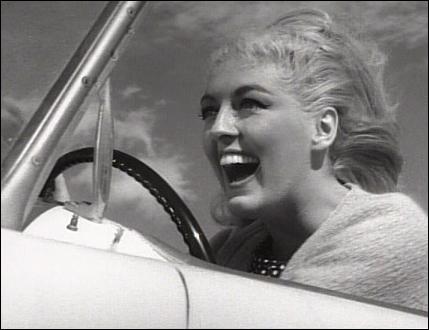
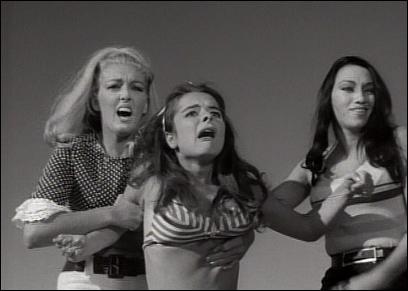
Three thrill-seeking superwomen, working as dancers in a go-go bar, set out on a violent odyssey through the desert, killing men along their way. They have a car each that they use to race against – or drive over their victims.

The women drug and kidnap a young girl after they have wasted her boyfriend. After that, they hatch the plan to rob a crippled father and his sons. These patronizing men deserve a lesson, but it soon becomes clear that this is a journey from which there is no return. Varla, the leader, deliberately goes down the path of her own self-destruction, dragging her two buxotic cohorts along with her.

In a time when men were still considered superior, these three women level the score. It is therefore a feminist film, despite the fact that these women are portrayed as sex objects. This female empowerment is typical for its director, Russ Meyer, the undisputed master of large breasted women, campy humour and sly satire.

Faster, Pussycat! Kill! Kill! stands as Meyer’s masterpiece, a cult movie pur sang. Funny, sexy, exploitative and provocative: a FilmDungeon favourite! They don’t make them like this anymore. Well Tarantino surely tries. But the originality and cult appeal of Faster, Pussycat! Kill! Kill! is rarely matched and never bettered. Watch these pussycats roar and love it!

Rating:

Biography: Russ Meyer (1922, California – 2004, California) is known primarily for making a large number of sexploitation flicks, such as Faster, Pussycat! Kill! Kill! and Vixen! He did almost everything – directing, writing, editing – himself. He even did the distribution of his own movies. In the cult / exploitation circuit his films did very well and made him more than enough money to continue his film career. In the late seventies, Meyer retired as a wealthy man. Many of his films are nowadays considered as cult classics.

Filmography: The French Peep Show (1950, short doc), The Immortal Mr. Teas (1959), The Naked Cinema (1961, short), Eve and the Handyman (1961), Erotica (1961), Wild Gals of the Naked West (1962), Skyscrapers and Brassieres (1963, short), Europe in the Raw (1963, doc), Heavenly Bodies (1963), Lorna (1964), Fanny Hill (1964), Mudhoney (1965), Faster, Pussycat! Kill! Kill! (1965), Motor Psycho (1965), Mondo Topless (1966), Common Law Cabin (1967), Good Morning… and Goodbye! (1967), Finders Keepers, Lovers Weepers! (1968), Vixen! (1968), Cherry, Harry & Raquel! (1970), Beyond the Valley of the Dolls (1970), The Seven Minutes (1971), Black Snake (1973), Supervixens (1975), Up! (1976), Beneath the Valley of the Ultra-Vixens (1979), Pandora Peaks (2001, short)

Planet Terror

Director: Robert Rodriguez
Written by: Robert Rodriguez
Cast: Rose McGowan, Freddy Rodriguez, Josh Brolin, Marley Shelton

Year / Country: 2007, USA
Running Time: 105 mins.

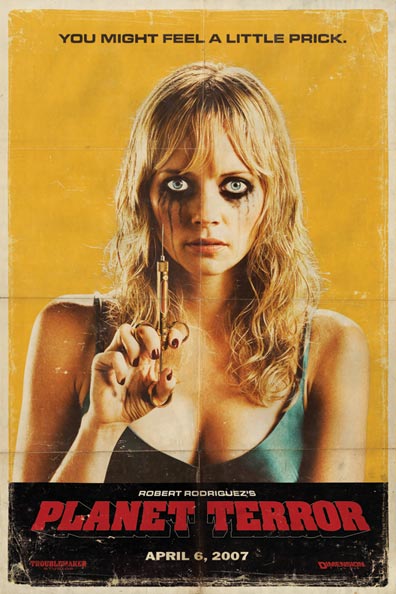
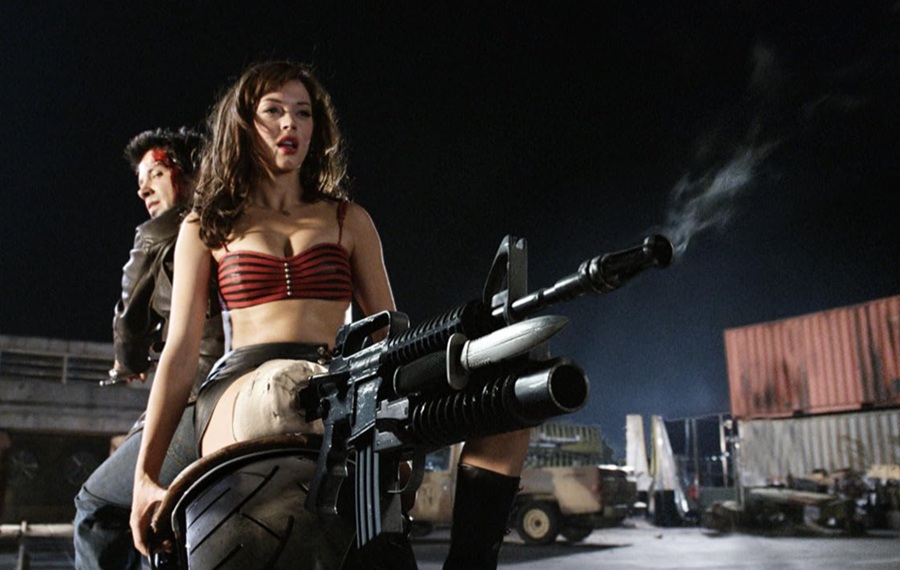
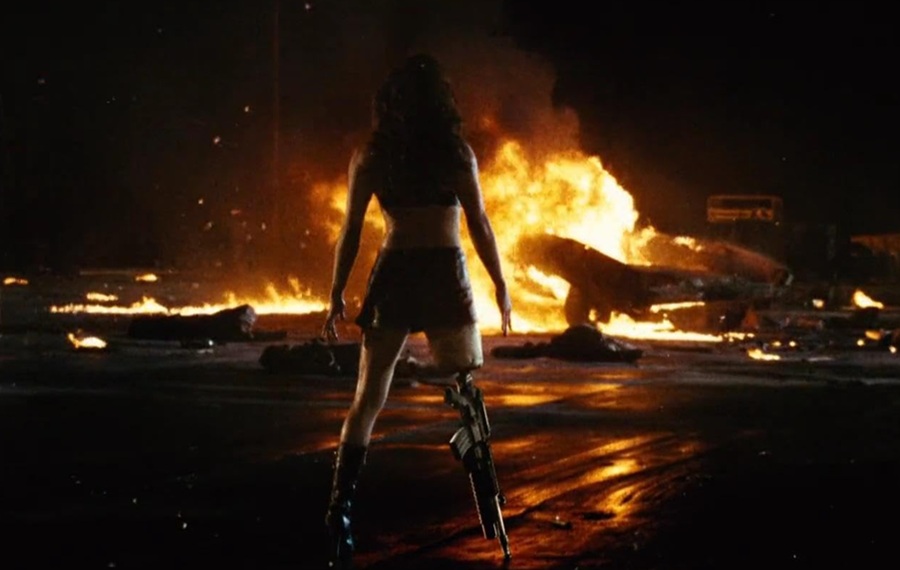
After an experimental bio-weapon is released, thousands of civilians are turned into zombie-like creatures. It is up to a small group of survivors to stop the infected and those behind its release. The group of survivors includes go-go dancer Cherry Darling and her ex-boyfriend, the mysterious El Wray. Cherry is searching for ways to put her ‘useless talents’ to good use. The zombie threat might give her a great opportunity for this.

Planet Terror is Rodriguez’ contribution to the double-bill Grindhouse. It is also a tribute to the zombie genre. Opinions differ on whether Planet Terror or Tarantino’s Death Proof is the best part of Grindhouse. I personally prefer Tarantino’s production. Since the idea behind Grindhouse was to replicate the experience of viewing exploitation films in a ‘grindhouse’ theatre, it is probably not the best idea to make a high budget too apparent. With Death Proof this is the case. Planet Terror on the other hand has so many explosions and spectacular action scenes a la Desperado that it is obviously a movie shot on a major budget. The casting of Hollywood icon Bruce Willis also doesn’t contribute to the exploitation feel. It is however successful in delivering entertainment without any pretensions. There is no film that has a cooler way of showing zombies getting blown to bits.

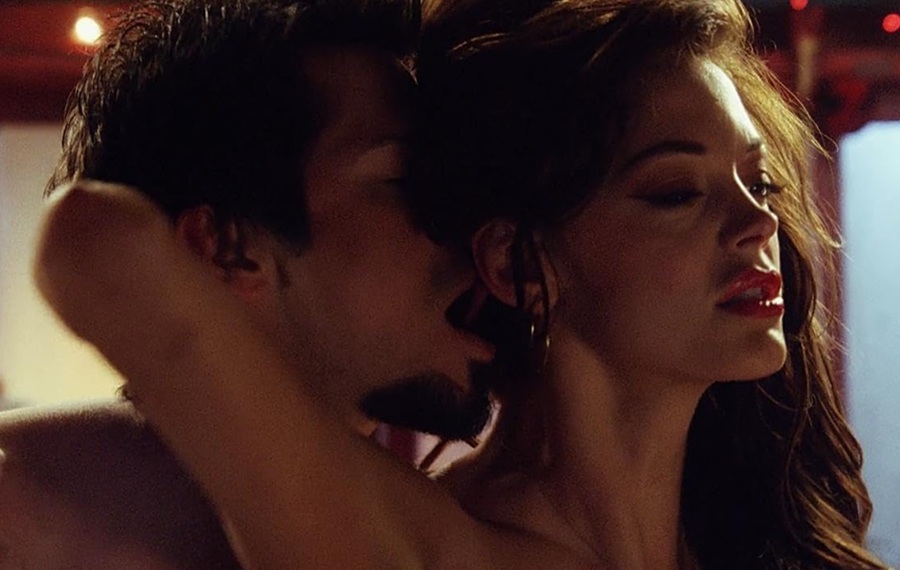
Some casting choices have also turned out well. Rose McGowan proves to be, especially in the go-go dance-opening scene, to be one of the sexiest actresses around. She gets good support from Rodriguez (no relation), who positions himself well as an action star. As a proper zombie tribute requires, Tom Savini is present for a bit part. Many of the other cast members have worked with Rodriguez before. All in all, Planet Terror is not exactly a masterpiece, not in general nor in its kind. But…there are definitely fun bits. Some extremely gory hospital scenes come to mind.

Rating:

Biography: Robert Rodriguez (1988, Texas) saw John Carpenter’s Escape From New York in 1981 and proclaimed “I am going to make movies”. Ten years later, Rodriguez made his feature debut with El Mariachi, an almost single handedly made action film that cost him only 7.000 dollars. It made Rodriguez a legend of independent, ultra-low budget filmmaking. His further career is a sign for young filmmakers that even the wildest dreams may come true if you are brave enough to follow your own path. He has directed many movies since, often collaborating with Quentin Tarantino. Besides directing, he frequently acts as cinematographer like he did on El Mariachi.

Filmography (a selection): Bedhead (1991, short), El Mariachi (1992), Roadracers (1994, TV), Desperado (1995), Four Rooms (1996, segment ‘The Misbehavors’), From Dusk Till Dawn (1996), The Faculty (1998), Spy Kids (2001), Spy Kids 2: Island of Lost Dreams (2002), Spy Kids 3-D: Game Over (2003), Once Upon a Time in Mexico (2003), Sin City (2005), The Adventures of Sharkboy and Lavagirl 3-D (2005), Grindhouse (2007, segment ‘Planet Terror’), Machete (2010), Machete Kills (2013), Sin City: A Dame to Kill For (2014), Alita: Battle Angel (2019), The Mandalorian (2020, TV episode)

Glen or Glenda


“I Changed My Sex!”

Director: Edward D. Wood Jr.
Written by: Edward D. Wood Jr.
Cast: Bela Lugosi, Lyle Talbot, Tomothy Farrell, Dolores Fuller, Edward D. Wood Jr.

Year / Country: 1953, USA
Running Time: 68 mins.

In the making of this film, which deals with a strange and curious subject, no punches have been pulled – no easy way out is taken. Many of the smaller parts are portrayed by persons who actually are, in real life, the character they portray on the screen. This is a picture of stark realism…taking no sides…but giving you the facts…All the facts…as they are today… You are society…JUDGE YE NOT…..

This is how it starts. Director Ed Wood sure meant business. As a cross dresser, he was driven to bring his ‘dilemma’ to the screen. Glen is what medical science calls ‘a transvestite’. The world doesn’t understand it. A very serious subject. But if you want the audience to take it seriously, throwing in Bela Lugosi in improvised talkie scenes, completely unrelated to the story, is probably not the best idea.

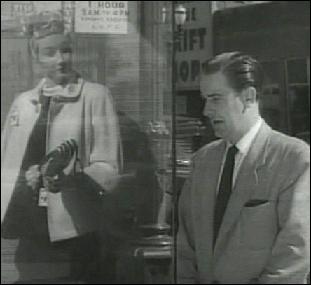
Director Edward D. Wood Jr.’s breakthrough movie suffers from way too much explanation. There are some very funny scenes though. Glenda in front of the store window, Bela Lugosi’s ‘pull the strings’ monologue intercut with buffalos, Bela being entertained by sexy girls. Hilarious then, hilarious now. Glen or Glenda belongs in any cult geeks collection.

Rating:

Biography: Edward D. Wood Jr. (1924, New York – 1978, Hollywood) is widely considered as the world’s worst filmmaker. His low-budget movies, usually mergers of science-fiction and horror, are mostly complete disasters in terms of production values and continuity. In 1994, Edward D. Wood Jr. became the subject of an amazing biopic directed by Tim Burton called Ed Wood.

Filmography: The Sun Was Setting (1951, TV short), Trick Shooting with Kenne Duncan (1953, short), Glen or Glenda (1953), Crossroad Avenger: The Adventures of the Tuscon Kid (1953, TV short), Boots (1953, short), Jail Bait (1954), Bride of the Monster (1955), The Night the Banshee Cried (1957, short), Final Curtain (1957, short), Plan 9 from Outer Space (1959), Night of the Ghouls (1959), The Sinister Urge (1960), Take It Out in Trade (1970), The Young Marrieds (1971), Necromania: A Tale of Weird Love (1971)