Mind Book #1 – Being You

Anil Seth is one of the world’s leading neuroscientists who is working on the ‘problem’ of consciousness. His ideas are discussed in the book Being You (2022). His working theory is that our conscious experiences of the world and the self are forms of brain-based prediction – ‘controlled hallucinations’ – that arise with, through, and because of our living bodies. We are conscious, beast machines, Seth believes.

The widely held assumption in science is that the brain is responsible for creating our conscious experiences. Philosopher David Chalmers, who introduced the term ‘the hard problem of consciousness’, wrote: ‘It is widely agreed that experience arises from a physical basis, but we have no good explanation of why and how it so arises.’

Why is there so much agreement about the physical nature of consciousness if it is totally unclear and unexplainable how something physical can cause a mental state? The opposite approach – consciousness producing physical states – is almost never considered in science.

Seth is honest in stating that his view is philosophical and not a proven scientific fact. He writes: ‘My preferred philosophical position, and the default position of many neuroscientists, is physicalism or materialism. This is the idea that the universe is made of physical stuff, and that conscious states are either identical to, or somehow emerge from particular arrangements of this physical stuff.’ He does not elaborate on why he favors this philosophy. Although he briefly acknowledges alternatives such as dualism and idealism, he does not engage in a detailed discussion of why materialism should be considered a preferable default, particularly over idealism – the view that the mind creates reality.

Seth’s theory is summarized in this following statement: ‘The experience of being you emerges from the way the brain predicts and controls the internal state of the body. The essence of selfhood is neither a rational mind nor an immaterial soul. It is a deeply embodied biological process. a process that underpins the simple feeling of being alive that is the basis for all our experiences of self, indeed for any conscious experience at all. Being you is literally about your body’ (P. 6/7).

Seth bypasses the hard problem of consciousness – solving the problem of why consciousness should arise from material interaction in brains – by introducing ‘the real problem of consciousness’. The real problem, he writes, accepts that conscious experiences exist and focuses primarily on their phenomenological properties. What is it like to be something? His task is then to explain, predict and control what happens in the brain leading to a certain experience. What happens in the brain that makes you see red rather than blue? What happens when you experience a jealous feeling?

What sets Seth’s theory apart is his view of the brain as a prediction machine. According to him, everything we see, hear, and feel is simply the brain’s best guess about the causes of its sensory inputs. Essentially, all our perceptions are hallucinations, and when these hallucinations align across individuals, we call it reality. Through examples of various visual illusions, Seth demonstrates that perception is a generative, creative act.

However, I struggle to see why materialism is necessary in this framework. Imagine you’re at the zoo and see a black and furry shape – your brain’s best guess about the most probable cause for this sensory input is that it’s a gorilla, so the perception of a gorilla is created. Why must this perceived gorilla correspond to a physical, material gorilla in the external world? In my view, the creation in the mind of the gorilla is the gorilla.

My thoughts about this book
Neuroscientists like Anil Seth have come a long way in explaining how the brain modulates conscious experiences, but they have one major conceptual leap to make, namely that the brain does not create conscious experiences, but merely puts restraints on it. Reality is not created by the brain, but by the mind itself: the brain and body are part of this controlled hallucination as well. Brains and neurons are not really ‘there’, but they are what consciousness looks like to observers from the outside. Why ‘they’ (the materialists) find this one so hard I can only speculate about. Perhaps it is that once you acknowledge that you are part of a larger consciousness, that means that you are truly immortal and forever part of nature. And this can be a frightening idea, I guess.

You can read more about my (very distinct) ideas about consciousness on my platform:
http://free-consciousness.com
Fear and Loathing in Las Vegas

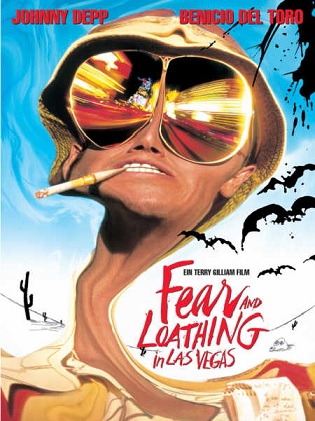
Director: Terry Gilliam
Written by: Hunter S. Thompson (book), Terry Gilliam (screenplay), Tony Grisoni (screenplay), Tod Davies (screenplay), Alex Cox (screenplay)
Cast: Johnny Depp, Benicio Del Toro, lot’s of cameo’s including; Tobey Maguire, Gary Busey, Ellen Barkin, Christina Ricci, Cameron Diaz, Flea and Harry Dean Stanton

Year / Country: 1998, USA
Running Time: 118 mins.

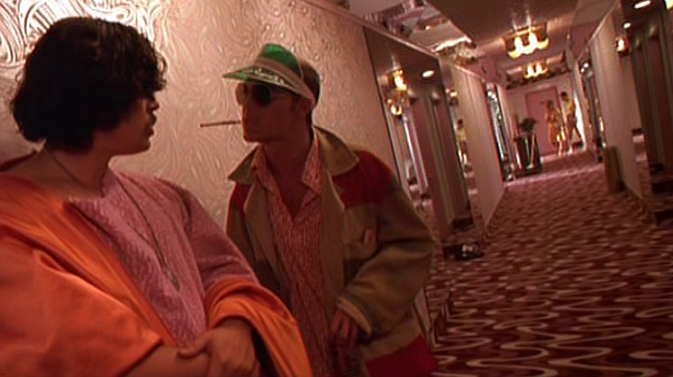
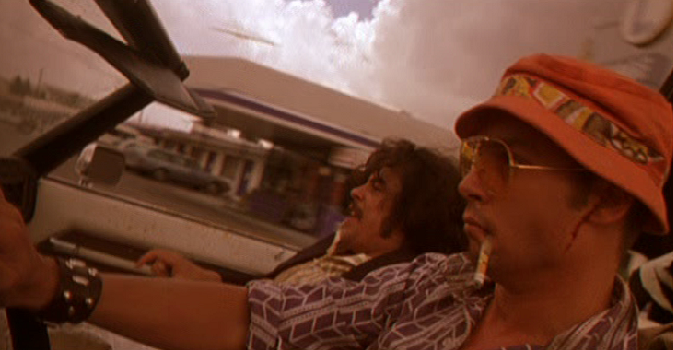
It is the foul year of our lord 1971 and Gonzo journalist Hunter S. Thompson (Raoul Duke in the story) and his Samoan attorney Dr. Gonzo decide to undertake the ultimate trip of the seventies. The official assignment is to cover the Mint 400 desert race in Las Vegas, but they have something bigger in mind. They want to find the American dream. Armed to the teeth with highly dangerous narcotics, they head out to Las Vegas in their fire red convertible… Some trip it’s gonna be…

While searching for the American dream, Thompson and Dr. Gonzo only find fear and loathing. Intolerable vibrations in a town not at all suitable for the use of psychedelic drugs. The atmosphere is extremely menacing, but as they behave as animals, nobody even notices them. Vegas turns out to be a savage town. And while soldiers are dying in Vietnam, used car dealers from Dallas throw their money in the slot machines, Debbie Reynolds sings in the Desert Inn and the national police force meets at a congress about marijuana. Thompson and Dr. Gonzo are there.

Thompson’s novel ‘Fear and Loathing in Las Vegas’, which was first published in two parts in Rolling Stone Magazine, became a cultural phenomenon (and my personal favorite book of all time). The movie adaptation by Terry Gilliam is a literal one. Thompson wrote his famous novel Gonzo style, which means the events are told through the eyes and vision of the author who fully participates in the story himself. Since Thompson was heavily under the influence during the writing process, he claims he can’t fully remember which parts truly happened and which ones did not (fully). Therefore this literal adaptation is a highly enjoyable blast, though not always realistic.

There is one downside to director Gilliam’s literal approach. In the novel, all the psychedelic escapades form an integral part of what is obviously a literary masterpiece. In the translation to film however, these escapades sometimes appear to be useless fuckarounds, especially during the final part of the film. However, that is a minor criticism for this is obviously a highly enjoyable movie. Depp and Del Toro are both terrific in their method acting approaches to their roles. Thompson’s poetic writing, beautifully narrated by Depp in voice-over, runs through the movie that captures the era and hallucinogenic nightmare perfectly. Combined with a beautiful seventies soundtrack and Grade A settings, the great time capsule that is Fear and Loathing in Las Vegas is complete. Also, it is one of the funniest movies of all time. So buy the ticket and take the ride.

Rating:

Biography: Terry Gilliam (1940, Minneapolis) started his career as the only American member of the British comedy group Monty Python. As animator, he was responsible for the bizarre cartoons used in the sketches. In 1975 he directed his first movie for Monty Python, namely Monty Python and the Holy Grail. After his period with Monty Python, he moved on as independent director and had remarkable success with his bizarre masterpiece Brazil in 1985. After that success, things went downhill for Gilliam; The Adventures of Baron Munchausen became an expensive flop and the disastrous production of the never completed Don Quichotte became legendary. Despite these problems, Gilliam returned and directed a number of valuable contributions to cinema, including sci-fi masterpiece Twelve Monkeys and cult classic Fear and Loathing in Las Vegas.

Filmography: Storytime (1968, short) / The Miracle of Flight (1974, short) / Monty Python and the Holy Grail (1975) / Jabberwocky (1977) / Time Bandits (1981) / The Crimson Permanent Assurance (1983, short) / The Adventures of Baron Munchausen (1988) / The Fisher King (1991) / Twelve Monkeys (1995) / Fear and Loathing in Las Vegas (1998) / The Brothers Grimm (2005) / Tideland (2005) / The Imaginarium of Doctor Parnassus (2009) / The Legend of Hallowdega (2010, short) / The Wholly Family (2011, short) / The Zero Theorem (2013) / The Man Who Killed Don Quixote (2018)

Videodrome

Director: David Cronenberg
Written by: David Cronenberg
Cast: James Woods, Sonja Smits, Deborah Harry, Peter Dvorsky

Year / Country: 1983, Canada
Running Time: 84 mins.

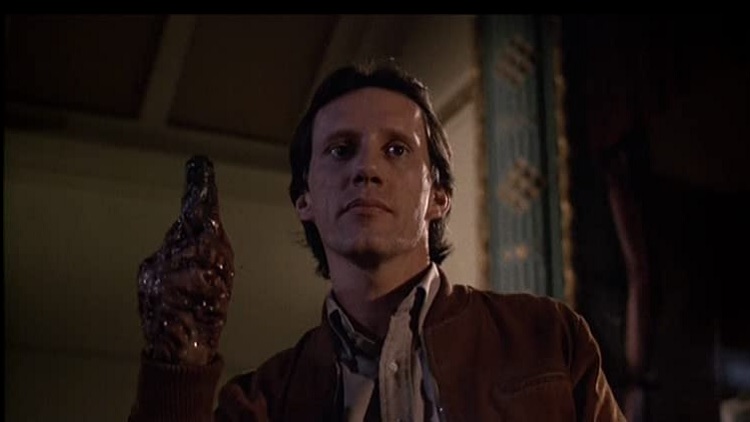
In David Cronenberg’s Videodrome, shabby network TV-producer Max Renn (James Woods) is searching for the ultimate shock-TV experience to serve his buccaneers. When his tech-man Harlan breaks into a secret cult-network show called ‘Videodrome’ he finds what he is looking for. A series of snuff videos that are very grotesque, realistic and brutal. Not meant for public consumption. But, as Max puts it, his channel is too small to be considered public.

Max justifies his occupation with economics. His network is small and can only survive by giving the audience something they can’t get anywhere else, hence his interest in Videodrome. When Max participates in a television debate about the ethics of his work, he meets the girl Nicki with whom he hooks up afterwards. She turns out to be pretty much a masochist, who wants to audition for Videodrome herself. Then Max finds out that the show – that is all about torture, mutilation and murder – is real.

When Max goes to speak to television guru Brian O’Blivion, he starts having hallucinations. And very soon the lines between reality and video begin to fade. It goes deep. What we learn along with Max is that reality is pure perception. According to O’Blivion, Videodrome will eventually evolve the human brain so that it will be able to control hallucinations and change the human reality entirely.

Master of body horror David Cronenberg sets up this creepy movie perfectly. The prospect of an unleashed hallucination machine is pretty much terrifying, especially after seeing what Max sees. Max has to watch his own body mutate when a videocassette inserter appears in his belly. This can be used by the creators of Videodrome to insert hallucinations in the form of pulsating VHS-cassettes. The flesh transformations are made very gruesomely by FX-wizard Rick Baker. A frightening exploration of the mind of those who like extreme stuff. A movie that was ahead of its time and is still powerful today in both style and message.

Rating:

Biography: David Cronenberg (1943, Toronto), also known as the King of Venereal Horror or the Baron of Blood, grew up in Toronto. His father was a journalist and his mother a piano player. Cronenberg graduated from the University of Toronto with a degree in literature after switching from the science department. He then turned to filmmaking and reached a cult status with a few early horror features including Shivers and Rabid. He rapidly became a very popular genre filmmaker and eventually a true auteur, making profound statements on modern humanity and ever-changing society.

Filmography (a selection): Transfer (1966, short) / Stereo (1969) / Shivers (1975) / Rabid (1977) / Fast Company (1979) / The Brood (1979) / Scanners (1981) / The Dead Zone (1983) / The Fly (1986) / Dead Ringers (1988) / Naked Lunch (1991) / Crash (1996) / eXistenZ (1999) / Spider (2002) / A History of Violence (2005) / Eastern Promises (2007) / A Dangerous Method (2011) / Cosmopolis (2012) / Crimes of the Future (2022)