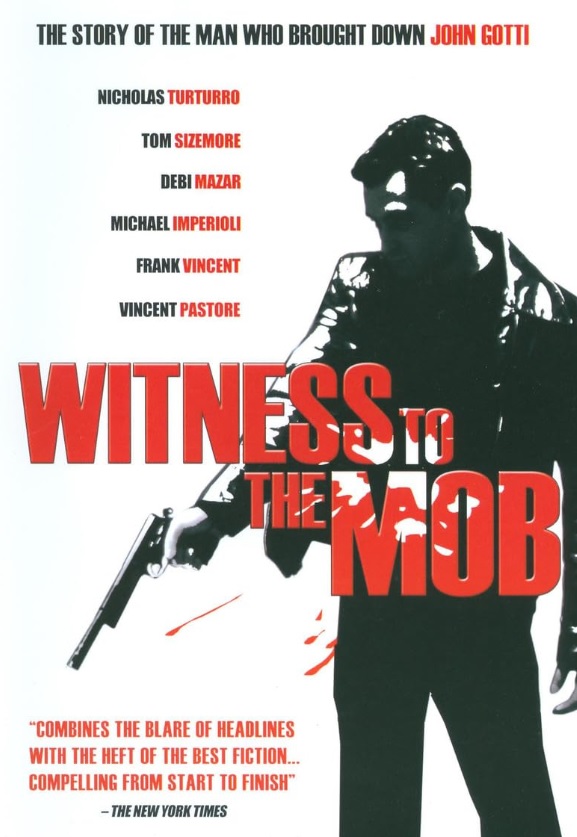
Witness to the Mob (1998)

Directed by:
Thaddeus O’Sullivan

Written by:
Stanley Weiser

Cast:
Nicholas Turturro (Sammy ‘The Bull’ Gravano), Tom Sizemore (John Gotti), Debi Mazar (Deborah Gravano), Michael Imperioli (Louie Milito), Abe Vigoda (Paul Castellano), Frankie Valli (Frank LoCascio), Katherine Narducci (Linda Milito), Arthur J. Nascarella (Bruce Mouw), Frank Vincent (Frankie DeCicco), Vincent Pastore (Mikey De Bat)
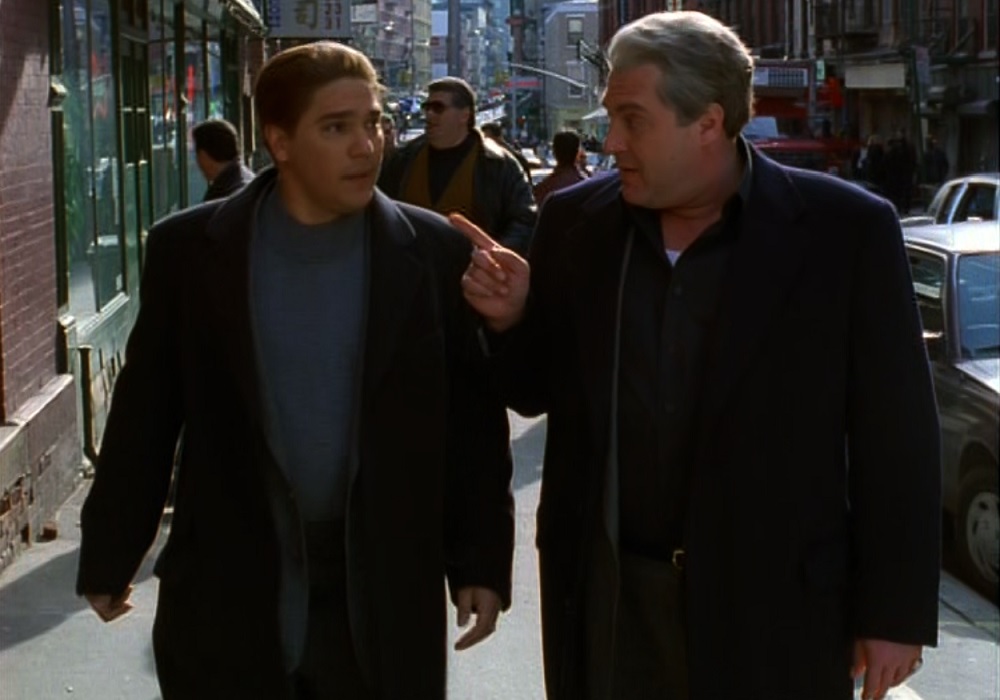
Sammy ‘The Bull’ Gravano is remembered as one of the most notorious informants in mob history. He betrayed the Dapper Don, John Gotti – whom he believed had first betrayed him. Before making that fateful decision, the story flashes back nineteen years to his childhood in Brooklyn. There, he and his best pal Louie (Michael Imperioli) begin their careers in organized crime as part of the powerful Gambino family.

Gravano rises quickly through the ranks. His willingness to follow orders to the letter – and to kill without hesitation – earns him the respect of higher-ups. Before long, he’s made an official member by boss Paul Castellano himself.

Around the same time, John Gotti (Tom Sizemore) is on the rise as well. When Castellano begins to break the mob’s code of honor, Gravano and Gotti conspire to take him out and seize control. Gotti becomes boss, while Gravano becomes his second-in-command. But Gotti’s flashy lifestyle draws unwanted attention from the press, the public, and the FBI – setting the stage for a conflict that will bring everything crashing down.

This made-for-TV film was released just two years after HBO’s Gotti. Both screenplays are based on the real Gravano–Gotti saga, and the similarities are striking – not only in story but also in style. Several familiar faces from The Sopranos and Goodfellas (Tony Sirico, Frank Vincent, Vincent Pastore) appear in both films. The key difference is perspective: Witness to the Mob is told through Gravano’s eyes, while Gotti presents Gotti’s side of the story.

Still, there’s something about Witness to the Mob that doesn’t quite ring true. Despite the strong ensemble, the interactions don’t always feel believable. Nicholas Turturro (brother of John) lacks the presence and charisma needed to carry Gravano’s role, and most of the actors have delivered stronger mob performances elsewhere. That said, fans of mob movie clichés – the talk, the mannerisms, the hits – may still enjoy Witness to the Mob. It has plenty of all that, even if it never quite rises above the familiar.

Rating:

Quote:
JOHN GOTTI: “So the boss of bosses is dead?”
SAMMY GRAVANO: “He lived a long life. His maid is gonna miss him.”
JOHN GOTTI: “His wife won’t.”

Trivia:
Arthur J. Nascarella plays FBI special agent Bruce Mouw, who is in charge of breaking up the Gambino family. In The Sopranos, his character Carlo Gervasi eventually betrays mob boss Tony Soprano.

Gotti (1996)

Directed by:
Robert Harmon

Written by:
Jerry Capeci (book ‘The Last Gangster: Winning the War Against John Gotti and the Mob’)
Gene Mustain (book ‘The Last Gangster: Winning the War Against John Gotti and the Mob’)
Steve Shagan (teleplay)

Cast:
Armand Assante (John Gotti), William Forsythe (Sammy Gravano), Richard C. Sarafian (Paul Castellano), Frank Vincent (Robert DiBernardo), Anthony Quinn (Neil Dellacrose), Dominic Chianese (Joe Armone), Robert Miranda (Frank DeCicco), Scott Cohen (Gene Gotti), Vincent Pastore (Angelo Ruggiero), Tony Sirico (Joe Dimiglia)

John Gotti seemed destined for the Mafia. He was smart, tough, loyal to the code of omertà, never skimmed from the top, and respected the boss’s policy on narcotics. These qualities helped him rise to become boss of the infamous Gambino family in the 1980s. But Gotti also had his flaws: he craved media attention and was too careless about discussing sensitive business in unsecured settings.

Gotti is the biography of one of history’s best-known mobsters. The story begins in 1973, when Gotti first comes to the attention of his crime family, the Gambinos – then the most powerful of New York’s Five Families. Boss of bosses Carlo Gambino asks Gotti for a personal favor, which nearly goes wrong due to the interference from underboss Paul Castellano. The conflict almost dooms Gotti, but his mentor, second underboss Neil Dellacroce (Anthony Quinn), steps in to resolve it.

In the years that follow, Gotti steadily rises through the ranks alongside his close associate and fellow captain Sammy Gravano. When Gambino dies of old age in 1976, he names Castellano as his successor, to the disapproval of Gotti and other top figures. While Gotti was seen as a true man of Cosa Nostra, Castellano was regarded more as a businessman. Tensions eventually culminate in one of the most infamous gangland hits in history: the 1985 assassination of Castellano and his partner outside Sparks Steak House in Manhattan.

Now John Gotti is the boss. But, as noted earlier, his weaknesses ensured that his reign would be relatively short-lived (until 1992 to be precise). As a biographical made-for-tv HBO production, Gotti stands out for offering a complete look at the life and times of a legendary mobster. Armand Assante is memorable in the lead. The supporting cast – featuring many future Sopranos actors – is also strong, with Anthony Quinn and William Forsythe delivering standout performances. If you watch only one television production about the mob, make it Gotti .

Rating:

Quote:
JOHN GOTTI: “A Mexican, a Puerto-Rican and a black guy are sitting in a car. Who’s driving? The police.”

Trivia:
According to IMDb, this film was the highest rated original telefilm in HBO history at that time. The success of the film convinced HBO to cast film co-stars, Dominic Chianese, Vincent Pastore and Tony Sirico in a series in development at the time called The Sopranos (1999).

Wiseguy Guide for Rookies

Terminology

Agita: Stress
A good earner: What wiseguys are supposed to be.
Associate: Involved with Mafia but not yet a made guy.
Bada Bing!: Stripclub owned by Silvio Dante (in The Sopranos).
Busting someone’s balls: Bothering somebody with sh*t.
Bust Out: Ordering on a company’s account till it runs out of credit and goes bankrupt.
Capo / Captain: Crew boss. Leads a number of soldiers. Reports to underboss.
Consigliere: Counselor of the Don. For example Tom Hagen in The Godfather and Silvio Dante in The Sopranos.
Contract: Someone needs to disappear by means of a hitman.
Don: Boss of organised crime family.
Fanook: Gay
Goomar: Steady girlfriend on the side. Of course most wiseguys are married like good Catholics ought to be.
Illegal gambling: A wiseguy’s main source of income
La Cosa Nostra (LCN): Literally ‘our thing’. Mafia. Organised crime families.
Made Guy: Connected to the mob by blood-oath.
Making one’s bones: Performing a first kill for the mob.
Mustache Pete: An old-fashioned mob boss.
OC: Short for Organised Crime. Term used by the FBI.
Omerta: Bow of silence. Never rat on your friends and always keep your mouth shut.
Opening the books: New members (made guys) are accepted by the mob commission.
Outstanding loan: It’s time for a weekly visit to collect or bust some skulls in.
Points: Interest over debt. Average mob rate is two points weekly.
Pop someone: To shoot someone.
Rat/stoolie/turncoat: Wiseguy that betrays his friends. Usually because he fears a lengthy prison sentence or getting whacked (or both).
RICO Laws: Main government tool for prosecuting members of the Mafia. Stands for ‘Racketeer-Influenced and Corrupt Organizations’. According to the federal statutes, RICO can be applied to anyone who is involved in the ‘operation or management’ of a ‘pattern of racketeering activity’ designed to acquire or maintain an interest in an ‘enterprise’.
Sit down: Conversation between the Don and two conflicting made members.
Soldier: Lowest rank under made guys.
To eat: To be allowed to earn.
To flip: To turn FBI informant.
Vig: Amount charged by bookmakers for services. Short for Vigorish. Also known as juice.
Whack someone: To kill someone.
Wiseguy, Goodfella: Made member of the mob.

Expressions from The Godfather

Moe Green Special: Gunshot clean through the eye because someone’s eyes became bigger than his stomach.
Going to the mattresses: Going to war.
‘Take the gun, leave the Cannoli’: What you say after you have popped a guy.
An offer you can’t refuse: Either your brains or signature will be on the contract.

Rules

Never insult, threaten or hit another made guy. (*GoodFellas, The Sopranos, Gotti)

Stick to the omerta (never rat out your friends). (*GoodFellas, The Sopranos, Gotti)

Money should be carried in a bundle. Not in a wallet. (*Donnie Brasco)

Mustaches are not acceptable. (*Donnie Brasco)

Who kills a don can never become a don. (*Mobsters, Gotti)

A made guy is untouchable for anyone except of course the bosses. (*GoodFellas)

A soldier kicks up money to his capo who gives a piece to the (under)boss. Never keep income secret from the bosses. (The Sopranos)

Never start an affair with another member’s wife. (Casino)

* Examples of movies in which those rules were broken.

Read also: The Sopranos – 100 Greatest Moments

Het defecte management control system van de maffia

Lees ook:
De maffiaboeken van Nicholas Pileggi – Deel 1: Wiseguy: Life in a Mafia Family
De maffiaboeken van Nicholas Pileggi – Deel 2: Casino: Love and Honor in Las Vegas

Waarom gaat het altijd mis met gezworen maffialeden? Waarom kunnen ze niet gewoon hun mond houden en hun tijd uitzitten als ze gepakt worden? Sommige kunnen het wel: John Gotti bijvoorbeeld. Maar er zijn ook talloze ratten die hun familie verraden om hun eigen hachje te redden. De bekendste zijn Henry Hill, Joseph Valachi en Sammy ‘the Bull’ Gravano (die John Gotti levenslang bezorgde). De reden is dat het strakke managementsysteem van de maffia zich regelmatig tegen de organisatie keert.

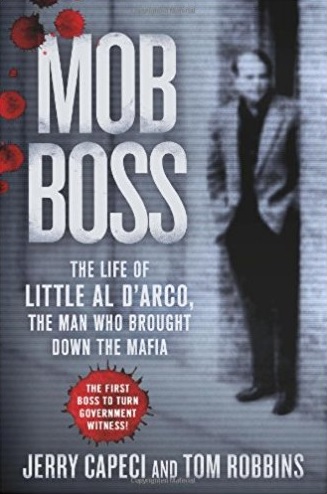
In 1991 werd Alphonse ‘Little Al’ D’Arco – ‘made member’ en zelfs enige tijd ‘acting boss’ van de Luchese familie – bijna geliquideerd in een hotelkamer. Hij wist te ontkomen en besloot kort daarna getuige te worden voor de FBI. Hij was het lid met de hoogste rank binnen de maffia ooit die getuige voor de overheid werd. In 2013 verscheen het boek ‘The Life of Little Al D’Arco, the Man Who Brought Down the Mafia’ van Jerry Capeci en Tom Robbins over het leven van D’Arco.

D’Arco geloofde in de maffia; het bezorgde hem een inkomen en bovenal respect. In ‘Mob Boss’ beschrijft hij hoe hij na een lange loopbaan eindelijk officieel lid werd gemaakt van de Luchese familie. De ceremonie is al vaak beschreven: het mes en pistool op tafel, een prik in de vinger en het bloed van de ingewijde op de kaart van een heilige. Deze kaart wordt vervolgens verbrand en de leider van de familie zegt; ‘als je ons verraad zal je ziel eeuwig in de hel branden, zoals deze kaart’. Ook wordt duidelijk gemaakt dat de maffiafamilie voor alles komt, inclusief je eigen gezin. Dit lijkt een slechte deal, maar er komen ook voordelen met het lidmaatschap: andere criminelen kunnen niet meer aan je bezittingen komen; wat van jou is, is nu echt van jou.

Natuurlijk kunnen gemaakte leden van de maffia ook vermoord worden als ze de regels overtreden. D’Arco had hier begrip voor, al was hij het niet altijd eens met de manier waarop het ging. Zo was hij er getuige van dat gangster Tommy de Simone (in GoodFellas legendarisch neergezet door Joe Pesci) een bar binnenkwam helemaal in mooie kleding gestoken. Hij dacht dat hij gemaakt ging worden. Kort daarna zag hij hem in een pizzeria met twee ‘vrienden’. Het zou zijn laatste avondmaal worden. Ook al had DeSimone de regels gebroken (een made guy vermoord) vond D’Arco dit disrespectvol. “Ze zeggen dat ze hem gaan maken en ze whacken hem.”

Maar moord is soms nodig om het strakke regime van de maffia in stand te houden. Problemen ontstaan als het middel onnodig wordt ingezet. En dat is waar het misging in de Luchese familie en bij andere maffiafamilies. De baas en onderbaas van de familie – Vittorio ‘Little Vic’ Amuso en Anthony ‘Gaspipe’ Casso (ja, alle maffialeden hebben bijnamen) – werden gezocht voor een grootschalige bouwfraude en moesten onderduiken. Ze stelden D’Arco aan als tijdelijk leider. Het duurde niet lang voor het eerste moordcontract binnenkwam. Er zouden er vele volgen in korte tijd. De slachtoffers waren meestal andere leden die ervan beschuldigd werden verrader te zijn. D’Arco liet de contracten uitvoeren, maar begon steeds meer twijfel te krijgen bij de legitimiteit van de opdrachten. Toen werd hij er zelf van beschuldigd rat te zijn en had hij geen keuze om onder te duiken.

Wanneer je er als organisatie zulke extreme regels op na houdt is de ‘tone at the top’ nog belangrijker dan normaal. Bazen, zoals Paul Castellano, die hun mannen drugshandel verbieden, maar er zelf rijk van worden vragen erom dat hun manschappen gaan muiten.

Door deze hiërarchische machtsstructuur voort te blijven zetten heeft de maffia in de Verenigde Staten flink veel macht moeten inleveren. In de tijd voor Lucky Luciano (jaren 50’) – onder de oude ‘Mustache Pete’s’ (Siciliaanse bazen die de connectie met de oorspronkelijke maffia op Sicilië bleven onderhouden – werkte het nog. Toen kwam Luciano met de oprichting van de commissie en brak de glorietijd voor de Amerikaanse maffia pas echt aan. Maar door hebzucht begonnen de oude maffiawaarden in rap tempo af te brokkelen. In de jaren 70’s werden de boeken gesloten en namen de bazen lange tijd geen nieuwe leden aan omdat ze dan hun inkomsten dan met meer leden zouden moeten delen. Deze manier van denken heeft de maffia pas echt de das omgedaan.

Is het tijd voor een nieuw ‘losser’ maffia organisatiemodel voor de 21ste eeuw? Daar is het al veel te laat voor. De maffia had al veel eerder moeten veranderen hadden ze onderdeel van deze eeuw willen uitmaken. De macht die ze ooit hadden krijgen ze nooit meer terug. Dit is een les voor ondernemingen: organisaties bestaan uit niets anders dan het geloof van de mensen die er werken. Verliezen ze hun geloof, dan verliest de organisatie zijn macht.