Z Channel: A Magnificent Obsession

Z-Channel 3

(2004, USA)

Director: Xan Cassavetes
Features: Robert Altman, Penelope Sheeris, Jim Jarmusch, Quentin Tarantino, ao.

Running Time: 120 mins.

Documentary about the legendary Z Channel in Los Angeles, a pay TV channel where great cinema was shown between 1974 and 1988. Aspiring filmmaker Jerry Harvey became chief programmer of the channel and created a Walhalla for cinema lovers in that time in L.A.

Unfortunately, Harvey was mentally very unstable and in 1988 he committed suicide after killing his wife. After his death, Z Channel was finished as well when it turned into a sports channel. In this ‘legacy’ of Harvey, former friends, teachers and colleagues as well as filmmakers explain why Z Channel was such a successful and important platform for cinema at that time.

It was before VHS made its way into the living room, and people were dependent on television, besides cinema, to view movies. Harvey combined art films and commercial films in his programming which turned out to be a fantastic formula. Quentin Tarantino and Jim Jarmusch explain how much they loved Z Channel when they were growing up, and how it formed an important part of their education. Director Xan Cassavetes, the daughter of actor-director John Cassavetes and actress Gena Rowlands, got hooked to Z Channel after being grounded as a child. It was the beginning of her obsession with cinema.

The channel was so popular that even market leaders HBO and Showtime couldn’t muscle it out of L.A. Z Channel had a zero turnrate which means that no subscriber ever cancelled the channel.

Z-Channel 1
Programmer Harvey wrote the screenplay for the western China 9, Liberty 37

Another one of Harvey’s triumphs was to show uncut versions of films such as The Wild Bunch, Heaven’s Gate, Once Upon a Time in America and 1900. Films that were initially trashed by critics now became very successful features. Z Channel also became a platform for European directors, like Paul Verhoeven, that found work in America thanks to the screening of their European work on the channel. Harvey and his team also organised regular film festivals with retrospectives of Kurosawa and the likes. It must have been truly magnificent.

Cassavetes shows a great collection of film fragments that give a good sense of how brilliant and revolutionary the Z Channel programming must have been. Cinema lovers will be thrilled at the idea of seeing something like Fassbinder’s Berlin Alexanderplatz uncut on television. It was not made to last. Like one of the interviewees says; ‘you just never know when you are living in a glorious time’. The downfall of Z Channel came together with the downfall of Harvey. An obvious loss that Cassavetes makes manifestly clear.

Z-Channel 4
Boxoffice hit The Empire Strikes Back had its television premiere on Z Channel

Review originally written for International Film Festival Rotterdam, where this documentary was screened in 2005.

See also: List of Film Fragments in Z Channel: A Magnificent Obsession
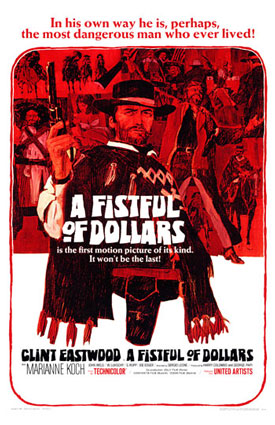
A Fistful of Dollars

Director: Sergio Leone
Written by: Victor Andrés Catena, Jaime Comas, Sergio Leone
Cast: Clint Eastwood, Marianne Koch, Gian Maria Volontè, Wolfgang Lukschy

Year / Country: 1964, Italy / Spain / West Germany
Running Time: 96 mins.

During the filming of The Last Days of Pompeii in Europe, directors Sergio Leone and Sergio Corbucci were struck by the idea of using the landscapes they encountered as the backdrop for a western. Five years later, A Fistful of Dollars arrived – a groundbreaking and hugely influential film that launched both Leone’s and Clint Eastwood’s international careers.

For its plot, Leone drew inspiration from Akira Kurosawa’s classic samurai film Yojimbo. A mysterious stranger arrives in a desolate town where no one works except the coffin maker. The town is controlled by two rival gangs – the Baxters and the Rojos – who each try to buy his loyalty. But the stranger is playing his own game. Instead of choosing a side, he orchestrates a deadly conflict to eliminate both gangs and free the town from their oppression.

At the time, Eastwood was virtually unknown, with his biggest credit being the TV show Rawhide. Leone had considered other actors for the role – James Coburn, Charles Bronson, Lee Marvin, and Henry Fonda – but ultimately, Eastwood’s brilliant performance became a key factor in the film’s success. As the enigmatic gunslinger, he exudes effortless cool. With his cobra-quick draw, sharp intellect, and signature poncho, hat, and cigar, he creates an unforgettable character. Despite his stoic presence and minimal dialogue, he also delivers moments of dry humor, particularly in the scene where he demands apologies from four outlaws for scaring his horse – a comic masterpiece.

From the opening animated credit sequence, A Fistful of Dollars pulls you in. Leone’s direction is flawless, blending breathtaking widescreen cinematography with expertly staged duels that brim with tension. Despite the film’s modest budget, its visual and narrative execution mask any limitations. A major part of its success is owed to Ennio Morricone’s unforgettable score – one of his early masterpieces – that elevates the film’s atmosphere and impact.

Initially, A Fistful of Dollars developed a cult following in Italy before becoming a mainstream box-office sensation. Word spread quickly – this was the must-see film of the year. It was soon followed by two sequels, For a Few Dollars More and The Good, the Bad and the Ugly, completing what would become the legendary Dollars Trilogy.

Rating:

Biography: Sergio Leone (1929, Rome – 1989, Rome) made his debut in the cinema working as a voluntary assistant and extra, among other things, in The Bicycle Thieves by Vittorio de Sica. Later, he became assistant director to Mario Bonnard. In 1959, when Bonnard was ill, he took over from him on the set of The Last Days of Pompeii. In 1961 he directed his first full-length film: The Colossus of Rhodes. But the film that was to bring him to the general attention came out in 1964: A Fistful of Dollars. His next films, For a Few Dollars More and The Good, The Bad and the Ugly complete what came to be known as the Dollars Trilogy and were a great box-office success. He would only make three more films before tragically passing away in 1989. He was taken from us by a heart attack in his house in Rome, while working on an ambitious project for a film on the Siege of Leningrad.

Filmography: The Colossus of Rhodes (1961), A Fistful of Dollars (1964), For a Few Dollars More (1965), The Good, The Bad and the Ugly (1966), Once Upon a Time in the West (1968), A Fistful of Dynamite (1971), Once Upon a Time in America (1984)