What Will Be Tarantino’s 10th and Final Film?

It is well established that Quentin Tarantino wants to complete his career as director with a total of 10 films. With Once Upon a Time in Hollywood (2019) as his ninth, that that leaves just one final movie to cap off an iconic career.

Tarantino has taken long breaks between projects before. After Jackie Brown (1997), he didn’t return with another feature until Kill Bill: Vol. 1 in 2003. So the current six-year gap since Once Upon a Time in Hollywood isn’t unusual, but fans are still eagerly waiting for news.

In 2023, it looked like Tarantino had settled on his swan song: The Movie Critic. The film was to center on a character inspired by a real-life reviewer for an adult magazine Tarantino encountered as a teenager while restocking porno mag vending machines. During his work, Tarantino said he came to really appreciate the writing of this film critic.

“He was as cynical as hell. His reviews were a cross between early Howard Stern and what Travis Bickle might be if he were a film critic”, Tarantino said. Tarantino wanted an actor he had never worked with as the main character and Brad Pitt was said to be in talks to join the cast, though not as the title critic. The project sounded promising, but in 2024, Tarantino shelved it for artistic reasons. Just like that, The Movie Critic was off the table.

There was also buzz about Tarantino tackling a Star Trek film – an unusual move, given his preference for original stories (with Jackie Brown, adapted from Elmore Leonard, being the lone exception). But on the ReelBlend podcast, he suggested that a Star Trek film perhaps wouldn’t ‘count’ as his tenth. That project, too, now seems dead.

So what’s next? According to The Hollywood Reporter, while rewriting The Movie Critic, Tarantino toyed with an ambitious idea: a ‘farewell metaverse’ in which characters from his past films might reappear in a ‘movie within a movie’ format – either as their original characters or as fictionalized versions of the actors who played them. But for now, that’s just speculation.


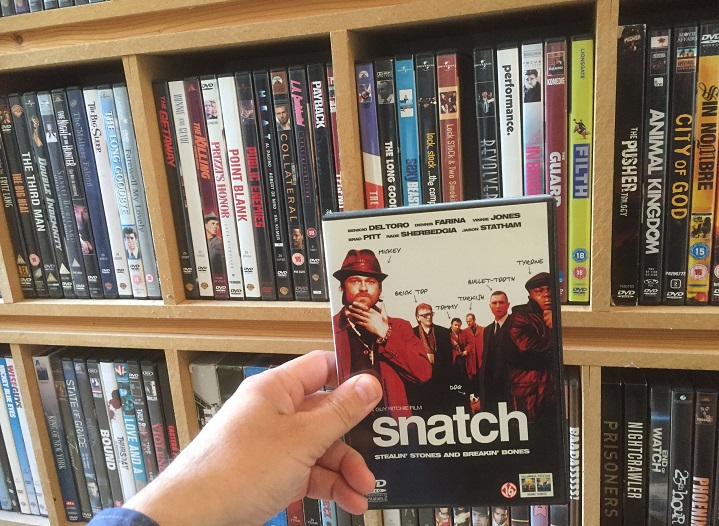
In my DVD collection, I left over a single place for Tarantino’s final film. His filmography as director so far: 1. Reservoir Dogs, 2. Pulp Fiction, 3. Jackie Brown, 4. Kill Bill (counting as one film), 5. Death Proof, 6. Inglourious Basterds, 7. Django Unchained, 8. The Hateful Eight, and 9. Once Upon a Time in Hollywood.

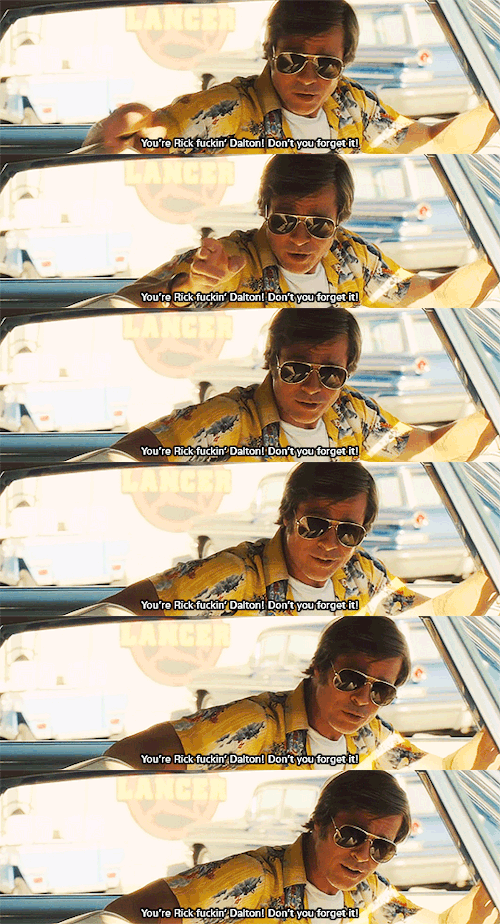
The only concrete Tarantino-related project currently in the pipeline is The Continuing Adventures of Cliff Booth, a spin-off from Once Upon a Time in Hollywood. In this film, Brad Pitt’s character – stuntman and all-around tough guy Cliff Booth – becomes a Hollywood studio fixer. The film is being directed by David Fincher for Netflix, marking the first time since From Dusk Till Dawn (1996) that Tarantino is writing but not directing a film.
So what about the final film? At the 2025 Sundance Film Festival, Tarantino addressed this very question. “I don’t want to rush into production”, he said. “I’ve been in a hurry for the last 30 years, but not right now.” The reason? His family. “My son turns five next month, and my daughter is two and a half. The idea of taking on a huge project when my kids are so young doesn’t appeal to me.”

Tarantino added that he wants to wait until his son is at least six. “That way, he’ll know what’s going on, he’ll be there, and it’ll be a memory for the rest of his life.” That could mean production starts sometime next year, but only if inspiration strikes.

Interestingly, Tarantino revealed at Sundance that he’s currently working on a stage play. While he didn’t share any details, he hinted that if the play turns out well, it might be adapted into his final film. “If it’s a fiasco, it’s just a play. But if it succeeds, maybe it becomes the movie.”

So there you have it: while Tarantino’s tenth film remains a mystery, we know he’s not in a rush. In the meantime, The Continuing Adventures of Cliff Booth promises to deliver more of the filmmaker’s signature style even if he’s not in the director’s chair this time. And who knows? That stage play just might be the unexpected final chapter in a legendary career.

What Many People Missed in Fight Club

Fight Club was an unexpected spectacle from 1999. The direction by David Fincher is top notch and Edward Norton and Brad Pitt form an extremely memorable screen duo. Norton as the typical working stiff addicted to buying stuff he doesn’t need and Pitt as his uber cool and revolutionary counterpart.

SPOILERS: If you haven’t seen Fight Club, and you definitely should see it, stop reading NOW and enjoy the fucking MOVIE.

Towards the end of Fight Club, we discover that Norton’s character and Pitt (Tyler Durden) are actually the same person. Norton – called the narrator – ‘invented’ Durden in his mind to help him change and become the man he really desired to be. In the movie, at times he is seeing Tyler as a separate person and actually fights him (and thus himself) which leads to the start of the revolutionary Fight Club movement. At other times he is still his self-doubting self and again at other times he is fully Tyler Durden (which as an audience we don’t see) and he is spreading his movement through America.

The reason that he is sometimes still himself is that the journey to fully become his hero Tyler is quite a mental challenge. He finds it hard to be Tyler because it goes against his nature. Yet, because he is also repulsed by his own ‘slave’ behavior, he needs to become Tyler to set himself free from his consumerist lifestyle.

Now here comes a description the narrator gives of Tyler shortly after he meets him: “Tyler was a night person. When the rest of us were sleeping, he worked. He had one part time job as a projectionist. A movie doesn’t come all on one big reel. It comes on a few. Someone has to switch the projectors at the exact moment that one reel ends and the next one begins. You look for it and you can see those little dots come into the upper right corner of the screen. (Tyler: “In the industry, we call them cigarette burns”.) That’s the cue for a changeover. He flips the projector, movie keeps right one going and nobody in the audience has any idea. (Tyler: “Now why would anyone want this shit job?”) Because it affords him interesting opportunities. (Tyler: “Like splicing a single frame of pornography into family films.”) So when the snooty cat and the courageous dog with the celebrity voices meet for the first time in reel three, that’s when you’ll catch a flash of Tyler’s contribution to the film. Nobody knows that they saw it but they did. (Tyler: “Nice big cock.”) Even a hummingbird couldn’t catch Tyler at work.”

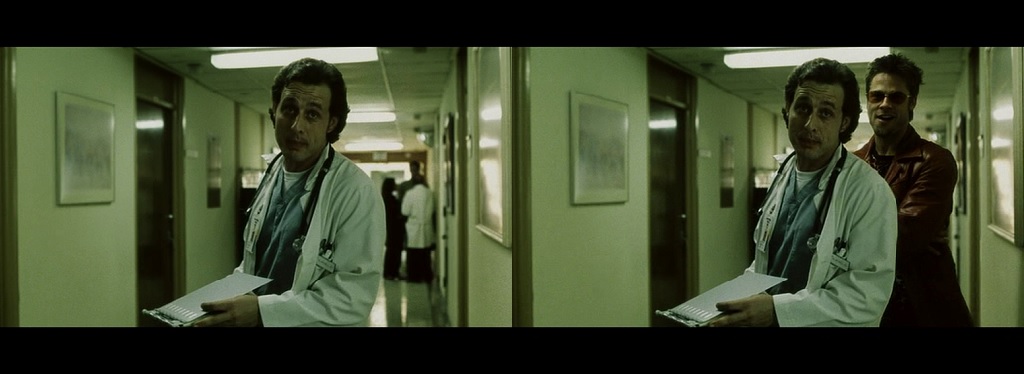
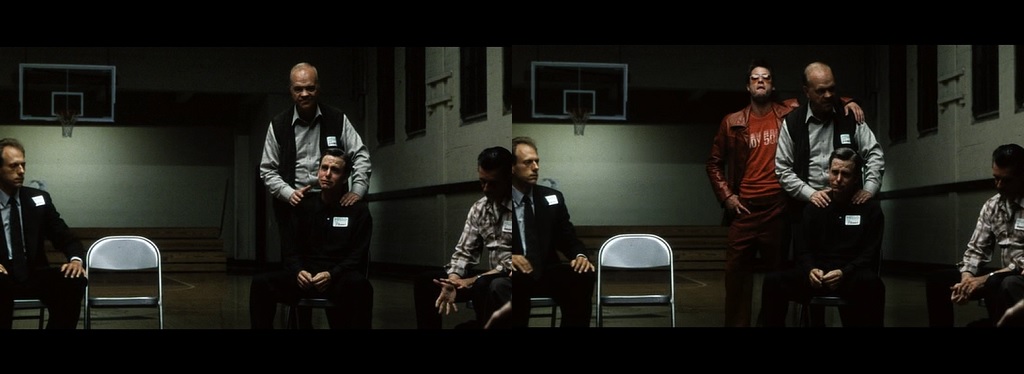
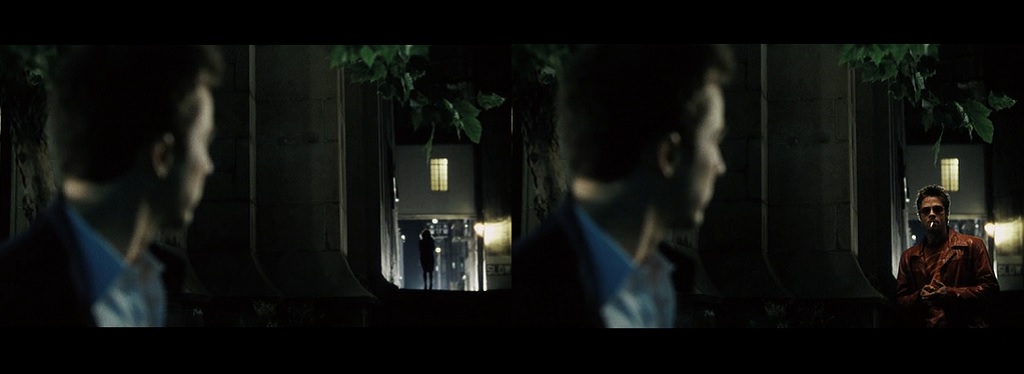
Now what many people missed is that these types of flashes occurred earlier in the movie. When the narrator is suffering from insomnia, Tyler appears in four flashes. Blink and you’ll miss them.

This is the process of Tyler manifesting himself in the narrator’s mind. Then the narrator meets (hallucinates) the complete Tyler for the first time on the airplane and the plot is set in motion. Tyler Durden starts setting Fight Clubs in major American cities and later renames it Project Mayhem. His ultimate goal is to blow up all financial buildings, so that all credit card data is destroyed and society can start again at zero.

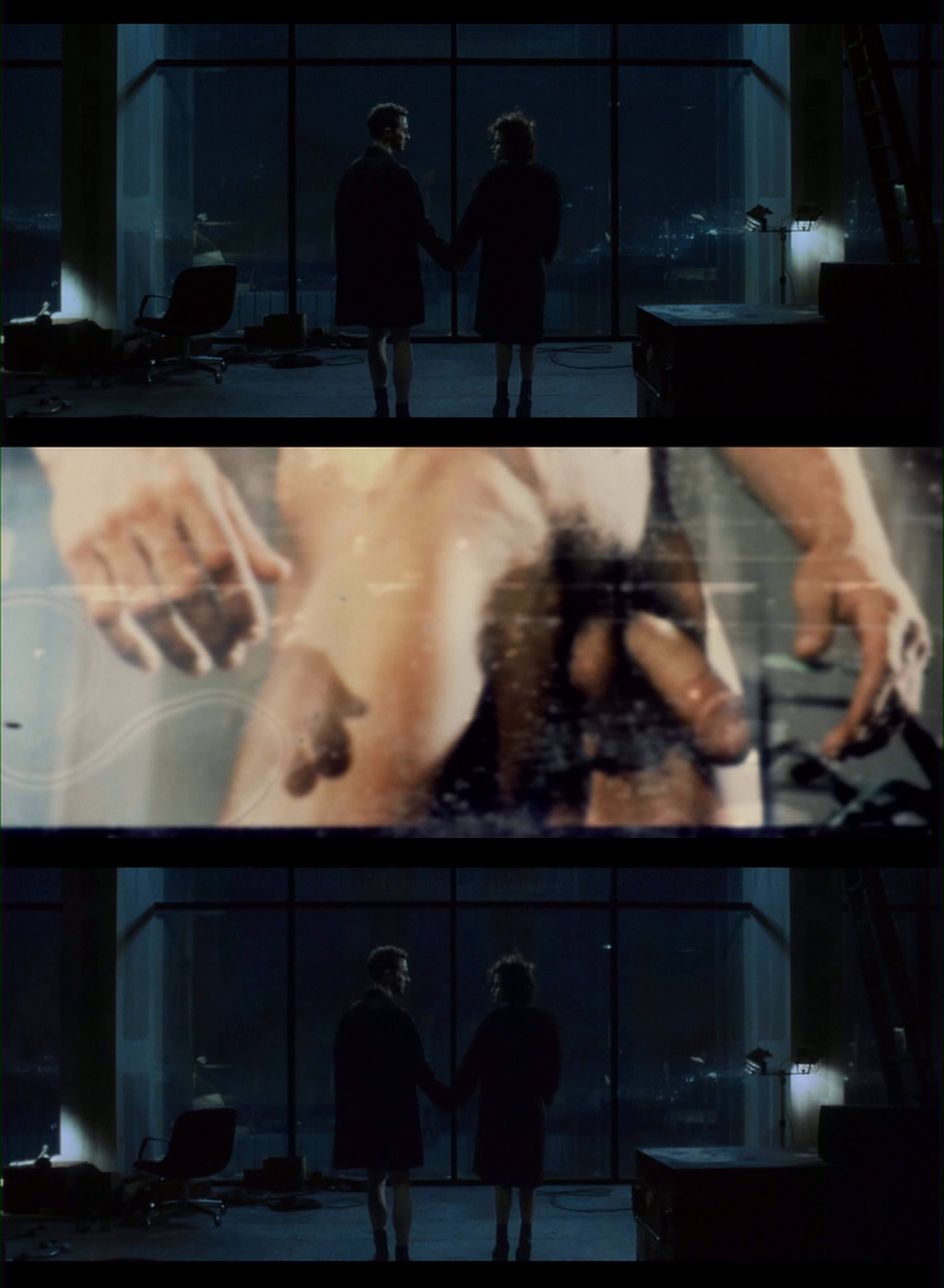
At the end, the narrator discovers Tyler’s plans and wants to stop him. He shoots himself through the mouth and Tyler drops dead. The narrator is severely wounded, but he survived. Then his love interest Marla is delivered by his (Tyler’s) soldiers. They have a final conversation while the city block around them is reduced to cylinders. “You met me at a very strange time in my life”, is the final line.

But then! As the two lovers watch the inferno, we get an original Tyler Durden dick flash!

So that means the narrator did not really kill him. The mischievous Tyler is still in there and will definitely come back to once again become the narrator. So in the end it is Tyler that wins.

Once Upon a Time in Hollywood (het boek)

The first novel by Quentin Tarantino….

Jawel, van zijn unieke ode aan het Hollywood uit zijn jeugd heeft QT nu een boek gemaakt. En dat medium heeft zijn voordelen, ervaart de debuterende romanschrijver. In een boek kun je veel meer informatie stoppen dan in een film. Zo leren we in het eerste hoofdstuk – de afspraak tussen acteur Rick Dalton (Leonardo DiCaprio in de film) en de speciale agent Marvin Schwarz (Al Pacino in de film) – de hele carrière van Rick kennen.

Rick barst in tranen uit in het kantoor van Schwarz omdat hij zich een ‘has been’ voelt. Hij heeft het zelf verkloot. In seizoen 3 van Bounty Law gedroeg hij zich onuitstaanbaar en maakte hij een hoop vijanden. Daardoor is het vierde seizoen er nooit gekomen en is de filmcarrière die hij zo ambieerde ook in het slop geraakt. We leren hoe diep het incident met Steve McQueen hem zit. Dat hij de hoofdrol had kunnen spelen in The Great Escape, een rol die een A-lister van hem had gemaakt.

Voor Schwarz, een specialist in het casten van Amerikaans talent in Europese cinema, is het allemaal goed nieuws. McQueen kunnen de Italianen niet krijgen, maar wel: Rick Dalton. De show Bounty Law is bovendien in Europa uitgezonden net als verschillende (B-)films waar Dalton in heeft gezeten. Een herstart van zijn carrière ligt in het verschiet, kortom, maar hij zal zijn beeld van succes moeten bijstellen. En dat valt niet mee voor de bipolaire acteur die lijdt aan extreme stemmingswisselingen.

De onzekere Rick wordt getroost door zijn stunt double Cliff Booth (Brad Pitt in de film), een heel relaxed personage dat het leven neemt zoals het komt. In het boek leren we Cliff beter kennen dan in de film. Zo ontdekken we dat Cliff gefascineerd is door buitenlandse films. Op zondag gaat hij in zijn eentje naar buitenlandse films met ondertiteling: iets dat Rick (en overigens de meeste Amerikanen) nooit zouden doen. Tarantino wijdt een heel hoofdstuk aan Cliff’s filmsmaak. En zijn uitstekende smaak lijkt op de mijne: Kurosawa en Lone Wolf & Cub vindt hij te gek. Bij Truffaut en Fellini haakt hij af.

Vanzelfsprekend zit er net als in de film enorm veel humor in het boek. Neem deze laugh-out-loud passage: It was during the third season on Bounty Law (‘61 – ‘62) that Cliff Booth was brought in to double the series lead. Rick didn’t take Cliff right off. For one really good reason: Cliff was way too handsome to be a stuntman. Bounty Law was Rick’s pussy party. He didn’t need a swingin’ dick, who looked better in Rick’s costume than Rick did, horning in on all that ample tail.

Cliff blijkt ook een een man te zijn die nogal wat mensen om zeep heeft geholpen. Als oorlogsheld heeft hij meer confirmed Japanese kills op zijn naam staan dan welke Amerikaanse soldaat dan ook. Maar ook buiten het leger heeft hij gemoord. Twee gangsters, een vriend waarmee hij aan hondengevechten deelnam (daar heeft hij zijn hond Brandy vandaan die de hippies te grazen neemt in de film) en zijn vrouw. Die laatste schiet hij in tweeën met een harpoengeweer. In zijn verdediging; het was een verschrikkelijke bitch, Cliff had er meteen spijt van en hij heeft haar lichaam zeven uur lang bij elkaar gehouden voordat ze stierf.

Een ander personage dat meer aan bod komt is Charlie Manson. De sekteleider was in de film niet meer dan een edelfigurant. In het boek brengen we een aantal hoofdstukken door in het gezelschap van Manson en zijn familie. Alleen de verrassende wending uit de film, dat drie van zijn volgelingen per ongeluk het huis van Rick inlopen in plaats van dat van Sharon Tate, vindt middenin het boek plaats in plaats van aan het einde.

Met welke scène het boek dan wel eindigt zal ik hier niet verklappen. Maar wat we wel leren is dat het hippie-incident erg goed is voor de carrière van Rick. Hij wordt uitgenodigd in talkshows om te vertellen over hoe hij de vlammenwerper uit The 14 Fists of McCluskey heeft gebruikt om een hippie te toasten, en hij wordt weer volop gecast in films. Kortom, in het alternatieve Hollywood-universum dat Tarantino geschapen heeft komt het met Dalton, Booth én niet te vergeten Sharon Tate (Margot Robbie in de film) helemaal goed.

Dungeon Classics #12: Snatch

FilmDungeon’s Chief Editor JK sorts through the Dungeon’s DVD-collection to look for old cult favorites….

Snatch (2000, UK | USA)

Director: Guy Ritchie
Cast: Jason Statham, Stephen Graham, Brad Pitt, Alan Ford
Running Time: 104 mins.

Two years after his formidable debut Lock, Stock and Two Smoking Barrels, Guy Ritchie, now one of the hottest new directors around, returned with Snatch: a crime comedy with exactly the same formula. Poker is replaced with bare knuckle boxing, stolen antique rifles became a stolen diamond, and Big Chris is renamed Bullet Tooth Tony. The visual gimmickry is still there. And a few cast members returned, most notably Jason Statham, now as leading man. Ritchie had more money this time around, so he could also hire A-listers like Brad Pitt and Benicio Del Toro. Both are great as usual, but Pitt plays one of his most memorable roles ever as Mickey, a ‘pikey’ boxer with an indecipherable accent. What also returns most prominently is the humour. Snatch has sequences – like the black guys attempt to rob the bookies – that will make you piss your pants. It’s one of the funniest crime movies ever made. And the dialogues are one of a kind. In short, Snatch is 86 carats. Or is it 84?