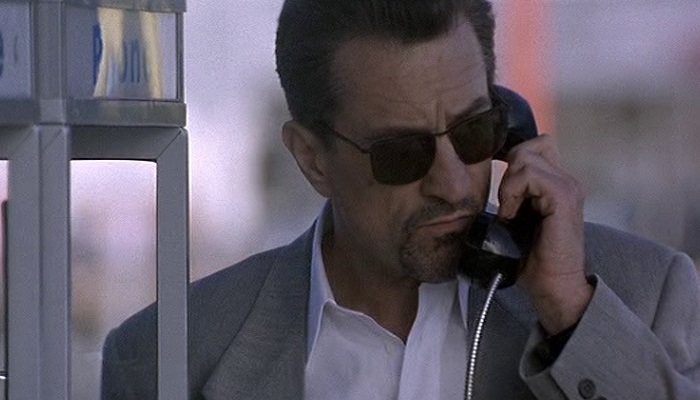
The Untouchables (1987)


‘AL CAPONE. He rules Chicago with absolute power. No one could touch him. No one could stop him. Until Eliot Ness and a small force of men swore they’d bring him down.’

Directed by:
Brian De Palma

Written by:
Oscar Fraley (book)
Eliot Ness (book)
David Mamet (screenplay)

Cast:
Kevin Costner (Eliot Ness), Sean Connery (Jim Malone), Charles Martin Smith (Oscar Wallace), Andy Garcia (George Stone), Robert De Niro (Al Capone), Richard Bradford (Police Chief Mike Dorsett), Jack Kehoe (Walter Payne), Brad Sullivan (George), Billy Drago (Frank Nitti), Patricia Clarkson (Catherine Ness)

Chicago in the 1930’s was a very dangerous place. This was mainly the result of the Volstead Act that reinforced the prohibition of alcohol and allowed such gang lords as Al Capone to literally make a killing. The story of treasury officer Eliot Ness and his squad of untouchables had already been told in the classic television show from the sixties, but director Brian De Palma figured it was time for a movie update. And boy was he right…

The Untouchables just radiates class throughout its running time. The first masterful scene occurs when a newspaper gets delivered in Al Capone’s hotel bedroom. The camera sways from the street, through the hotel and into Capone’s bedroom where the larger-than-life gangster is smoking a massive cigar in bed and laughs at the newspaper’s headline: ‘Crusader cop busts out’. Ennio Morricone composed a very cool piece of music for this scene.

The newspaper is referring to Eliot Ness’ first failure to confiscate Capone’s booze. Ness (Kevin Costner) is determined to bring Capone down, but he doesn’t know how to do it. Irish street cop Jim Malone (Sean Connery) suggests a more unorthodox approach to get it done.

Malone is hesitant at first to join Ness’ team, but gradually evolves into a true fighter. A very impressive and Oscar winning performance by Sean Connery. Andy Garcia and Charles Martin Smith are in equally fine shape. They portray the other members of Ness’ squad. Garcia as the hot-headed, but talented rookie cop George Stone and Smith as a public accountant, whose ideas about income tax evasion would eventually lead to Capone’s downfall.

Costner as the leading man was also the perfect choice. Although he can’t get rid of his goodie goodie two shoes image, despite the violent acts he eventually commits in the film, he is still an inspiring person to watch. He even managed to touch me in the heart one or two times.

Of course, De Niro is once again the show stealer. His method acting really works at its best in The Untouchables. In fact, it works so well that I totally forgot I was watching De Niro: I was watching Al Capone. His character is what he’s supposed to be: an extremely dominant and intimidating personality. In a famous scene based on a true incident, Capone demonstrates his powers. During a black tie dinner with all his cronies, he shockingly beats one of them to death with a baseball bat.

The violence described above is characterising for De Palma’s approach in making this film. Brains are painting the ceiling on more than one occasion. The brutality is justified though as it really helps to better understand Ness’ determination to get the job done. Drinking may be innocent, but when you touch a man’s family, his friends and innocents in general, it is very understandable that he is driven to despair and acts of brutal violence.

De Palma’s direction on this movie is flawless. His trademark suspense is evident from the credit sequence on, up until the amazing train station shoot-out at the end. Every scene in The Untouchables is just perfect in setting, rhythm, composition and acting. He has made a timeless film that deserves to be celebrated a lot more than it currently is.

Rating:

Quote:
AL CAPONE: “I want this man DEAD! I want his family DEAD! I want his house burnt to the ground. I wanna go there in the middle of the night and I wanna piss on his ashes!”

Trivia:
Robert De Niro tracked down Al Capone’s original tailors and had them make him some identical clothing for the movie. He also insisted on wearing the same style of silk underwear that the real Capone wore.

Casino (1995)


‘No one stays at the top forever’

Directed by:
Martin Scorsese

Written by:
Nicholas Pileggi (book and screenplay)
Martin Scorsese (screenplay)

Cast:
Robert De Niro (Sam ‘Ace’ Rothstein), Sharon Stone (Ginger McKenna), Joe Pesci (Nicky Santoro), James Woods (Lester Diamond), Frank Vincent (Frank Marino), Pasquale Cajano (Remo Gaggi), Kevin Pollak (Phillip Green), Don Rickles (Billy Sherbert), Vinny Vella (Artie Piscano), Alan King (Andy Stone)

With Casino, director Martin Scorsese has made another powerful statement about the gangster lifestyle, but like its setting Las Vegas, it is way flashier than its New York based predecessor GoodFellas. Scorsese regular Robert De Niro portrays Sam ‘Ace’ Rothstein, an overly serious professional gambler, who is sent to Las Vegas by the Midwest Mafia to run the Tangiers Casino. This task is handled superbly by control freak Rothstein (“an equal amount of blueberries in each muffin”), but as Rothstein’s protector, gangster Nicky Santoro (Joe Pesci) explains in voice-over: “In the end, we fucked it all up”.

It is easy to see why Scorsese wanted to tell this real-life story, written by Nicholas Pileggi (who also wrote the book Wiseguy on which GoodFellas is based). There is some real poetry in this tale of greed and power. Rothstein, who plays every bet as safe as possible, takes a real chance by marrying the unstable hustler Ginger (Sharon Stone). He also miraculously survives an attempt on his life by an amazing coincidence. Two very interesting occurrences for a man who doesn’t believe in luck.

Visually, Scorsese takes Casino further than any of his previous movies. There are loads of terrific shots and camera moves. The fifty million dollar budget is well spent on beautiful seventies Vegas settings and to portray Rothstein’s and Ginger’s flamboyant lifestyle. The greed of this desert city is also visualised in what must be the largest amount of dollar shots in cinema history.

Pesci delivers a chilling performance as a psychopathic mobster. His Nicky Santoro is less of a loose cannon than his Tommy De Vito from GoodFellas, but he’s possibly even scarier and more violent. No surprise then, that Santoro is the biggest contributor to the extremely harsh violence Casino portrays. The infamous vice and baseball bat scenes are very unpleasant to look at, but many of the other killings are repellent and nasty as well.

Stone’s Ginger brings some balance to the business oriented and almost documentary-style story of the Mafia’s Las Vegas. Although some scenes of her drug problems and failing marriage with Rothstein feel repetitious, they are never dull. Stone, like De Niro, delivers a flawless performance. Some minor flaws don’t detract from Casino’s status as an absolute gangster classic.

Rating:

Quote:
NICKY SANTORO: “You called my friends a faggot? You told him to go fuck himself? Is that what you did? You told him to go fuck himself? You fuckin’ hick! You fuckin’ hick you! Come here!”

Trivia:
Among other Las Vegas regulars, veteran comedy headliners Alan King, Don Rickles, and Dick Smothers appear in major, non-comedic roles.

Carlito’s Way (1993)


‘He wanted out. There was only one way to get there.’

Directed by:
Brian De Palma

Written by:
David Koepp (screenplay)
Edwin Torres (novels)

Cast:
Al Pacino (Carlito Brigante), Sean Penn (David Kleinfeld), Penelope Ann Miller (Gail), Luis Guzman (Pachanga), Viggo Mortensen (Lalin), James Rebhorn (District Attorney Norwalk), John Leguizamo (Benny Blanco), Joseph Siravo (Vincent Taglialucci), Richard Foronjy (Pete Amadesso), Ingrid Rogers (Steffie)

Brian De Palma’s career is often seen as a mix of brilliant, boundary-pushing filmmaking and controversial, uneven output. About his contributions to the gangster genre (Scarface, The Untouchables, Carlito’s Way), there can be no doubt however: they belong to the absolute best. It’s right up there with Coppola’s and Scorsese’s output.

Carlito’s Way is largely set in the barrio of Manhattan’s Spanish Harlem, one of New York’s tougher areas that is filled with poverty, drugs and Latino gangs. This is the area in which Judge Edwin Torres grew up, who wrote two novels about the main character Carlito Brigante. It seems that in this neighbourhood, there are only two options in life; escape the slumps or join a gang. And those to go for option B have a way bigger chance on an early funeral (Carlito’s cousin) than to rise to the relative top (Carlito).

The Puerto Rican Carlito Brigante (Pacino) was a major heroin dealer before the law caught up with him and locked him up. His slick attorney David Kleinfeld (Penn) gets him an early release due to the DA’s usage of illegal wiretap evidence. The now free and seemingly new man Carlito desperately wants to change his ways. But many players, both old and new, intent to drag Carlito back into the deadly game of crime.

Despite the many temptations, Carlito manages to stay legit. He gets back together with his former girlfriend Gail (Penelope Ann Miller) and cooks up an exit plan. As soon as he has saved sufficient money by running a nightclub, he wants to take Gail to the Bahama’s and start a new life together. But then faith strikes and Carlito is placed in an impossible dilemma from which there is no escape. Kleinfeld – who Carlito feels he owes for giving him a fresh start – is in big trouble and he needs Carlito’s help with a very dangerous task.

The job turns sour, but leaves Carlito with enough cash to escape. It also puts him in a bad position with both the feds and the mob. Both his dream and downfall are now closer than ever.

Although the story of a criminal who wants out is nothing new, Carlito’s Way tells a beautiful tragedy. The deeper layers provide for a much more satisfying viewing experience than a clichéd gangster tale.

The acting is excellent. Pacino is solid as a rock as always, but the real joy here is Sean Penn. He portrays the manic, coke addicted lawyer Kleinfeld to perfection. His haircut deserves a special place in the gallery of wrong.

The finale of Carlito’s Way is an extremely suspenseful showdown with an ending that will leave no viewer unmoved. The fantastic escalator shoot-out – that looks as if Hitchcock could have directed it –is the highlight. It also pays a fitting tribute to the baby carriage scene in The Untouchables, which in turn paid tribute to Sergei Eisenstein’s Battleship Potemkin.

De Palma has delivered a movie that is very rewatchable. Not only is it extremely entertaining, it is also character driven and manages to touch the viewer in the heart. Carlito’s ‘way’ turns out to be a fascinating one.

Rating:

Quote:
CARLITO: “Now I ain’t saying that my way would have been different had my mother been alive when I was a kid, cause that’s just bullshit.”

Trivia:
The exterior of the hospital where Carlito visits his bedridden attorney is the same one where Vito Corleone is taken in The Godfather (1972), also starring Al Pacino.

Brooklyn Rules (2007)


‘Not made to be broken’

Directed by:
Michael Corrente

Written by:
Terence Winter

Cast:
Freddy Prinze Jr. (Michael Turner Jr.), Scott Caan (Carmine Mancuso), Alex Baldwin (Caesar Manganaro), Jerry Ferrara (Bobby Canzoneri), Mena Suvari (Ellen), Monica Keena (Amy), Robert Turano (Mr. Canzoneri), Phyllis Kay (Mrs. Canzoneri), Ursula Abbott (Angela), Paulo Araujo (Young Michael)

The premise of friends growing up in a mob-infested neighborhood is a natural fit for coming-of-age dramas like A Bronx Tale. Brooklyn Rules unfolds against the backdrop of Aniello Dellacroce’s death, a pivotal moment that sparked a violent power struggle within the Gambino crime family.

Amid this turmoil, the film follows three close friends – Michael, Bobby, and Carmine – from their 1974 church service, where a young Michael (Freddie Prinze Jr.) steals from the collection plate, to their complicated lives in 1985. Perhaps because of his early lack of conscience, it’s Carmine (Scott Caan) who gravitates toward the mob, drawn into the orbit of Gambino captain Caesar (Alec Baldwin), a ruthless figure who dominates their neighborhood.

Bobby (Jerry Ferrara), the gentle soul of the group, dreams of a simple life: marrying his girlfriend and becoming a mail clerk. Michael, however, faces a more complex path. Though intelligent enough to attend Columbia and pursue a law career, he finds himself increasingly desensitized to the violence around him. A brutal brawl with a local thug forces the friends to confront their mortality, and Michael’s choices grow darker; stealing from a church is one thing, but murder is another.

Written by Terence Winter, known for his sharp work on The Sopranos, Brooklyn Rules delivers a solid screenplay about friendship, choices, and growing up. While it lacks the razor-sharp edge of The Sopranos, director Michael Corrente compensates with an authentic atmosphere, a stellar soundtrack (featuring ‘Sympathy for the Devil’), and evocative Brooklyn locations.

The trio of lead actors brings their characters to life, making their friendship feel genuine despite some uneven dialogue. The romantic subplot between Michael and Ellen (Mena Suvari of American Beauty) adds a welcome layer to the story. Though not groundbreaking, Brooklyn Rules is a worthy entry in its genre, offering an engaging 90 minutes for viewers.

Rating:

Quote:
MICHAEL: “He got a necklace with a fucking ear on. Cut it of some gook in the war.”

Trivia:
Scott Caan is the son of screen legend James Caan.