Thinking, Fast & Slow: Dialogues on Reality (1)

By J.H. Kash

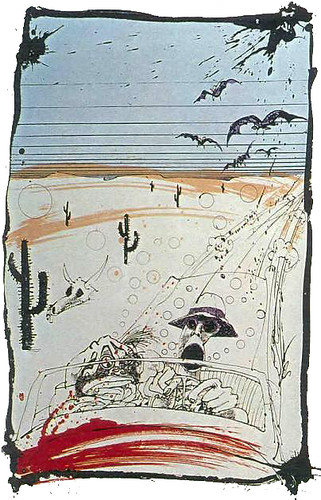
I was on my way to Vegas for a conference on quantum mechanics and the nature of reality with the famous Dr. Lanza. He was driving our fire red convertible as we discussed the difference between mind and brain.

“If the mind is not the brain, then what is it?” I asked.
“The mind is that which experiences. That which perceives. By definition, that means it cannot perceive itself”, he answered.
“But here’s the problem”, I objected. “How can it do anything if it is not physical? You say it’s some sort of super turbine creating reality as we know it.”
“Right.”
“Right. So if it is an engine, but it’s not made of anything, then how can it function? And this is not just me asking, but anyone being skeptical of the mind being anything other than the brain.”
He took a sip of his coffee.
“You ask good questions, Kash. You see, the mind is part of the non-local domain, that is powered by zero point energy. That is energy so powerful a teaspoonful could easily blow Nevada to smithereens. This mind field also possesses phenomenality. Because of this energy, of which we cannot even comprehend how powerful it is, it can create worlds without breaking a sweat. Including our world.”
“You’re a fucking lunatic”, I said. “I love it.”

“So how do you look at this mind-at-large concept?” I continued. “That what we experience is merely a fragment of the potential mind that encapsulates the cosmos?”
“It makes perfect sense. If the brain localises the consciousness to the body, it means it only uses a insignificantly small piece of the mind power that exists.”
“Many people who’ve had near-death experiences say they experienced this mind-at-large. When their consciousness was temporarily detached from their brain, due to say… cardiac arrest, they all of a sudden understood… quantum mechanics.”
“That’s very possible. The brain slows our thought processes way down to accommodate our experience on earth. Would we be in a different dimension, our conscious experience could be entirely different. Perhaps unbounded, completely free from filters.”
“Imagine that.”
“We can’t. Our slow brains normally prevent us from experiencing that.”
“Let’s drop some acid then.”
He laughed. “Yeah, let’s.”

Fragment from what might one day become a novel called ObserverWorld. Right now it merely exists in the ocean of possibilities we call the quantum realm. But it might be in the future manifested by a number of conscious agents, including me, Lanza and you dear readers.

Het Tibetaanse Dodenboek

“Alles wat vorm heeft vergaat. Alles dat zich verzameld heeft valt uit elkaar. We zijn allemaal net als bijen, alleen op de wereld, gonzend en zoekend zonder een plek om uit te rusten. En dan komt de meest radicale transitie die we kunnen ervaren. Het licht van deze wereld verdwijnt. En het licht van de volgende wereld verschijnt.”

We zijn in het Westen verleerd om te sterven. In onze cultuur is de dood gelijk aan falen. Een mislukking. Een fout van het universum die niet had mogen gebeuren. Deze overtuiging zorgt voor onnodige angst en verwarring.

Het Tibetaanse Dodenboek werd in de achtste eeuw geschreven door de beroemde Indiase leraar Padmasambhava, dezelfde die het Boeddhisme naar Tibet bracht. Het boek dient als gids voor de stervenden. Het beschrijft het proces van het sterven als natuurlijke overgang.

Het dodenboek beschrijft hoe het bewustzijn plotseling wordt gescheiden van alle omstandigheden die het dagelijks leven uitmaken. De geest ervaart zijn eigen bevrijding als een stralend zuiver wit licht.

Volgens het Bardo Thödol (Tibetaanse naam voor het Dodenboek) zijn zowel het leven als de dood een onafgebroken stroom van onzekere overgangen die de Bardo’s worden genoemd. De tekst legt uit hoe we, door de bewustzijnsstaten en het fysieke lijden te herkennen, we met onze wezenlijke aard in contact kunnen komen. Op die manier is het mogelijk om je van verwarring en angst te bevrijden.

Een stervende in Tibet wordt gedurende 49 dagen elke dag het Bardo Thödol voorgelezen. Volgens deze tekst dwaalt het bewustzijn van de overledene in deze tijdsperiode tussen het ene leven en het volgende. Gedurende deze tijd is hij in staat om te luisteren. Daarom wordt de tekst hardop gelezen om de gestorven persoon te begeleiden en ondersteunen.

“De dood is nu gekomen en je vertrekt van deze wereld. Maar je bent niet de enige want de dood komt bij alle mensen op aarde. Probeer alles wat je aan dit leven bindt los te laten en ook de mensen waar je je mee verbonden voelt. Wees je hiervan bewust en blijf vooruitgaan wat voor angst of schrik zich ook voordoen tijdens het ervaren van de werkelijkheid van je geest. Herken dat elk beeld in je geest je eigen schepping is. Blijf dat herkennen! Dan zal je bevrijding bereiken.”

Als je geboren wordt, dan huil je, maar de hele wereld juicht. Als je dood gaat huilt de wereld, maar jij vindt misschien wel de grootste bevrijding. “Freed from boundaries of any kind. Just brilliant light.”

Meer over de dood: From Here To Eternity And Back Again. About Death In Mental Space

Idealism Vs. Materialism

Idealism entails that reality is what you experience: it’s the book, or electronic reader in your hands; it’s the room around you, with all its color, textures, and depth; it’s the sounds and smells in the air; it’s the feeling you have of being in your own skin right now. In contrast, the reigning materialist worldview is rather abstract: it postulates that, behind the ‘copy’ of reality you’re experiencing right now, there is the ‘real’ reality, which is not what you are experiencing. The dynamics of objects and living entities in that ‘real’ reality supposedly unfolds according to certain regularities and patterns – the laws of physics – that exist outside mind. As it unfolds, it leaves an imprint on your sense organs – like footprints – which your brain then uses to perform a reconstruction of reality inside your head.

A big part of the motivation for our culture’s current embrace of materialism is the observed regularities according to which reality seems to unfold: it is hard to imagine for most people that it is the unfolding of contents of mind itself – that otherwise voluble and rather unstable medium we associate with the ego – that obeys what we call the ‘laws of physics.’ Moreover, the world ‘outside’ feels very separate from our egoic minds. We don’t seem to have any direct mental influence on reality and often feel entirely at the mercy of impersonal, external forces.

As we discussed above, this impression arises solely because we ordinarily identify ourselves with only a very small part of our minds: our personal egoic awareness. Yet, each one of us has direct experience of the broader aspects of mind: when we dream at night: it is undeniable our minds that construct and project the entire universe of our dreams. It is created by a part of mind that we have no control over.

Imagine mind as the screen of a movie theater. Images on the screen represent the entire set of your subjective experiences. Materialism states that those images have an external source and are captured by ‘cameras’ – our sense organs – used to record the movie you are watching. Under idealism, on the other hand, only the movie theater exists: all images you see are generated in the theater itself, like a computer animation rendered in real-time, and have no external source. We can empirically identify certain patterns and regularities in the unfolding of those images. The so-called laws of physics are simply a model of these observed patterns and regularities according to which the pixels of these images seem to change.

Fragment from: Why Materialism is Baloney, Bernardo Kastrup

Massapsychose in de VS

Okee, laten we er even vanuit gaan dat Carl Jung gelijk had en er een collectief onbewustzijn bestaat. Dus dat bewustzijn niet iets individueels is, maar iets dat we met zijn allen delen. Dan zou dat een verklaring kunnen geven voor de waanzin die nu in de VS speelt. Welke waanzin? Kijk niet verder dan deze uitzending van The Daily Show (het fragment met Ivanka Trump):

Are you shitting me, right now?

In het collectieve onbewustzijn, of liever collectieve bewustzijn als in: er bestaat een veel grotere geest dan de jouwe, alleen heb je niet toegang tot de volledige inhoud, dan is het daarin mogelijk dat ideeën (ook hele bizarre ideeën) zich over de bevolking verspreiding als een virus. Precies wat er in WWII helemaal verkeerd ging.

In de VS speelt nu soortgelijke collectieve waanzin. Namelijk het idee dat sociale zekerheid iets verwerpelijks is en vooral iets heel onamerikaans. Iedereen moet zijn eigen broek ophouden. Het idee dat iemand belastinggeld ontvangt zonder een tegenprestatie te leveren is bijna gelijk aan diefstal. Maakt niet uit wat de omstandigheden zijn van de ontvanger en of de belangbetaler een multi-miljardair is.

Deze angstgolf voor socialisme heeft Amerika al sinds de jaren 50’ in zijn greep. Er is niks ergers dan socialisme. Dat is ingeprogrammeerd in het Amerikaanse zenuwstelsel. En emoties zijn duizend maal krachtiger dan rationele ideeën. Ze hebben namelijk de functie ons blijvend alert te maken op gebeurtenissen. Is het te herprogrammeren? Zeker, maar dit is een langdurig proces. Slecht nieuws voor de mensen die nu sociale zekerheid nodig hebben. Of zou de nieuwe Green Deal ze gaan redden? Ik betwijfel het. De Amerikaanse psyche is nog niet klaar voor een Grote Ommekeer: Dat laat The Don nog bijna dagelijks zien. Er is weerstand tegen zijn waanzin, maar hij wordt nog door grote delen van de bevolking geaccepteerd of zelfs aanbeden. En zo gaat de Grote Menselijke Komedie vrolijk verder en verder…