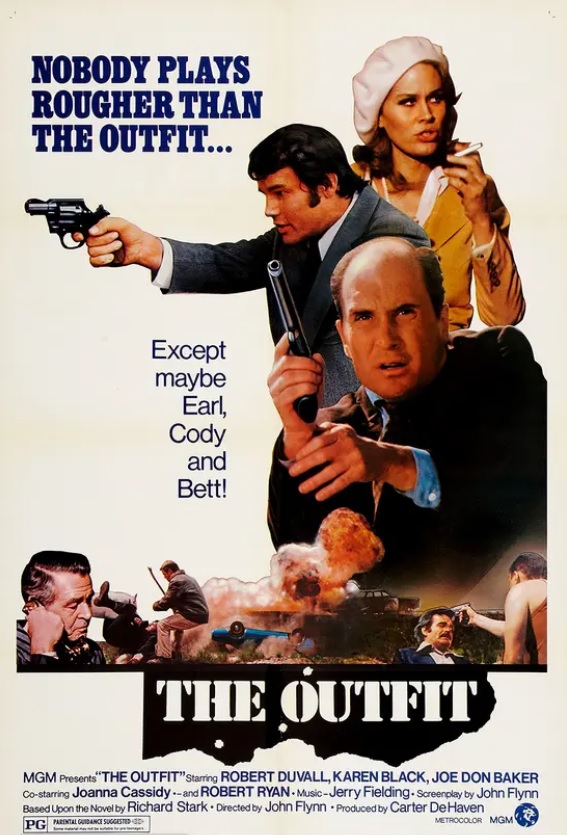
The Outfit (1973)

Nobody plays rougher than The Outfit…Except maybe Earl, Cody and Bett!

Directed by:
John Flynn

Written by:
Donald E. Westlake (novel ‘The Outfit’ as Richard Stark)
John Flynn (screenplay)

Cast:
Robert Duvall (Earl Macklin), Karen Black (Bett Harrow), Joe Don Baker (Jack Cody), Robert Ryan (Mailer), Timothy Carey (Jake Menner), Richard Jaeckel (Kimmie Cherney), Sheree North (Buck’s Wife), Felice Orlandi (Frank Orlandi), Marie Windsor (Madge Coyle), Jane Greer (Alma Macklin)
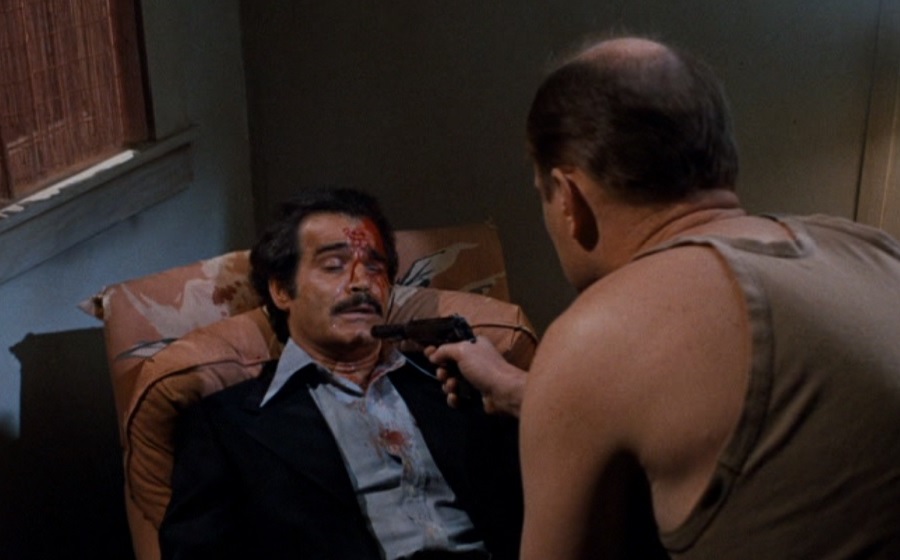
Forgotten, gritty ’70s crime flick loosely adapted from a novel by Richard Stark (a follow-up to ‘The Hunter’, the book that inspired Point Blank and Payback).

The novel’s central character, Parker – named Earl Macklin here for some reason – has a score to settle with the crime syndicate known as the Outfit. After they murder his brother in retaliation for a robbery the two pulled on one of their banks, Macklin decides they owe him payback.

True to Parker’s nature, he demands compensation in his own way: together with his buddy Jack Cody and girlfriend Bett Harrow, he begins hitting the Outfit’s operations one by one. In return they set a trap for him, but Macklin is not a man easily cornered. It ends in a memorable shootout in the mansion of the Outfit’s top boss.

The film is directed by John Flynn (Rolling Thunder), who also wrote the screenplay. Flynn was a fine, efficient, and sadly underrated filmmaker who specialized in lean, mean crime pictures. He’s a director admired by Quentin Tarantino – as Tarantino noted in ‘Cinema Speculation’, his book on ’70s cinema – and it’s easy to see why. The film is stylishly shot and Robert Duvall is great in the lead tough guy role.

That said, it misses the real hard-boiled coolness or cinematic innovation that made John Boorman’s Point Blank, which was again based on similar source material, such a memorable film.

Rating:

Quote:
EARL MACKLIN: “Now, the Outfit’s gonna pay me money for my trouble. I figure 250.000 to make things right. Tell your friends. That’s the bill: 250. I hit you until you pay me. What I take in between is extra.”

Trivia:
The Outfit (1973) (much like The Friends of Eddie Coyle (1973) and other crime films of this period) has been included on many lists of lesser known films recommended by 21st century film analysts.
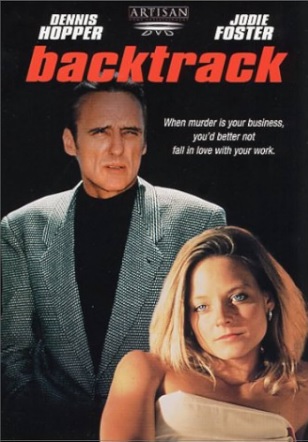
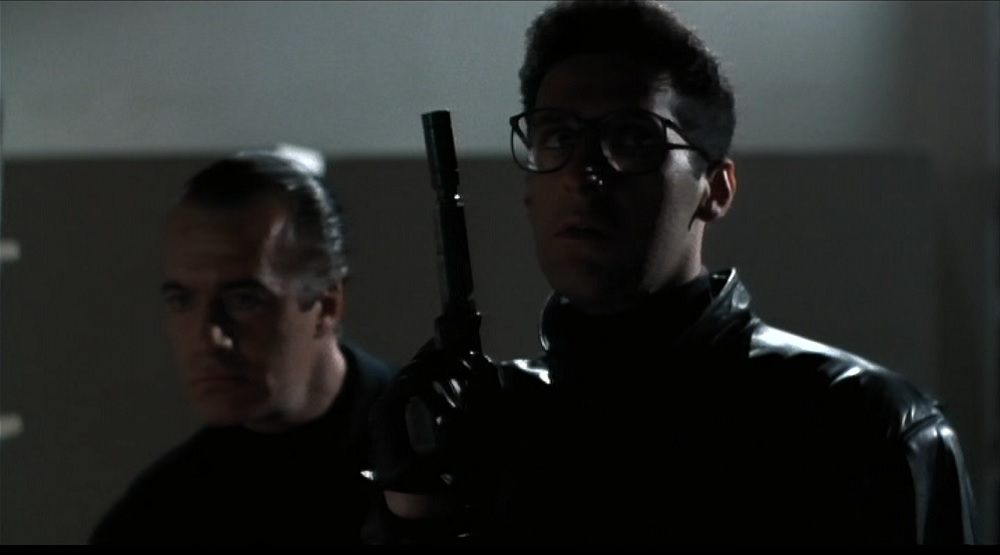
Backtrack (1990)


‘When murder is your business, you’d better not fall in love with your work.’

Directed by:
Dennis Hopper

Written by:
Rachel Kronstadt Mann, Ann Louise Bardach

Cast:
Dennis Hopper (Milo), Jodie Foster (Anne Benton), Joe Pesci (Leo Carelli), Dean Stockwell (John Luponi), Vincent Price (Lino Avoca), John Turturro (Pinella), Fred Ward (Pauling), Julie Adams (Martha), Tony Sirico (Greek), Sy Richardson (Capt. Walker)

Alright, so this is quite a strange film by Dennis Hopper. It was originally released as Catchfire, but that version was apparently so bad that Hopper had his name replaced in the credits with the pseudonym Alan Smithee. Backtrack is the 18-minutes-longer cut made for cable TV, with Hopper’s directorial credit restored.

Jodie Foster plays an artist who witnesses a mafia murder. The mob – led by the explosive Leo Carelli (Joe Pesci, in the same year he gave his ultimate mobster performance in GoodFellas) – hires hitman Milo (Dennis Hopper) to silence her.

What makes it puzzling is the sheer amount of talent involved: Jodie Foster, Joe Pesci (uncredited, despite a substantial role), Dean Stockwell, John Turturro, and others. The film also features familiar faces like Charlie Sheen, Bob Dylan (!), and Tony Sirico (Paulie Walnuts from The Sopranos). Yet, despite this very impressive cast, no one is given particularly strong dialogue – not even the two leads.

The bigger problem is that the film never decides what it wants to be. Is it a tense thriller? An arthouse experiment? A romantic gangster film in the vein of Bonnie and Clyde? Or an action movie given that out of nowhere, there’s a helicopter chase? The tone shifts constantly, leaving the viewer wondering: what exactly am I watching? That question is never answered.

It’s also unclear what motivates Hopper’s character, Milo, a saxophone-playing hitman. He suddenly falls in love with his target, but why? And why does she start to reciprocate? Their relationship feels entirely unconvincing.

Originally, Hopper’s cut ran 180 minutes. It’s difficult to imagine what his true vision for the film might have been. The studio, Vestron Pictures, disliked his version and re-edited it without his consent. Hopper was furious and sued, but by then the company had already gone bankrupt.

In short, Backtrack is a curious film for many reasons, but unfortunately the final product simply doesn’t work. It’s a shame, given the remarkable cast, but the movie is proof that without a strong screenplay, even great talent can’t save the day.

Rating:

Quote:
MILO: “There’s something going on here that I really don’t understand. But I like it.”

Trivia:
The movie includes three Oscar winners: Jodie Foster, Joe Pesci and Bob Dylan; and three Oscar nominees: Dennis Hopper, Catherine Keener and Dean Stockwell.

Easy Rider

Director: Dennis Hopper
Written by: Peter Fonda, Dennis Hopper, Terry Southern
Cast: Peter Fonda, Dennis Hopper, Jack Nicholson

Year / Country: 1969, USA
Running Time: 95 mins.

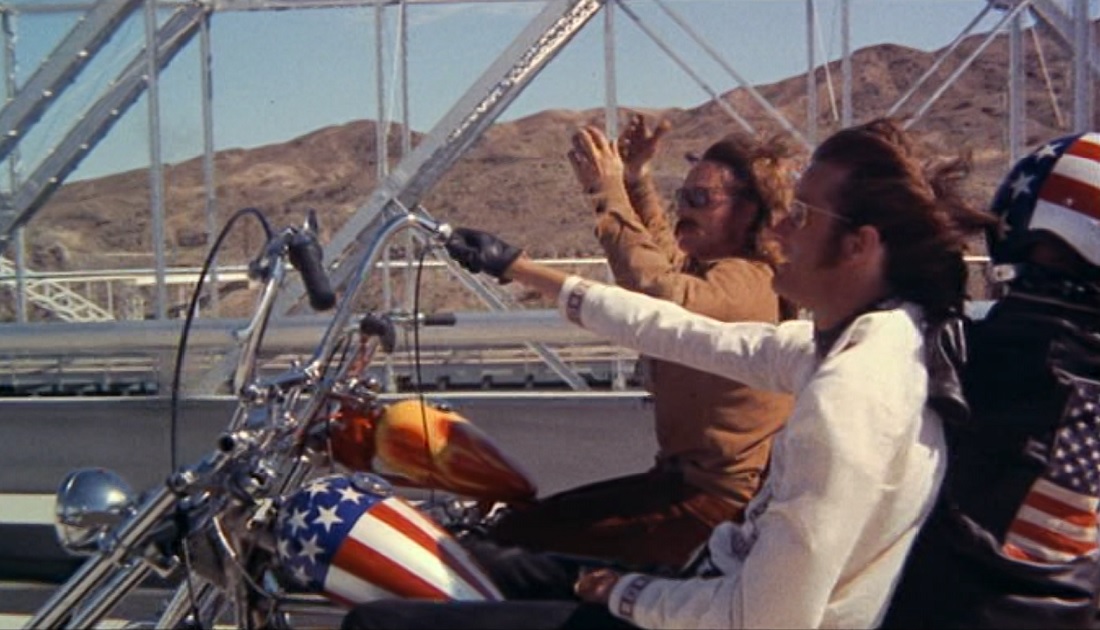
Two American bikers, Billy (Dennis Hopper) and Captain America (Peter Fonda), make a drug deal in Los Angeles, selling a stash of cocaine. They stash the money in plastic tubes hidden inside Captain America’s gas tank, which is decorated in stars and stripes like the American flag. Then they hit the road, heading for the Mardi Gras festival in New Orleans.

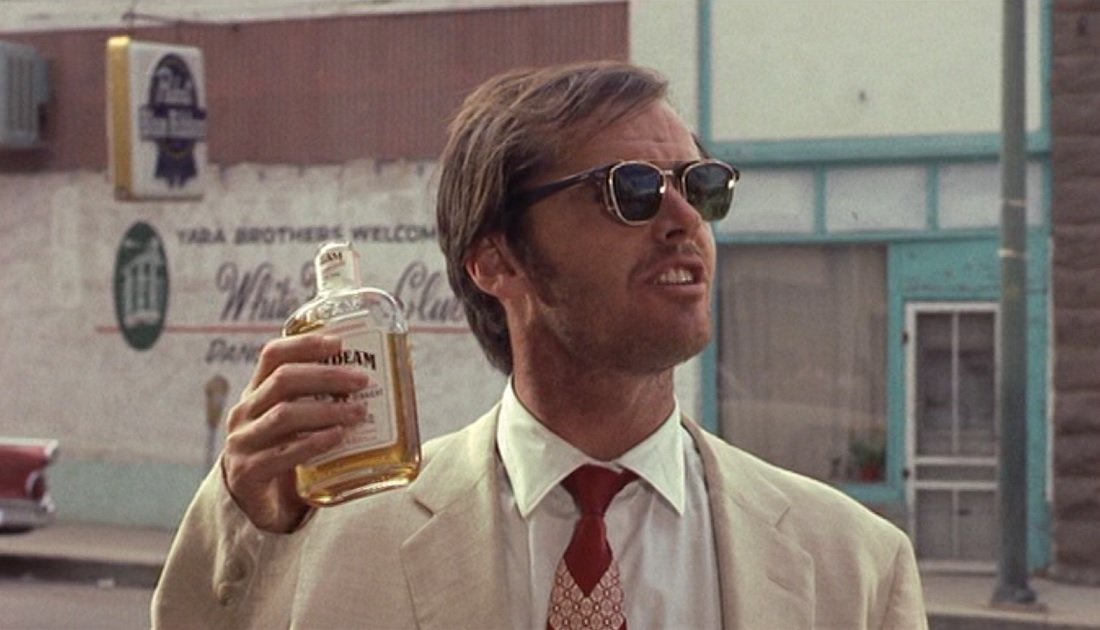
These two are counterculture figures; bikers, yes, but more hippie than outlaw. They ride through the American South and Southwest, camping under the stars, smoking grass by the fire, and drifting freely. Along the way, they encounter fellow wanderers, free-spirited hippie women, and the memorable, alcoholic lawyer George Hanson (Jack Nicholson).

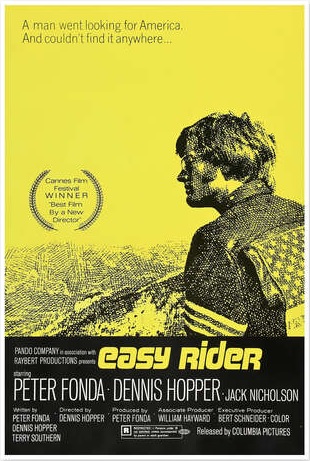
Easy Rider has a unique atmosphere all its own. The film’s striking images of wide-open, desolate landscapes, paired with its incredible rock soundtrack, create a dreamlike sense of freedom. It’s a road movie, yes, but also a time capsule. The tagline sums it up perfectly: ‘A man went looking for America. And couldn’t find it anywhere…’ Throughout the journey, they meet farmers, hippies, rednecks – a cross-section of America. But beneath it all is a deeper tension: a clash between the angry and the peaceful.

The film’s marijuana-smoking scenes feel genuine, and the acid trip near the end is raw and unsettling – likely because the cast actually used real drugs during filming. That honesty helps make Easy Rider the ultimate hippie movie, capturing the spirit and disillusionment of its era.

The film was a surprise box office success, shaking up the Hollywood system and briefly shifting creative power to the directors. For a moment, they – not the studios – understood what audiences really wanted to see. The film became a landmark of New Hollywood, capturing the spirit of the 1960s and earning Hopper an Academy Award nomination for Best Original Screenplay.

Rating:

Biography: Dennis Hopper (1936, Kansas – 2010, Los Angeles) was an American actor, director, writer, and artist known for his intense screen presence and deep ties to countercultural cinema. Hopper began his career in the 1950s with small roles in films like Rebel Without a Cause (1955), alongside James Dean. His early work in Hollywood was promising, but his rebellious nature and substance abuse problems often put him at odds with studios. He achieved cult status with Easy Rider (1969), which he co-wrote, directed, and starred in alongside Peter Fonda. He continued his directing career with a mix of critical and commercial disappointments, as well as a few moderately successful films. As an actor, however, he delivered memorable performances in several major hits, including Blue Velvet and Speed. Beyond his film work, Hopper was also a prolific photographer and painter, with his artwork exhibited in galleries around the world.

Filmography: Mary Jennifer at the Beach (1964, short), Easy Rider (1969), The Last Movie (1971), Out of the Blue (1980), Colors (1988), Catchfire (1990), The Hot Spot (1990), Chasers (1994), Homeless (2000, short), Pashmy Dream (2008, short)

What Will Be Tarantino’s 10th and Final Film?

It is well established that Quentin Tarantino wants to complete his career as director with a total of 10 films. With Once Upon a Time in Hollywood (2019) as his ninth, that that leaves just one final movie to cap off an iconic career.

Tarantino has taken long breaks between projects before. After Jackie Brown (1997), he didn’t return with another feature until Kill Bill: Vol. 1 in 2003. So the current six-year gap since Once Upon a Time in Hollywood isn’t unusual, but fans are still eagerly waiting for news.

In 2023, it looked like Tarantino had settled on his swan song: The Movie Critic. The film was to center on a character inspired by a real-life reviewer for an adult magazine Tarantino encountered as a teenager while restocking porno mag vending machines. During his work, Tarantino said he came to really appreciate the writing of this film critic.

“He was as cynical as hell. His reviews were a cross between early Howard Stern and what Travis Bickle might be if he were a film critic”, Tarantino said. Tarantino wanted an actor he had never worked with as the main character and Brad Pitt was said to be in talks to join the cast, though not as the title critic. The project sounded promising, but in 2024, Tarantino shelved it for artistic reasons. Just like that, The Movie Critic was off the table.

There was also buzz about Tarantino tackling a Star Trek film – an unusual move, given his preference for original stories (with Jackie Brown, adapted from Elmore Leonard, being the lone exception). But on the ReelBlend podcast, he suggested that a Star Trek film perhaps wouldn’t ‘count’ as his tenth. That project, too, now seems dead.

So what’s next? According to The Hollywood Reporter, while rewriting The Movie Critic, Tarantino toyed with an ambitious idea: a ‘farewell metaverse’ in which characters from his past films might reappear in a ‘movie within a movie’ format – either as their original characters or as fictionalized versions of the actors who played them. But for now, that’s just speculation.


In my DVD collection, I left over a single place for Tarantino’s final film. His filmography as director so far: 1. Reservoir Dogs, 2. Pulp Fiction, 3. Jackie Brown, 4. Kill Bill (counting as one film), 5. Death Proof, 6. Inglourious Basterds, 7. Django Unchained, 8. The Hateful Eight, and 9. Once Upon a Time in Hollywood.

The only concrete Tarantino-related project currently in the pipeline is The Continuing Adventures of Cliff Booth, a spin-off from Once Upon a Time in Hollywood. In this film, Brad Pitt’s character – stuntman and all-around tough guy Cliff Booth – becomes a Hollywood studio fixer. The film is being directed by David Fincher for Netflix, marking the first time since From Dusk Till Dawn (1996) that Tarantino is writing but not directing a film.

So what about the final film? At the 2025 Sundance Film Festival, Tarantino addressed this very question. “I don’t want to rush into production”, he said. “I’ve been in a hurry for the last 30 years, but not right now.” The reason? His family. “My son turns five next month, and my daughter is two and a half. The idea of taking on a huge project when my kids are so young doesn’t appeal to me.”

Tarantino added that he wants to wait until his son is at least six. “That way, he’ll know what’s going on, he’ll be there, and it’ll be a memory for the rest of his life.” That could mean production starts sometime next year, but only if inspiration strikes.

Interestingly, Tarantino revealed at Sundance that he’s currently working on a stage play. While he didn’t share any details, he hinted that if the play turns out well, it might be adapted into his final film. “If it’s a fiasco, it’s just a play. But if it succeeds, maybe it becomes the movie.”

So there you have it: while Tarantino’s tenth film remains a mystery, we know he’s not in a rush. In the meantime, The Continuing Adventures of Cliff Booth promises to deliver more of the filmmaker’s signature style even if he’s not in the director’s chair this time. And who knows? That stage play just might be the unexpected final chapter in a legendary career.