Scarface (1932)

Directed by:
Howard Hawks, Richard Rosson

Written by:
Armitage Trail, Ben Hecht, Seton I. Miller

Cast:
Paul Muni (Tony), Ann Dvorak (Cesca), Karen Morley (Poppy), Osgood Perkins (Lovo), C. Henry Gordon (Guarino), George Raft (Rinaldo), Vince Barnett (Angelo), Boris Karloff (Gaffney), Purnell Pratt (Publisher), Tully Marshall (Managing Editor)

The original Scarface opens with a challenge — literally. The very first words on screen declare: “This picture is an indictment of gang rule in America. What are YOU going to do about it?” I can’t think of another film that confronts its audience so directly. It sets the tone for what’s to come: bold, brash, and unafraid to stir things up.

The story kicks off when Louis Costillo, the last of the old-school gang leaders, is gunned down. With him out of the way, Chicago is up for grabs. Enter Tony Camonte — a ruthless, trigger-happy Italian thug with big ambitions. He works for Johnny Lovo, a mob boss running the city’s bootlegging operations, but Tony clearly has bigger plans.

Tony’s greatest strength is his fearlessness. His greatest weakness? He’s reckless to the point of stupidity. At one point, he openly tells an underling — someone he barely knows — that he plans to kill Lovo and take over. Still, Tony lives by his own brutal code: “Do it first. Do it yourself. And keep doing it.” And for a while, that philosophy takes him far.

It’s no secret that Tony Camonte is a thinly veiled version of Al Capone — the real-life ‘Scarface’. The film even recreates the infamous St. Valentine’s Day Massacre, among other bloody moments from Capone’s reign. Paul Muni, who plays Tony, throws himself into the role with raw intensity. At times, maybe too much intensity. His exaggerated Italian accent borders on parody today — but to be fair, that larger-than-life acting style was very much in fashion back then.

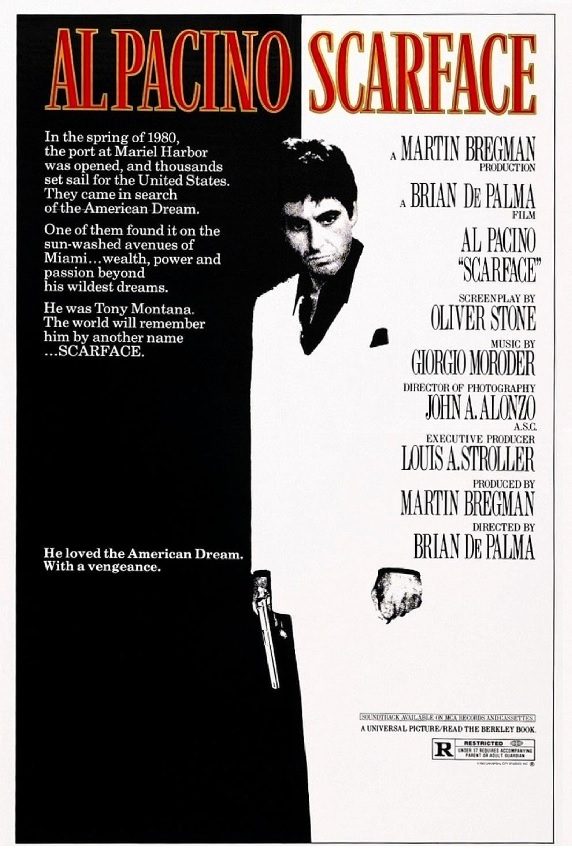
Watching Scarface for the first time, I was struck by how much it echoes Brian De Palma’s 1983 version — the one I grew up with. Tony’s obsessive, almost incestuous protectiveness over his sister, the iconic ‘The World is Yours’ sign, and of course, his violent downfall in a hail of bullets — it’s all here. The DNA of De Palma’s Scarface runs straight back to Howard Hawks’ original.

But what really stood out to me on my recent rewatch was just how groundbreaking the action scenes are. The machine gun shootouts — stark, brutal, and filmed in gritty black and white — feel years ahead of their time. There’s a raw energy to them that still hits hard, even nearly a century later. This Scarface might not have the swagger of Al Pacino’s Tony Montana, but it’s every bit as bold, violent, and unforgettable.

Rating:

Quote:
TONY CAMONTE: “Hey, Cesca, you and me, huh? We’ll show them. We’ll lick them all, the North Side, the South Side! We’ll lick the whole world!”

Trivia:
Like many of the early gangster movies, real machine gun fire is used to create the bullet damage in walls, including scenes with main characters ducking gunfire.

Bullets Over Hollywood

Bullets Over Hollywood (2005, USA)

Director: Elaina Archer
Written by: John McCarty (book), Elaina Archer, Tom Marksbury
Features: Paul Sorvino (narrator), Leonard Maltin, Michael Madsen, Edward McDonald, ao.

Running Time: 70 mins.

This Hugh Hefner produced documentary shows the fascination of moviegoers with the mob. ‘Once in the racket, always in the racket’, Al Capone said who became the archetype of the gangster and role-model for some legendary movie characters like Caesar ‘Rico’ Bandello (Little Caesar) and Tony Camonte/Montana (Scarface) This also applies to Hollywood when it comes to making gangster films. Every time you think the realms of the genre have been fully explored, some new masterpiece comes along. After the time that Cagney, Robinson and Bogart dominated the screen, a new generation of filmmakers emerged in the seventies with Coppola, Scorsese and De Palma. Then at the brink of the new millennium, the Hollywood gangster legend continued on the small screen with The Sopranos.

Bullets Over Hollywood opens with the very first gangster film: The Musketeers Of Pig Alley, made in 1912. It then goes on to chronologically move through gangster film history right up until The Sopranos. The documentary combines film fragments, interviews and real gangster footage while Paul Sorvino (GoodFellas) provides the narrative. It is an interesting viewing for enthusiasts of the genre, but misses real insight in the works that it covers. Some interesting facts are revealed such as the story that Howard Hawks was forced by Hollywood to add ‘the shame of the nation’ to his gangsterfilm Scarface, because they didn’t want to glorify gangsters. Also interesting is some behind-the-scene footage of gangster classics, but these fragments are unfortunately a little brief. Altogether this is worth a look. If only to hear Leonard Maltin rave about The Godfather and to re-experience some of the finest sequences in the history of this fascinating American phenomenon.

Rating:


The Musketeers Of Pig Alley (1912, D.W. Griffith)

The Many Saints of Newark (2021, Review)

Directed by:
Alan Taylor

Written by:
David Chase
Lawrence Konner

Cast:
Alessandro Nivola (Dickie Moltisanti), Leslie Odom Jr. (Harold McBrayer), Jon Bernthal (Johnny Soprano), Vera Farmiga (Livia Soprano), Corey Stoll (Junior Soprano), Ray Liotta (‘Hollywood Dick’ Moltisanti), Michela De Rossi (Giuseppina Moltisanti), Michael Gandolfini (Teenage Tony Soprano), Billy Magnussen (Paulie Walnuts), John Magaro (Silvio Dante)

“My uncle Tony…” It is certainly great to hear Christopher’s voice again. He narrates the story in this long awaited Sopranos prequel from the grave. Chrissy forms the link between the spirit world – where the beloved show now resides – and the world of The Many Saints of Newark, which is now coming to life on cinema screens worldwide and on streaming service HBO Max.

This world, which is set in the 1960’s in New Jersey, is inhabited by many familiar characters in their younger years: Tony Soprano, ages 9 and 17, his parents Johnny Boy and Livia, his uncle Junior, Silvio Dante, Paulie Walnuts, Big Pussy Bonpensiero, and a couple of others. The main character is Christopher’s father Dickie Moltisanti (Alessandro Nivola), who was referred to as a legend in the series, but never seen. Logical, since he was already dead when the show started.

We meet Dickie at the Jersey station, where his father Hollywood Dick, played by Ray Liotta, brings home a new Italian wife from the home country. She is into the handsome and charming Dickie immediately, which complicates the already difficult relationship between him and his mobbed-up father. And soon it leads to a dramatic moment early in the film, which is also none of the highlights of the movie. Both Nivola and Liotta are terrific in their roles. For Liotta, a double role that is; he also plays Dick’s twin brother Sally who’s in jail for life for whacking a made member.

Dickie is a troubled man obviously. He resembles his future son Christopher in many ways: he’s a compulsive law breaker, has an explosive temper and is a murderer. He is also searching. Dickie has the deep desire to do something good, something special to elevate his existence out of the mundane. But he doesn’t know how. Dickie is involved in the numbers rackets in Jersey together with a bunch of black criminals. In the first part of the movie, the 1967 Newark riots take place in which the black riotters, who are structurally discriminated against, face off against the police. In the second part of the film, Dickie’s black business partners get ambitions of their own which leads to a violent conflict in the Jersey underworld.

Besides having his own activities, Moltisanti is also deeply involved with the DiMeo crime family in Jersey whose members love him. But as we know from the show, in this volatile milieu inhabited by envious sociopaths, danger is always lurking. It is this world that young Tony Soprano (Michael Gandolfini) is inevitably drawn to. Dickie becomes his mentor, but on advice of Sally, whom he goes to visit in jail, he turns his back on him. Although the film was marketed as the story of how Tony becomes a gangster, there is not one defining moment through which this happens. This is really at the early beginning of his transformation. Dickie is certainly an inspiration for him with all his influence, his money and his women. But above all, Tony is just talented, and the invitation for him to join the Family is there.

The casting of Michael Gandolfini – son of the deceased James Gandolfini who became a legend by portraying Tony Soprano – works wonderfully well. He is obviously a gifted actor like his father, but the way he resembles his dad as Tony is uncanny at times. Especially during the scene in which he and his friends hijack an icecream truck and start handing out free ice creams. Another standout performance is given by Vera Farmiga as Tony’s batshit crazy mother Livia. The dynamic between her and Gandolfini is great, and the scene between her and Tony’s school counselor is genuinely touching.

Other positive points of Many Saints are the terrific sixties soundtrack, the dark humour and the many clever references to the show that fans will love. A point of critique is that although it feels cinematic, which The Sopranos also did by the way, the screenplay is written more like a long television episode. Storywise, a few cogs are missing and the ending comes too suddenly.

David Chase has expressed interest in doing another period piece about young Tony Soprano together with Terence Winter, who wrote some of the best Sopranos-episodes. Winter responded positively, so there might be another return to this universe Chase has created. But if it doesn’t, that’s okay by me. The Many Saints is a very enjoyable return to the show that still ranks as one of the best ever. The Many Saints can now be added as a great cinematic companion piece.

The Sopranos – 100 Greatest Moments: 100-91

100. Free Alterations

Episode: Meadowlands (SE1, EP4)
Characters: Tony and Mikey Palmice

When Tony is really enjoying himself, it is often because of violence. But who’s complaining when he is giving Junior’s sick henchman Mikey a good whacking? Tony is a real bear and when he hits somebody, the viewer can almost feel its impact. The reason for teaching Mikey a lesson is his killing of Brendan Filone and arranging a mock execution for Christopher. T uses a staple gun to attach a parking ticket to Mikey’s suit. That’s gotta hurt. “What are you screaming about? Free alterations”, Tony laughs. “This ticket is overdue.”

99. Idiot Squat

Episode: Full Leather Jacket (SE2, EP8)
Characters: Christopher, Matt Bevilaqua and Sean Gismonte

It was clear from the get go that Matt Bevilaqua and Sean Gismonte were not the sharpest tools in the work shed, but this idiotic action comes shockingly unexpected even from them. They shoot down Christopher because they somehow figured this would help them move up the mob hierarchy. They don’t even manage to pull it off. Sean wears a seatbelt, so he gives Chris time to shoot back and kill him. Matt takes off, having just signed his own death warrant. The Sopranos never fails to surprise.

98. West Caldwell

Episode: Sentimental Education (SE5, EP6)
Characters: Tony Blundetto and Mr. Kim

For a while, Tony Blundetto seemed to be different from all these selfish, sociopathic animals that inhabit Soprano-land, but his old personality comes back with a vengeance in ‘Sentimental Education’. All it took was finding a bag of money and gamble for a few nights straight. Here, he snaps and kicks the shit out of his sponsor and business partner Mr. Kim. Typical story of an ex con; he tries to improve his ways, but doesn’t have what it takes. He is as crazy as the rest of the crew. His imitation of Mr. Kim is hilarious though. “Wes cal well. Wes cal well. WEST CALD-WELL.”

97. Melfi Judges

Episode: From Where to Eternity (SE2, EP9)
Characters: Tony and Dr. Melfi

Usually Dr. Melfi behaves perfectly around Tony, despite his often rude behaviour. But in this session, his rant about how poor people came from Italy only to be used as worker bees becomes too much even for her. “What do poor Italian immigrants have to do with you? And what happens every day when you get out of bed in the morning?” It may not be professional, but it had to happen sometime in the treatment of a mobster. The scene also gives us insight on how Tony feels about his sins, like murder. “We’re in a situation, where everybody involved knows the stakes. If you’re gonna accept the stakes you gotta do certain things. It’s business. We’re soldiers. We follow codes. Orders.” Indeed an effective way to justify all his actions.

96. Poor Me, Poor You

Episode: Amour Fou (SE3, EP12)
Characters: Tony and Gloria

It is quite subtle, but Gloria really is the substitute for Livia who died earlier in Season 3. “I sit back like a mute, while you screw every woman out there.” In this scene, Tony finally sees it too. “I have known you all my life. A bottomless black hole.” Subsequently Gloria tries to commit ‘suicide by mob boss’. Normally an effective technique, but Tony is too clever to let it go down like this. Great acting here by Annabella Sciorra and James Gandolfini.

95. Rude Awakening

Episode: The Happy Wanderer (SE2, EP6)
Characters: Tony and Davey Scatino

A moment that illustrates the tragedy of the gambling addiction. After the euphoria comes the hangover. Davey just had to sit in with the executive game. He had a few good rounds, but then he started losing. Big time. In the end, Davey gambled away 45 boxes of ziti (45.000 dollars). Tony, who was his friend before, now puts on his other face. “If I don’t get back every penny, I am gonna send a guy to your joint every Saturday, for five percent interest.” These are the people mobsters prey on and Davey slowly starts to realise, this bet is gonna cost him everything.

94. A Killer’s Conscious

Episode: Kennedy and Heidi (SE6, EP18)
Characters: Tony and Dr. Melfi

After Tony murdered his nephew Christopher, he feels relieved. But he can’t share his true feelings with anyone, because, well you know Christopher’s death is supposed to be due to the accident. So what does the unconscious do? In a dream, Tony comes clean to Dr. Melfi. The truth is pretty chilling when you think about it: “The biggest blunder in my career is now gone and I don’t have to be confronted by that fact no more. Let me tell you, I murdered friends before, even relatives. My cousin Tony. My best friend Puss… but this…” Then he wakes up all worried that he spoke in his sleep.

93. Dismemberment

Episode: Whoever Did This (SE4, EP9)
Characters: Tony, Christopher and Ralphie’s corpse

In ‘Whoever Did This’, we get to spend the night with two mobsters, who have to get rid of a corpse. These mobsters are Tony and Christopher and Ralphie is the corpse. Chris, who is high like a kite, has to ‘make him ready’. He discovers that Ralphie is wearing a wig. This freaks him out more than chopping off his hands with a meat cleaver does. These sociopaths…

92. Traumatic Encounter

Episode: Employee of the Month (SE3, EP4)
Characters: Jennifer Melfi and Jesus Rossi

Completely unexpected, Dr. Melfi becomes the victim of a brutal sexual assault. It’s a terrible scene to watch because it makes you feel so powerless. Up to this point, Dr. Melfi – who now briefly becomes Jennifer – had been an observer, someone who could offer some sensible comments on the pretty twisted universe all the other characters live in. Now, she becomes part of the action in the least desirable way possible. It’s a painful experience for her and the audience.

91. Setting the Trap

Episode: Long Term Parking (SE5, EP12)
Characters: Tony and Adriana

Tony makes a memorable call to Adriana. He tells her that Christopher tried to commit suicide and that he was ‘very upset about something’. But Tony is lying. He sends Silvio over to her place to take her on her last ride. The conversation ends with the iconic line; “I’ll see you up there.”