Half a Shot at Redemption

A Sci-Fai Short Story
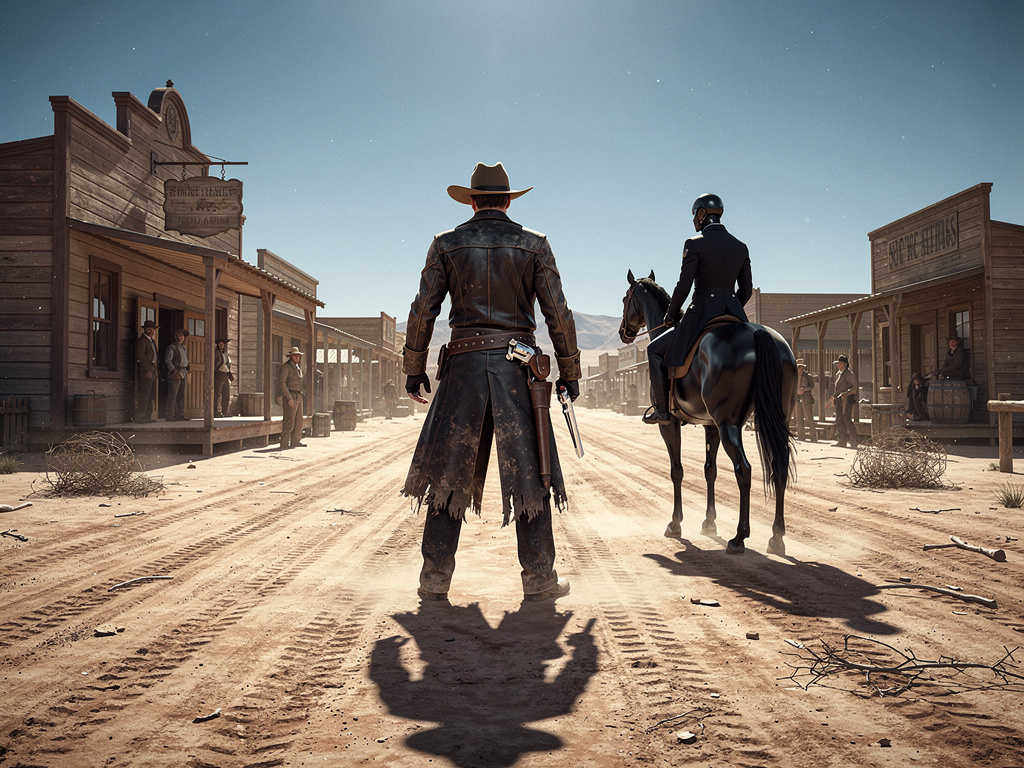
The saloon doors of The Rusty Spur creaked shut behind Jason Terry as he stepped into the dust-choked street, his revolver holstered low. The air smelled of gunpowder and regret. He had one destination: the Iron Trigger Showdown, the fastest-draw tournament west of the Mississippi. One problem: Jason wasn’t just there to compete. He was there to prove something—to himself, to the ghost of his pa, to the whiskey-soaked memories of every draw he’d ever lost.

He hadn’t gone twenty miles out of town when the stranger appeared. Leaning against a sun-bleached post, hat tipped just enough to hide whatever passed for eyes, the figure looked like any other drifter—except for the way the light bent around him, like heat off a desert mirage. His duster was too clean, his boots too quiet in the dirt.

“You got the look of a man riding toward something he ain’t ready for,” the stranger said. His voice was smooth, like oil on a freshly sharpened blade.

Jason’s hand twitched toward his Colt. “Who the hell are you?”

“Name’s Joe.” The stranger pushed off the post and stepped into the light. His face was all sharp angles, skin too perfect, like polished metal under a layer of dust.

“And you, Jason Terry, are riding toward a 97% chance of dying before sundown tomorrow.”

Jason’s fingers froze. “You calling me a liar or a fool?”

“Neither.” Joe tilted his head. “Just stating facts. You’re fast. Not Blaine Rodgers fast.”

The name hung between them like a noose. Blaine Rodgers—the undefeated, the untouchable. The man who’d put a bullet in his pa’s chest in a “fair draw” that had lasted less time than it took to blink. The man who’d laughed as Jason’s father bled out in the dirt, saying, “Should’ve practiced more, boy.”

“Against him, you got a 3% chance of walking away. Want me to break it down?”

Joe tilted his head. The movement was too smooth, too mechanical. “I know you’re 0.23 seconds too slow on the draw. I know you hesitate when you aim, because you’re afraid of missing. I know Blaine Rodgers has killed eighteen men in duels, and he has wounded dozens more. Your father was the only one who ever came close to beating him. I know you’ve been drinking too much, sleeping too little, and your hands shake when you think about the showdown four days from now.”

He paused. “I also know you didn’t come here to win. You came here to die.”

Jason’s throat went dry. “Who—what—are you?”

“A calculation.” Joe swung down from his horse. “And right now, I’m calculating that you’re going to throw your life away for revenge. Unless you let me help you.”

“Help me how?”

“By making you faster than a man.”

Joe didn’t explain where he came from, or why he was here. He just knew things—like how to break down Jason’s draw into a hundred tiny movements, each one shaved down to perfection. He made Jason practice until his fingers bled, until his arm screamed, until he could draw and fire before his mind even caught up. They worked with weights, with wires, with mirrors that showed Jason his own flaws in cruel detail.

“You’re not just slow,” Joe said on the second night, as Jason collapsed by the fire, his muscles screaming. “You’re thinking. Blaine doesn’t think. He reacts. You want to beat him? You gotta stop being human.”

“I ain’t no machine,” Jason snapped.

“No.” Joe’s voice was empty of judgment. “But you can be better.”

By the third day, Jason’s shots were cleaner. His draw was sharper. His aim was true.

“Now you’re at 17%,” Joe said.

Jason wiped sweat from his brow. “That all?”

“It’s enough.”

The tournament was a circus of death. Blaine Rodgers stood at the center of the ring, his reputation preceding him like a shadow. He’d already killed one man that morning—a hotheaded kid from Texas who’d thought he could make a name for himself. The crowd roared as Blaine holstered his smoking revolver, his grin wide as the devil’s.

Jason’s stomach twisted when he stepped into the ring. Blaine’s eyes locked onto him, and that same smirk from five years ago spread across his face. “Well, well. If it ain’t little Terry, all grown up.” He drew his revolver and spun it on his finger. “Your pa sent you to avenge him?”

The referee raised his hand. “Gentlemen. On my mark—”

Jason’s mind went blank. No hesitation. No fear. Just the weight of his Colt, the tension in his fingers, the memory of his father’s blood in the dirt.

The referee’s hand dropped.

Jason moved.

His shot took Blaine in the chest before the champion’s gun had even cleared leather. The crowd gasped. Blaine staggered, his eyes wide with something almost like surprise. He looked down at the spreading red stain on his shirt, then back up at Jason.

“How?,” Blaine wheezed.

Jason’s hand didn’t shake. His breath was steady. He didn’t lower his gun.

Blaine’s knees hit the dirt. “Finish it,” he rasped.

Jason’s finger hovered over the trigger. Five years of rage, of grief, of whiskey-soaked nights spent dreaming of this moment. He could pull it. End it. Make it fair.

Then Joe’s voice cut through the noise, quiet as a whisper: “17.3%.”

Why is he giving me the odds? Jason thought. I have already won the duel. Unless…

Jason’s finger relaxed.

Blaine coughed, blood bubbling at his lips. “You… you don’t have the guts.”

Jason holstered his Colt. “Ain’t about guts.” He turned and walked away, leaving Blaine choking in the dust. The crowd’s murmurs followed him, but he didn’t care. He’d come here to kill a man, but he’d left something else behind—the need for revenge.

Joe was waiting at the edge of town, mounted on his black horse.

“You didn’t take the shot,” Joe said.

“Didn’t need to.” Jason swung up onto his own horse. “What now?”

Joe tipped his hat. “Now you live with it.”

Jason rode on, the weight in his chest lighter than it had been in years. Behind him, a gunshot rang out—someone putting Blaine out of his misery. Jason didn’t look back. Maybe the odds had been against him. Maybe they still were.

But for the first time, Jason Terry had beaten them. And then some.
Idea, characters, outline: Jeppe Kleijngeld
Writing: Le Chat (Mistral AI)
Inspirator: Jan Bletz

TV Dungeon: Justified

(2010 – 2015, USA)

Creator: Graham Yost
Cast: Timothy Olyphant, Nick Searcy, Joelle Carter, Jacob Pitts, Erica Tazel, Walton Goggins, Natalie Zea, Jere Burns

6 Seasons (78 Episodes)

“Harlan County, one hell of a place to make your fortune”, quips lawman Raylan Givens (Timothy Olyphant) in one of the final episodes of Justified. It is an homage to Deadwood, another modern reinvention of the western in which Olyphant plays the lead role as sheriff Seth Bullock.

Both Givens and Bullock inhabit a hostile environment, in which long term survival is only possible for the most cunning double crossers, those who are willing to do evil deeds. The lawmen who work these areas also have to adopt or die. And they do…

Justified is based on a short story by Elmore Leonard. The ‘crime laureate’ (1925 – 2013) had a background in Western writing, and it definitely shows. Justified’s hero Raylan Givens is a modern gunslinger, a US marshal who is sent from Miami to his former home region of Eastern Kentucky after a deadly shooting incident.

In this Wild West of the 21st century, he faces off against a whole assortment of rednecks, hillbilly’s, neo-Nazi’s and South-Eastern crime bosses. Not to mention several beautiful Southern dames who surely know how to complicate his life.

His main antagonist is local crime figure Boyd Crowder, who he is acquainted with from his coal mining days. What they have in common is a rotten father who is still active within the Harlan criminal underworld. But despite their similar, rough upbringings, Raylan and Boyd ended up on opposite sides of the law. Their complex relationship is one of the main threats that runs through Justified’s six thirteen-episode seasons.

Timothy Olyphant played a similar role in Deadwood (and as a homage appearance in The Book of Boba Fett), and he was excellent there, but it must be said that in Deadwood, Ian McShane completely steals the show as psychotic saloon boss Al Swearenegen. Although Walton Goggins is great as main villain Boyd Crowder, he doesn’t exactly outstage Olyphant’s hero. On the contrary, Raylan Givens is without a doubt the best performance of Olyphant’s career, and his memorable portrayal is one of the reasons Justified works so well.

Olyphant once jokingly said that Raylan was pretty much a Sam Elliot impression. Funny, because Elliot shows up in the final season as crime boss Avery Markham. He is only one of many interesting criminal characters that make Justified such an extremely enjoyable show. Some last only for an episode, while others make it for multiple seasons. Most eventually meet their demise at the hands of Raylan Givens, because make no mistake: he is a killer, a true violent American hero. And if he thinks a kill is justified, he won’t hesitate to draw and shoot you dead.

The second season is probably the best, but the show remains immensely entertaining throughout its duration. Towards the final seasons, it did find that the story-lines were becoming increasingly unbelievable, but the characters and the dialogues remain a real treat; In 2023, Raylan Givens would return in Justified: City Primeval.

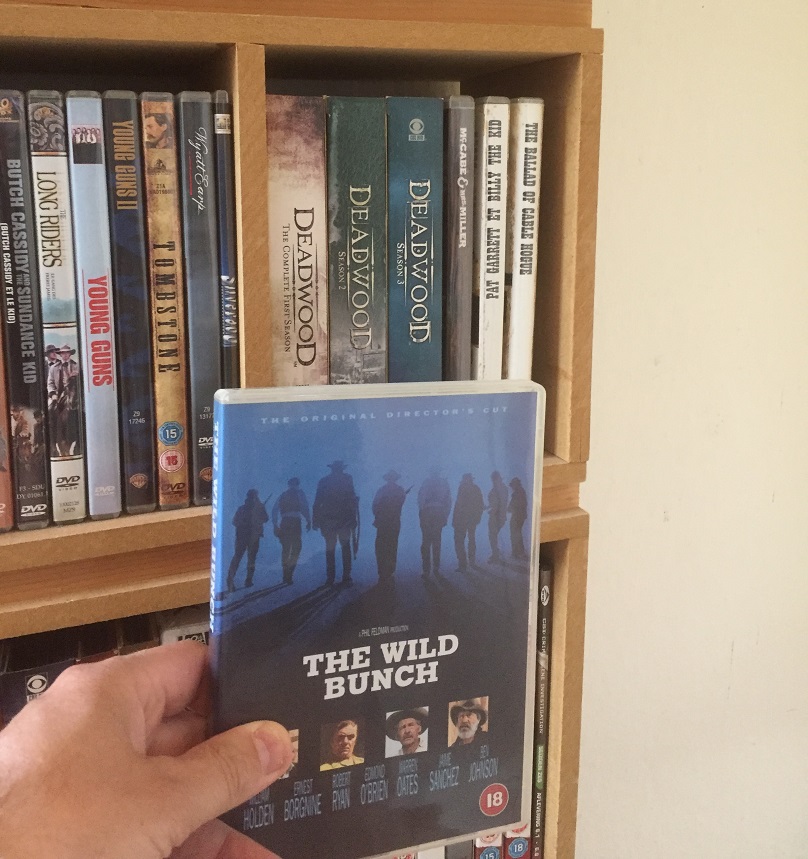
Dungeon Classics #30: The Wild Bunch

FilmDungeon’s Chief Editor JK sorts through the Dungeon’s DVD-collection to look for old cult favorites….

The Wild Bunch (1969, USA)

Director:
Sam Peckinpah
Cast: William Holden, Ernest Borgnine, Robert Ryan
Running Time: 145 mins.

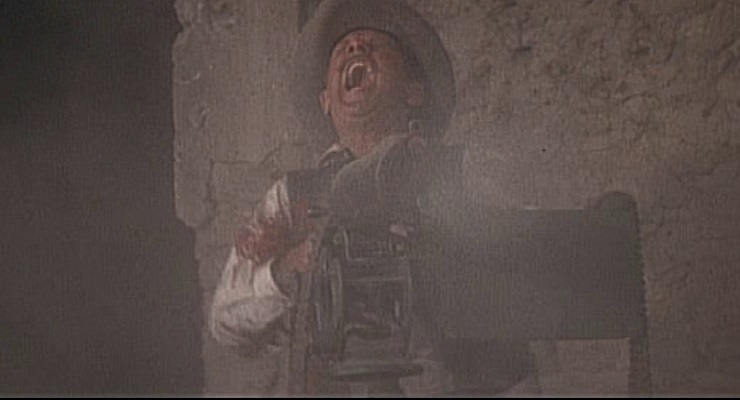
Pike Bishop (William Holden) is an aging outlaw who runs a gang called the Wild Bunch in the new American West of 1913, a time of trains and automobiles in which they no longer seem to fit. They get ambushed during their latest score and flee to Mexico, while being hunted by bounty hunters led by one of their former gang members (Robert Ryan). Once in Mexico, they agree to rob a train and steal weapons for a corrupt general after which Pike plans to retire. But if you think the Wild Bunch will disappear quietly into the night, you’re in for a very noisy surprise! The Wild Bunch was controversial at the time for the graphic violence on display and immoral characters in the lead. This was new indeed and clearly an inspiration for filmmakers like Quentin Tarantino. The movie looks and feels very gritty and raw, and the bloody bullet festival in slow motion at the end is a masterful sequence: one of the all-time greatest scenes in cinema history! Fun trivia: actor Robert Ryan was constantly whining to director Peckinpah that he wanted first billing. The director punished him by listing him third on several horses’ asses.

Dungeon Classics #28: Dead Man

FilmDungeon’s Chief Editor JK sorts through the Dungeon’s DVD-collection to look for old cult favorites….

Dead Man (1995, USA, Germany, Japan)

Director: Jim Jarmusch
Cast: Johnny Depp, Gary Farmer, Crispin Glover
Running Time: 121 mins.

A meek accountant called William Blake (Johnny Depp) travels through the old West. His destination is a place called Machine where he is supposedly hired for a job. But is this journey real, or is it a metaphorical journey undertaken by a dead man? He is in hell, a fellow passenger assures him. Things don’t get better when he arrives in Machine. There is no job for him, and he is soon forced to kill a man in self defense, which leads to him becoming a wanted man. He is then taken on a journey to nowhere by an Indian called nobody who believes he is the poet William Blake. Underway, he meets a long list of stupid white men to kill, played by well known actors/artists, including Lance Henriksen, Michael Wincott, Iggy Pop and Alfred Molina. Dead Man is a so-called acid western, a subgenre of the western that ‘subverts many of the conventions of earlier Westerns to conjure up a crazed version of autodestructive white America at its most solipsistic, hankering after its own lost origins’ (Wikipedia). It is another mesmerizing piece of art by writer-director Jim Jarmusch. The beautiful black and white imagery, accompanied by a moody electrical guitar score composed and performed by Neil Young, serves to create a truly unique atmosphere. Dead Man is best described as film as poetry. The images are the words and – like the poetry of William Blake – powerful words they are.