Compañeros

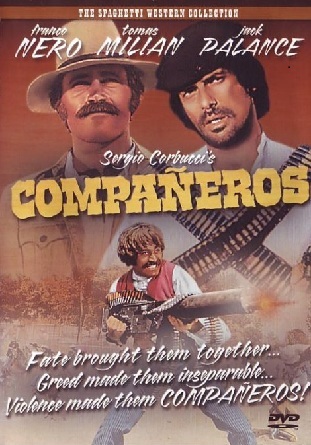
Director: Sergio Corbucci
Written by: Sergio Corbucci, Massimo De Rita, Fritz Ebert, José Frade, Dino Maiuri
Cast: Franco Nero, Tomas Milian, Jack Palance, Fernando Rey

Year / Country: 1970, Italy / West Germany / Spain
Running Time: 120 mins.

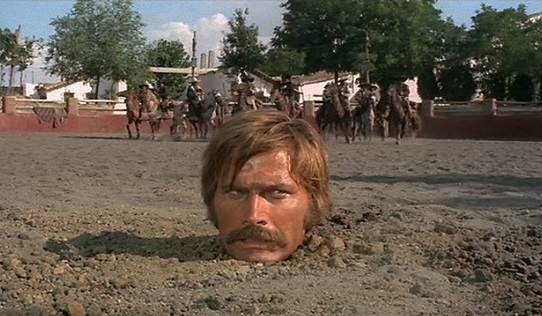
In a country torn apart by revolution, an unlikely duo teams up. The not too bright Mexican bandit Vasco (Tomas Milian) and the very polite arms dealer ‘The Swede’ (Franco Nero) go on a mission for the money hungry General Mongo. Their goal is to free Mongo’s pacifistic opponent Professor Xantos from a Texan jail because he knows the combination of a loaded safe. The two hate each other, so there is plenty of double-crossing along the way.

This spaghetti western, directed by the other Sergio, is an early buddy movie featuring two of the most established spaghetti western actors. The music is – of course – composed by Ennio Morricone and Jack Palance plays a very interesting supporting role as marijuana addicted gunslinger.

The movie misses the sharp humour and emotional depth that made genre films such as Django and the Dollar-trilogy so enjoyable, but it is certainly not the worst spaghetti western. The two strong leads fight, joke and shoot their way through a series of engaging adventures. The many last minute rescue scenes become kind of repetitive, so Corbucci could have been doing some heavier cutting. But, like the Mexican revolution, the movie ends in a massive shoot-out which is certainly worth the wait. Viva la Revolution!

Rating:

Biography: Sergio Corbucci (1926, Rome – 1990, Rome) is, alongside Sergio Leone, one of the most renowned directors of Spaghetti Westerns. He played a pivotal role in popularizing the genre, particularly through landmark films such as Django (1966) and Il grande silenzio (1968). Corbucci often collaborated with actor Franco Nero, creating some of the most iconic works of the genre. His films, often categorized as B-movies, are distinguished by their unflinching brutality, surreal and apocalyptic production design, dark humor, and politically left-leaning themes. A committed Marxist, Corbucci infused many of his works with a sense of revolutionary despair, reflecting the futility of social upheaval. Despite his significant contributions to cinema, Corbucci remained rooted in Italy throughout his career, with most of his films receiving limited international distribution. He passed away in Rome in 1990.

Filmography (a selection): Foreign Earth (1954), Water’s Love (1954), Supreme Confession (1957), Angel’s Sky (1957), Duel of the Titans (1961), Toto, Peppino and La Dolce Vita (1961), The Son of Spartacus (1963), Grand Canyon Massacre (1963), Django (1966), Navajo Joe (1966), The Mercenary (1968), The Great Silence (1968), Compañeros (1970), Bandera Bandits (1972), The White, the Yellow, and the Black (1975), The Payoff (1978), Super Fuzz (1980), My Darling, My Dearest (1982), Days of Inspector Ambrosio (1988)

Crisis!

In 2008 viel de bank Lehman Brothers om en we hadden een wereldwijde financiële crisis, of wel bankencrisis, te pakken. Dit werd gevolgd door een economische recessie en nu zitten we in Europa in een landencrisis. Wat komt hierna? Immers, als we al drie crisissen gehad hebben, waarom dan nu stoppen? Inderdaad; hierna komt een energiecrisis. We gebruiken nu 90 miljoen vaten olie per dag en opkomende landen zoals China gaan steeds meer energie consumeren. De prijs van olie zal dus enorm gaan stijgen, want de oliemaatschappijen kunnen steeds moeilijker voldoen aan de toenemende vraag. Het zal niet lang duren voordat deze vierde crisis begint.

Ik weet nog dat jonge mensen in 2008 geen idee hadden wat ze van de crisis moesten verwachten. Ik zelf ook niet overigens. We hebben toch te eten? We hebben onze banen nog, dus het lijkt in de verste verte niet op het beeld van de grote depressie uit de jaren 30’. Maar inmiddels is het voor bijna iedereen wel voelbaar wat een crisis inhoud. Salarissen zijn bevroren. Er zijn minder vacatures. De overheid gaat miljarden bezuinigen. Alles gaat op de schop. Bijvoorbeeld de kunst en cultuursector. Het Internationale Film Festival Rotterdam, waar ik trouw bezoeker en oud-werknemer ben, stuurde me gisteren bijvoorbeeld een brief. Of ik een donatie wil doen. Ze zijn niet de enige. Verre van.

Europa zit in, wat ze wel noemen The Great Stagnation; een lange periode van lage tot geen economische groei. Deze periode kan wel eens 10 tot 15 jaar gaan duren. Landen en banken moeten herstructureren, wat veel tijd kost, en bedrijven krijgen te maken met nieuwe en sterke competitie uit groeimarkten. Het is niet meer dan logisch; je kunt als land of continent niet blijven groeien. Op een gegeven moment komt er een landing, en dit is in Europa nu gebeurd. Ach, we moeten niet zeiken; we hebben het nog altijd hartstikke goed vergeleken met een heel groot deel van de wereld. Daarnaast is een heel groot voordeel van de crisis dat mensen er creatiever van worden. En dat kunnen we goed gebruiken in een land wat behoorlijk verwend en materialistisch is geworden.

Dus, we kunnen ons opmaken voor een lange periode van economische stilstand! Ik zou er zelf bijna blij van worden. Maar dat gaat misschien wat te ver. Laat ik het erop houden dat back-to-basics een hele heilzame werking kan hebben op de samenleving en het bedrijfsleven. Een vakantie en een iPadje minder kunnen de meeste Nederlanders prima hebben.

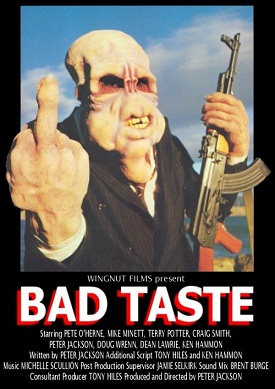
Bad Taste

Director: Peter Jackson
Written by: Ken Hammon, Tony Hiles, Peter Jackson
Cast: Terry Potter, Pete O’Herne, Craig Smith, Mike Minett

Year / Country: 1987, New Zealand
Running Time: 88 mins.

The Lord of the Rings isn’t the only movie-project Peter Jackson worked on for years. His debut Bad Taste, an amateur movie turned cult classic, took him four years to complete. Jackson and his friends shot it on weekends. The title says it all; a clan of extraterrestrials, under management of Lord Crump of Crump’s Country Delights, land in New Zealand because they think that with the delicacy of human flesh they will conquer the universe. But the government sends an anti-alien force and it’s splatter galore.

Bad Taste was filmed with amateur cameras and it shows. Still, because of Jackson’s dedication and perfectionism, the movie runs like clockwork; the steadicam shots and editing are done excellently. Also the improvised – no budget – special effects are very impressive. It’s even got an exploding sheep! True New Zealand style. You don’t have to look very closely to see that Jackson is a young master at work here. With his very own airbrush I might add. The gore is definitely not suitable for all stomachs.

Jackson felt he couldn’t let his friends do all the acting, so he took on one of the main parts himself. Derek (“Derek’s don’t run”) is a twisted maniac, who’s so devoted to saving planet Earth, that he is willing to kill and torture as many aliens as he can in the process. He is having as much twisted fun as his creator is. Jackson said in an interview one time that he would love to make Bad Taste 2. Let’s hope that he does, because it will be a blast to see Derek and the boys take on a new Lord Crump. “Those bloody bastards!”

Rating:

Biography: Peter Jackson (1961, Pukerua Bay, New Zealand) started making films at around the age of eight. His early short films already featured special effects that would become one of Jackson’s trademarks. Together with friends and family he worked on his first feature length movie Bad Taste which took him four years to complete. What had started as a joke became a cult classic and opened many doors for Jackson. He then made a number of professional horror films, including genre classic Braindead. Then he embarked on one of the most ambitious movie projects of all time; The Lord of the Rings trilogy. Jackson succeeded with glory and the three LOTR films were enormously successful. He continued with a remake of the film that inspired him the most as a filmmaker: King Kong.

Filmography (a selection): The Valley (1976, short) / Bad Taste (1987) / Meet The Feebles (1989) / Braindead (1992) / Heavenly Creatures (1994) / Forgotten Silver (1995) / The Frighteners (1996) / The Lord of the Rings: The Fellowship of the Ring (2001) / The Lord of the Rings: The Two Towers (2002) / The Lord of the Rings: The Return of the King (2003) / King Kong (2005) / The Lovely Bones (2009) / The Hobbit: An Unexpected Journey (2012) / The Hobbit: The Desolation of Smaug (2013) / The Hobbit: The Battle of the Five Armies (2014) / They Shall Not Grow Old (2018, doc) / The Beatles: Get Back (2021, TV Mini Series)

Once Upon a Time in America


As boys, they said they would die for each other. As men, they did.

Directed by:
Sergio Leone

Written by:
Harry Grey (book ‘The Hoods’)
Leonardo Benvenuti (screenplay)
Piero De Bernardi (screenplay)
Enrico Medioli (screenplay)
Franco Arcalli (screenplay)
Franco Ferrini (screenplay)
Sergio Leone (screenplay)

Cast:
Robert De Niro (David ‘Noodles’ Aaronson), James Woods (Maximilian ‘Max’ Bercovicz), Elizabeth McGovern (Deborah Gelly), James Hayden (Patrick ‘Patsy’ Goldberg), William Forsythe (Philip ‘Cockeye’ Stein), Tuesday Weld (Carol), Treat Williams (James Conway O’Donnell), Scott Tiler (Young Noodles), Rusty Jacobs (Young Max / David Bailey), Jennifer Connelly (Young Deborah)

In the late 1970s, master director Sergio Leone turned down the offer to direct The Godfather in order to make another gangster film, this one based on the novel ‘The Hoods’ by former mobster Harry Grey. When filming was completed, the total footage ran between eight and ten hours. Leone and editor Nino Baragli trimmed it down to around six hours, intending to release the film as two three-hour features. The producers, however, rejected this idea and cut the film down to just over two hours for the American market. In doing so, they also abandoned the film’s non-linear structure, rendering the story almost incomprehensible. Unsurprisingly, the film flopped in the U.S., and Leone was left devastated.

Fortunately, a 3-hour and 49-minute version was prepared for international release, with the original non-chronological storytelling restored. Audiences overseas responded more positively, and many critics recognized it as a cinematic masterpiece. With his spaghetti westerns, Leone revealed the gritty, opportunistic side of the Old West. Here, he does the same for the American city ruled by mobsters. He strikes exactly the right tone. His sprawling gangland epic shows a world that may sparkle with a thin coat of glamour, but beneath that lies grime and plenty of it.

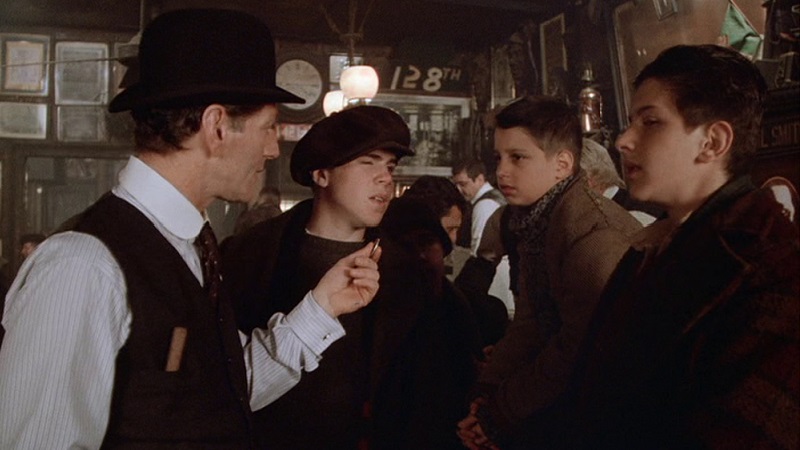
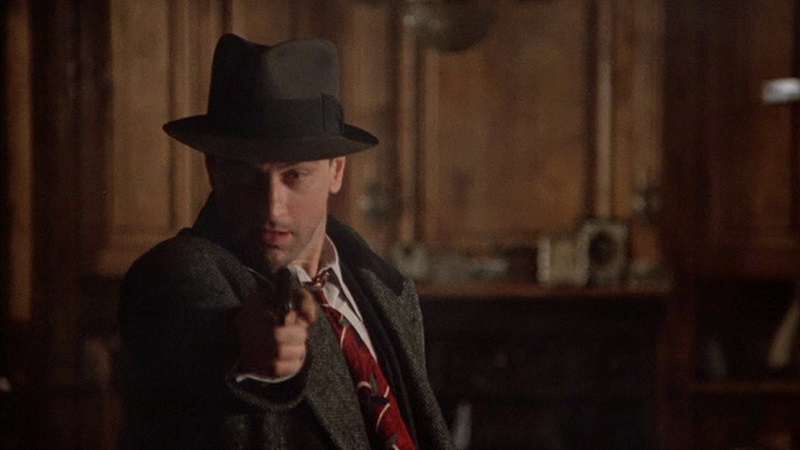
The narrative jumps across time, following Jewish gangster Noodles (Robert De Niro) through three phases of his life. First, his youth in the Lower East Side, where he meets his lifelong friend, the cunning but volatile Max (James Woods). In their prime during the Prohibition era, the two – along with childhood friends – rise to control a lucrative bootlegging operation. But tensions rise, and their friendship deteriorates with devastating consequences. In the third act, Noodles returns to New York as an old man after 35 years, confronting the ghosts of his past.

The fragmented screenplay may not feel intuitive, but it doesn’t need to be. The film works on a dreamlike, emotional logic. Many interpret the second half as nothing more than an opium-induced fantasy – a fugue state in which Noodles imagines a resolution, a reckoning, and perhaps a redemption that never truly came. It’s an ambiguous, melancholic meditation on memory, regret, and American myth. This is not a typical rise-and-fall gangster story; it’s about life itself. The psychological depth is extraordinary. Few films give you such an encompassing sense of a person’s entire existence: memories, pain, joy, death and, of course, love.

As with Leone’s finest work, the film is packed with haunting, unforgettable moments: Max and Noodles beaten in the alley, Noodles’ opium haze in the Chinese theater, Little Dominic dying in Noodles’ arms (“Noodles, I slipped”), and Noodles peeking through the wall at Deborah’s dance rehearsal. The art direction and cinematography render every frame like a painting, each one worthy of being hung on a wall. In that sense, this is Leone’s The Godfather.

Together with composer Ennio Morricone, Leone achieves true cinematic synergy. The film’s pacing often mirrors the rhythm of Morricone’s hauntingly beautiful score, enhancing the emotional impact to mesmerizing effect. The casting is another strength: De Niro brings nuance and reluctant sympathy to a deeply flawed anti-hero, while Woods is chillingly effective as Max. Strong supporting roles are delivered by Jennifer Connelly, Joe Pesci, Tuesday Weld, and Burt Young.

Though it may have its imperfections, Once Upon a Time in America remains a towering, influential achievement. Leone spent over a decade bringing this vision to life and it shows. It’s a shame it turned out to be his final film, but few directors could hope to end their career with something so ambitious, haunting, and unforgettable.

Rating:

Quote:
NOODLES: “You can always tell the winners at the starting gate. You can always tell the winners and you can tell the losers.”

Trivia:
Robert De Niro suggested that James Woods wear a set of perfect, bright white teeth to demonstrate Secretary Bailey’s wealth and vanity. The producers balked at the cost, so De Niro paid for them himself.