Bruce Campbell: A B-Moviestar’s Biography

For every George Clooney and Steven Spielberg, there are thousands of working class slobs in Tinsel Town. Bruce Campbell’s biography ‘If Chins Could Kill: Confessions of a B-Movie Actor’ is a homage to this B-crowd. Bruce who? That’s the point exactly. For those of us who grew up on a diet of classy horror movies in the eighties and nineties, he is a household name, for he was the star of one of the greatest horror series of that era: the holy Evil Dead trilogy (consisting of The Evil Dead, Evil Dead II and Army of Darkness).

‘If Chins Could Kill’ tells Bruce’s story. It was first published in 2001, so it doesn’t include the television adaptation of Evil Dead called Ash Vs. Evil Dead, but that’s no problem; there are plenty of great stories preceding that terrific cult show. In chapter 1, Campbell describes his childhood in Detroit, Michigan, with his parents and two older brothers. They did their fair share of monkeying around, and then good old Bruce became interested in girls. It became a lifelong obsession.

As he grew older, he had to find a way to keep on having fun. He discovered that his father Charles was an actor in a local theater. At age 14, Bruce joined the group and he soon played his first roles on stage. In the years that followed, he met various would-be actors and filmmakers, including one who would make it really big: Sam Raimi. After shooting a bunch of pretty cool 8 MM amateur films, Campbell, Raimi and another guy called Robert Tapert wondered: can we make a profession out of this?

The junior film crew decided to focus on the horror genre, because of the low budget required. For inspiration, they watched many horror shows at the drive-in theater and got a good sense of what audiences liked (when do they laugh? When do they scream?). Then they shot Within the Woods, the short predecessor of The Evil Dead. Their next challenge was a considerable one; they had to raise 150.000 dollars to be able to shoot their first feature length horror movie on 16 MM film (which they would afterwards blow up to 35 MM for cinema screenings) and to cover all other expenses. This seemed impossible, but they bought suits, went to work, and eventually raised the money.

After a grueling 12-week shoot in a run-down cabin in the woods of Tennessee, they canned the film, and luckily for the private investors, they delivered a genre classic. It turned out that its director was a genuine talent in visual storytelling, and Campbell undeniably a true horror star. True to the aim of his book, Campbell describes all the collaborators and the challenges they had to overcome to get this movie made. None of the other actors continued acting after The Evil Dead and all pursued other occupations.

If you’re serious about shooting a low budget movie, you should definitely read this book. It contains many tips on raising money, and then actually shooting it with hardly any resources. After that come the reshoots, the editing and sound editing, and then comes an even tougher part: marketing and selling the damn thing. Luckily for the crew, Stephen King saw their film at a movie event and wrote positively about it. His recommendation did miracles for the marketing of what was originally known as Book of the Dead, an unmarketable title; people might think they’d have to do reading at the screening. The investors of the retitled The Evil Dead made their money back, but the boys didn’t make anything. Yet, they now had a film under their belt.

What followed was the major flop Crimewave, co-written by The Coen Brothers. Campbell didn’t get a whole lot of work after that. He was in a soap series where he met his wife to be (a fragment from this show can be seen in Fargo, in the scene in which sociopath Gaear is watching television in the cabin). Crimewave could have been a career ender in Hollywood, but they had a fallback project: doing a sequel to the successful Evil Dead. Evil Dead II: Dead By Dawn (1987) became a legendary sequel and it is still considered to be among the greatest horror films ever made (it’s second on my top 10 horror list).

Still, Campbell – despite having played a lead role in a popular film – was no mainstream star and had to work as a security guard to make ends meet (“hey, you’re that guy from Evil Death, say that groovy line”). He also got divorced and met his new wife (a make-up artist) at a movie set. Campbell’s career would be closely tied to Raimi’s and in 1993, they would complete the trilogy with Army of Darkness. If you’ve ever wondered how much Bruce made with starring in the lead role in this movie ( I did!), the answer is in this book. It’s 500 K. This seems like an okay sum, but you have to subtract 25 percent for agents and managers leaving 375.000. Then deduct taxes (federal and state at the highest level) and you’re left with 187.500. Because he was recently divorced, his wife got half leaving Bruce with 93.750. This is still a lot of money, but considering it was two years work, he made just 46.875 a year, which is not what you’d expect a movie star (even a B-movie star) to make.

Still, Campbell continued to find work and most importantly: have fun. Especially when he went to New Zealand to work as actor and director on the tv-show Hercules: The Legendary Journeys and spin-of Xena: The Warrior Princess. In Campbell’s words: “shooting this show in New Zealand, away from studio interference, brought me back to the fun of filmmaking, like when we were shooting 8 MM movies back in Michigan.”

Read also: Ash vs Evil Dead: 5 Greatest Moments

Book: Peter Jackson & the Making of Middle-Earth

By Jeppe Kleijngeld

The Lord of the Rings trilogy has been the biggest movie event of my generation. By far. Strange to think that it almost didn’t happen. An initial 200 million dollar budget for the director of splatter horror Bad Taste (one of my favorites), was too much of a risk for any Hollywood studio to take. Then Bob Shaye, CEO of New Line Cinema, took a giant leap of faith….

Ian Nathan’s Anything You Can Imagine describes Peter Jackson’s heroic quest that started more than 20 years ago. After he had completed Heavenly Creatures – a critical success that showed he could handle an emotional story – and ghost movie The Frighteners – that lead to the foundation of special effects houses Weta Digital and Weta Workshop in New Zealand – the now hot director selected Rings as one of his new projects to pursue (the others were new versions of two ape classics: King Kong and Planet of the Apes).

Development of The Lord of the Rings started off at Miramax, together with the notorious Weinstein brothers who approached the project with numerous Tony Soprano tactics. Especially Harvey. Problems arose when the Weinsteins couldn’t raise more than 75 million dollars for the initial plan of a two movie adaptation which wasn’t nearly enough. After Jackson understandably refused to make it into one large movie, the Hollywood mogul and Kiwi director had a fall out. Then Jackson’s US manager Ken Kamiss negotiated with Harvey Weinstein and they got four weeks to strike a deal with another studio. This became the now legendary deal with New Line Cinema, who gambled the studio’s future on the project. It was New Line’s Bob Shaye who suggested they make it into three rather than two movies. The Weinsteins got a great bargain out of it: big time profits and their names on the movies’ credits.

So began the longest and most exhaustive production in the history of motion pictures. No studio had ever attempted to shoot a whole trilogy in one go, for good reasons. “Had we known in advance how much we would have to do, we would have never done it”, said Jackson. But a strong passion and drive by the entire cast and crew to bring Tolkien’s world to the big screen in the best possible way they could, eventually lead to a glorious result. Nobody expected it to become that good.

I remember being completely blown away at every screening back in 2001, 2002 and 2003. These movies are absolutely perfect. The first time I saw the fellowship march on Howard Shore’s brilliant score. The wondrous Gollum crawling into frame in the beginning of The Two Towers. The Rohirrim’s epic assault at the Pelennor Fields… And so many other magic moments forever branded in the collective cinematic consciousness. Jackson gave me and my generation a cinematic experience that could match, or even exceed, the excitement of the original Star Wars trilogy.

In The Two Towers, when Gandalf returns from death, he explains to his baffled friends: “I have been sent back until my task is done.” These words are not directly from Tolkien, but from screenwriters Fran Walsh, Peter Jackson and Philippa Boyens. They emphasized fate as one of the core themes of the story: “Bilbo was meant to find the ring. In which case you were also meant to have it. And that is an encouraging thought.” However pragmatic these New-Zealanders may be, fate was their compass in making those movies. Many chance encounters paved the way, major obstacles arose during production, but they overcame them all. It took the toughness of the bravest of hobbits to drive this one home. Even the conservative Academy didn’t fail to notice what they accomplished, and The Return of the King was awarded 11 major Oscars (except those for acting, the outstanding ensemble cast made it tough to single out any one actor).

Years later, fate lead to Jackson directing The Hobbit and so he had the ‘once in a lifetime experience’ twice (but there won’t be a third time, he has said). Jackson and his loyal team never expected to make better movies than Rings. They made The Hobbit to satisfy the fans. And they did for most part. To them, Jackson is a hero. A maverick filmmaker with an unique vision and the drive and mental toughness to accomplish things previously undreamed of. Jackson and his fellowship of collaborators reminded Hollywood on how to make really major cinema. They also put New-Zealand firmly on the map as country where movies and special effects are dreamt up.

Because special effects are Jackson’s big thing. He discovered the magic of filmmaking when he was nine years old and saw the original King Kong on television. Since that moment, he worked non-stop on creating special effects in his garage and eventually he completed a whole movie (Bad Taste) which became a cult hit. However successful his career got since, he never stopped aiming to satisfy that nine year old boy. In making The Lord of the Rings, he focused on making movies that he would enjoy himself. Even though he is a brilliant, technical craftsman and storyteller, his youthful energy is what really catapults his films from merely good to terrific.

With The Lord of the Rings, he wrote movie history. Anything you can imagine perfectly captures this history of how an outsider succeeded wildly in Hollywood. Much like the heroes of his story, he did it by staying true to himself. He may not have had to face the horrific challenges Frodo had, but at times it certainly came close. Sometimes you need an unlikely hero to change the course of history. And very much like his protagonist Frodo Baggins, Peter Jackson certainly fits that bill.

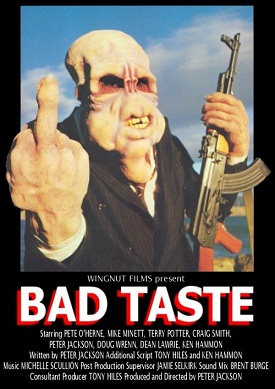
Bad Taste

Director: Peter Jackson
Written by: Ken Hammon, Tony Hiles, Peter Jackson
Cast: Terry Potter, Pete O’Herne, Craig Smith, Mike Minett

Year / Country: 1987, New Zealand
Running Time: 88 mins.

The Lord of the Rings isn’t the only movie-project Peter Jackson worked on for years. His debut Bad Taste, an amateur movie turned cult classic, took him four years to complete. Jackson and his friends shot it on weekends. The title says it all; a clan of extraterrestrials, under management of Lord Crump of Crump’s Country Delights, land in New Zealand because they think that with the delicacy of human flesh they will conquer the universe. But the government sends an anti-alien force and it’s splatter galore.

Bad Taste was filmed with amateur cameras and it shows. Still, because of Jackson’s dedication and perfectionism, the movie runs like clockwork; the steadicam shots and editing are done excellently. Also the improvised – no budget – special effects are very impressive. It’s even got an exploding sheep! True New Zealand style. You don’t have to look very closely to see that Jackson is a young master at work here. With his very own airbrush I might add. The gore is definitely not suitable for all stomachs.

Jackson felt he couldn’t let his friends do all the acting, so he took on one of the main parts himself. Derek (“Derek’s don’t run”) is a twisted maniac, who’s so devoted to saving planet Earth, that he is willing to kill and torture as many aliens as he can in the process. He is having as much twisted fun as his creator is. Jackson said in an interview one time that he would love to make Bad Taste 2. Let’s hope that he does, because it will be a blast to see Derek and the boys take on a new Lord Crump. “Those bloody bastards!”

Rating:

Biography: Peter Jackson (1961, Pukerua Bay, New Zealand) started making films at around the age of eight. His early short films already featured special effects that would become one of Jackson’s trademarks. Together with friends and family he worked on his first feature length movie Bad Taste which took him four years to complete. What had started as a joke became a cult classic and opened many doors for Jackson. He then made a number of professional horror films, including genre classic Braindead. Then he embarked on one of the most ambitious movie projects of all time; The Lord of the Rings trilogy. Jackson succeeded with glory and the three LOTR films were enormously successful. He continued with a remake of the film that inspired him the most as a filmmaker: King Kong.

Filmography (a selection): The Valley (1976, short) / Bad Taste (1987) / Meet The Feebles (1989) / Braindead (1992) / Heavenly Creatures (1994) / Forgotten Silver (1995) / The Frighteners (1996) / The Lord of the Rings: The Fellowship of the Ring (2001) / The Lord of the Rings: The Two Towers (2002) / The Lord of the Rings: The Return of the King (2003) / King Kong (2005) / The Lovely Bones (2009) / The Hobbit: An Unexpected Journey (2012) / The Hobbit: The Desolation of Smaug (2013) / The Hobbit: The Battle of the Five Armies (2014) / They Shall Not Grow Old (2018, doc) / The Beatles: Get Back (2021, TV Mini Series)