The Story of Film: Time Traveling For the Cinemad

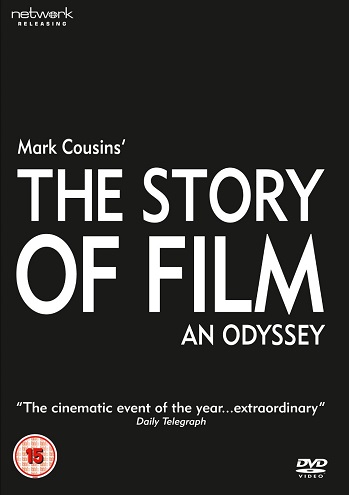
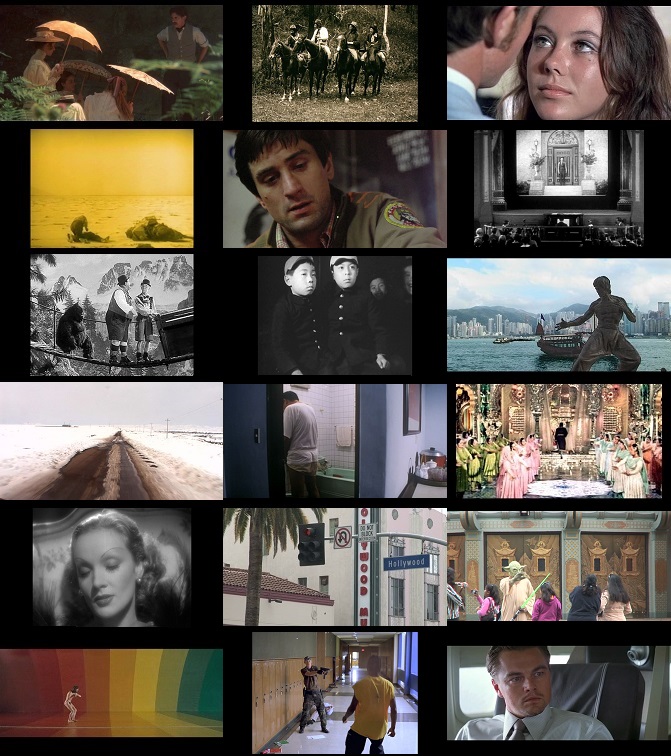
It had to be done someday; making a literal odyssey through the history of cinema and documenting it into a film. The traveller is Mark Cousins. The film is a 15 hour documentary called ‘The Story of Film’. Through cinematic innovation, the story of film is told, from the silent era to the multimillion dollar digital age, covering all continents, major cinematic hallmarks and most talented people in cinema.

The Story of Film 1

The beginning
In 1885 George Eastman of Kodak came up with the idea of film on a role. Then Edison figured that if you spin the images in a box you get the illusion of movement. Lumiere went on to invent the film projector and with that: Cinema! It is not difficult to imagine the excitement of those first screenings. When cinemas started appearing everywhere, it enabled people – who did not travel back then – to see other countries. Not just places, but other worlds. Like what the position of woman was in other countries.

After the invention came the content. And despite of what many believe, it is not the money men that drive cinema. They can’t. Because what you need is the visual ideas, and a clear understanding of what is in people’s hearts. It is psychology that became the driving force of film if anything.

Cousins continues to show us the birth of basic cinema language and techniques that are now common, such as editing, the close up, tracking shots and flashbacks. The road trip then takes us further to the places and the people that brought life to this sublime art form.

1910s
In this period a lot was happening in Scandinavia. Maybe it was the Northern Light, Cousins comments. Or the sense of destiny and mortality in Scandinavian literature that made Danish and Swedish movies more graceful and honest. In 1906 the first feature film was shot in Australia: ‘The Story of the Kelly Gang’. The first feature film in Hollywood was ‘The Squaw Man’ (1914). In 1911 the first movie studio was build. Another interesting thing about this period was that a lot of women were working in Hollywood writing and directing, such as Lois Weber and Alice Guy. They did not always get the credits though.

1920s
In Hollywood, cinema became big business in this period (and a men’s world as well). The 1920s saw the birth of an industry in Hollywood. But the studio system did not get in the film, according to Stanley Donen (director ‘Singing in the Rain’). There were also rebels that emerged – like Orson Welles – that tried to break the bubble. In Europe, cinema developed also. Thematically, the city was often the Big Evil. Think for example ‘Metropolis’ and ‘Sunrise: A Song of Two Humans’. In Japan it was as if the Japanese filmmakers tried to compensate for the massacres their country caused by making very humanistic films. In 1921, the first great Japanese movie was made: ‘Souls on the Road’.

1930s
A lot of innovations were introduced in the 1930s like sound and the use of two camera’s with overhead lighting. From Hollywood came horror movies like ‘Frankenstein’ which borrowed heavily from Germany (Der Golem). And the first gangster pictures appeared, which is an original American genre. The cartoon also arrived and was a very successful new genre. Mickey Mouse was a smash hit and in 1937 came the even more successful ‘Snow White and the Seven Dwarfs’. In Britain, the legendary Alfred Hitchcock started working. He understood the basic human emotion ‘fear’ like no other, and his films are still extremely influential to this day.

1940s
The war years meant less glory, and more gloomy films. In Italy we witnessed the birth of neo realism. The sensational ‘The Bicycle Thieves’ (1939) is a movie that best illustrates this style. In 1941 came ‘Citizen Kane’ – a film that is still often considered by many as one of the greatest movies of all time. It used deep staging so audiences could choose where to look. This was previously used in films like ‘Gone With the Wind’ (1939) and ‘Stagecoach’ (1939), which Welles said to have seen 39 times. A dark genre arrived in Hollywood, called Film Noir. These films, such as ‘Double Indemnity’ usually had characters with flaws that drove them towards their faith, even while they tried to avoid it. The decade ended as depressing as it began with a massive communist hunt in Hollywood: the studios had to fire the (alleged) lefties. This is still a major trauma in Hollywood.

1950s
In America in the fifties, we had the suburban, Christian society. But under the surface there was anger, frustration and tension. Classic films like ‘On the Waterfront’ (1954) and ‘Rebel Without a Cause’ (1955) best illustrate this. In Europe four legendary directors led the way in changing cinema. They were Jacques Tati, Robert Bresson, Ingmar Bergman and Federico Fellini, and they made films more personal and self aware than they had ever been. The era ended with the new wave to which French director Jean-Luc Godard belonged and in Italy Pier Paolo Pasolini. The later used religious music for everyday struggles. He felt consumerism was taking over.

The Story of Film 2

1960s
Sergio Leone made his first ‘spaghetti western’ (Italian made Western) and introduced deep focus, which was made possible by the Italian cinematic invention technoscope in 1960. This gives Leone’s movies an epic feel to them. Thematically, Leone was inspired by Japanese Master Akira Kurosawa (lone gunman / lone samurai). Filmmaking went global in the sixties. In Eastern Europe, directors like Roman Polanski and Milos Forman started their careers. In the Soviet Union, one of the greatest directors ever started working: Andrei Tarkovsky, who knew how to create remarkable imagery. According to Tarkovsky: ‘Imagery contains an awareness of the infinite.’ Late sixties, film schools were popping up all around the USA and a new generation was on its way.

1970s
After the realism in movies in the sixties, the seventies saw a return of old fashioned, romantic and entertaining cinema – and of the box office smash hits, think ‘Star Wars’, ‘The Exorcist’ and ‘Jaws’. ‘The Godfather’ was the return of an old Hollywood genre: the gangster film. New kids were fighting to open up new form, most notably Martin Scorsese with ‘Taxi Driver’ and ‘Mean Streets’. When people think of the seventies, they think about Spielberg, Lucas, Coppola and Scorsese. But there was more. In i.a. Britain and Italy, identity was a major theme. In Germany, Rainer Werner Fassbinder (woman in closed places) and Wim Wenders (men in open spaces) had their glory years. And Werner Herzog the explorer went across the world. He was not so much interested in the feminism or Americana of his contemporaries, but in prime evil life. After John Ford, he is the most important landscape filmer in the history of film. The 70’s also saw the arrival of Asian mainstream, epic films from India (‘Sholay’) and a lot of cinematic activity in Africa.

1980s
After the magnificent seventies came the not-so-great eighties. ‘Protest’ is the central theme of this decade. The 5th generation in China – Chen Kaige and Zhang Yimou – made interesting movies. From Russia came one of the greatest war movies: ‘Come and See’. In America, ‘Top Gun’ was a smash hit, and many movies were influenced by music video’s, like ‘Flashdance’. In France, filmmakers got more into popular culture, which was a protest in itself. Notable directors that moved up in the film world were David Lynch (with ‘Blue Velvet’) and David Cronenberg in Canada with ‘Videodrome’, a prophetic vision of the modern world in which the real and the televisual are dangerously confused.

1990s
Described by Cousins as the last days of celluloid, before the coming of digital. And directors like Wong Kar Wai and Hou Hsiao-hsien used celluloid devotedly. The 90s saw passionate films about other worlds (‘The Matrix’), but also an obsession about reality, for example in the work of Iranian director Abbas Kiarostami who tried to eliminate all dolly’s and clapperboards from the set. From Japan came horror movies about the fear for technology, like ‘Tetsuo’ about a man blending with metal. In Copenhagen, filmmakers returned to primitive filmmaking with Dogma, while Hollywood saw the increasing use of digital effects (‘Terminator 2’ / ‘Gladiator’ / ‘Jurassic Park’). Not only what was in the camera changed, what happened in front of the camera changed as well. Modern became post-modern: The idea that there are no new truths and everything is recycled. Tarantino made this his trade, but respected established directors, like Scorsese, used it as well.

2000s
Documentaries – like ‘Fahrenheit 9/11’ – did as well as blockbusters and blockbusters tried to be like documentaries. Innovative movies were made in the USA. Like ‘Requiem For a Dream’: The great distortion movie. The subconscious got at work in ‘Mulholland Drive’. And in Thailand: ‘Tropical Malady’, a film that changes from simplistic tale of friendship to the mythical story of the hunter and the hunted. The film reincarnates like its main character. Another innovative example is ‘Russian Ark’, which consists of one 90 minute long take showing Aristocrats walking downstairs in a massive palace towards the slaughter.

And the future of cinema? Who knows. Perhaps one day we can share dreams like in ‘Inception’. One thing is for sure: Whatever form it may take, the art of cinema is here to stay and deserves to be celebrated likes this.

Icon 29 - Movie Camera


- Aanbevolen Divider

Top 10 intro (credit sequences) van TV-series

https://jkleyngeld.wordpress.com/2011/09/07/

5 elementen van een krachtig verhaal

10 management lessons from highly successful gangsters

5 Reasons ‘Scarface’ Rarely Makes it to Critics’ Favorite Lists

Report: Over de moord op JFK

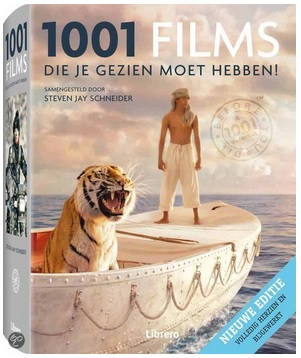
Soms koop ik spontaan een boek om me te inspireren. Laatst viel de keuze op het boek ‘1001 films die je gezien moet hebben’, met op de cover een still van ‘Life of Pi’.

1001 films die je gezien moet hebben

Bij het doorbladeren laatst viel me op dat er niet alleen feature films tussen staan, maar ook een enkele korte film. Daaronder ook ‘Report’ (Bruce Conner, 1967), een 13 minuut durende compilatie van nieuwsbeelden van de moordaanslag op John F. Kennedy.

Waarom is dit volgens het boek zo’n geniaal werk? De beschrijving leest: Op de dag dat John F. Kennedy vermoord werd, begon Bruce Conner televisiebeelden van de moord op film op te nemen. Na vier jaar bijwerken en monteren van het verzamelde materiaal bracht hij de avant-gardistische klassieker ‘Report’ uit.

Op de soundtrack horen we de radio- en televisiecommentaren van die dag, waardoor de gebeurtenis steeds hysterischer wordt. In zijn beelden blijft Connor echter terughoudend. Op het moment van sterven zien we een wit doek en vervolgens een heftige opeenvolging van zwart-wit beelden. Steeds weer verschijnen beelden van de moord – honderden, uit alle mogelijke nieuwsrubrieken, reclames, cartoons en films.

Het lijkt wel of Connor zich vanaf het begin gerealiseerd heeft dat onze hele houding tegenover die gebeurtenis voortkwam uit de manier waarop de massamedia ons onophoudelijk met beelden en geluiden van die dag bestookten. ‘Report’ geeft heel goed de twee tegengestelde reacties op de moord op Kennedy weer: frustratie over het ontbreken van wezenlijke informatie in het audiovisuele archief, en juist het zien van te veel beelden waardoor de complottheorie, in de stijl van Oliver Stone, werd versterkt.

Nog een beetje vaag? Bekijk zelf onderstaande videoessay over Conner’s korte docu-film op YouTube:

Senna

‘That day, I suddenly realised that I was no longer driving conscious. And I was in a different dimension. The circuit for me was a tunnel, through which I was just going, going, going. And I realise I was well beyond my conscious understanding.’
—- Ayrton Senna

Veel racers ken ik niet maar de Braziliaan Ayrton Senna moet wel de beste ooit zijn. De documentaire ‘Senna’ vertelt zijn verhaal.

Senna 2

De ouders van Senna waren behoorlijk welvarend, dus toen ze begrepen dat hun zoon een carrière nastreefde als Formule 1 racer konden ze hem op weg helpen met zijn Go Kart training. Maar het waren zijn talent en vechtlust die hem verder hebben gebracht. Hij wist al heel jong wat hij wilde en lette extra goed op tijdens school, zodat hij thuis meer tijd zou hebben om te karten.

Een commentator: ‘There is only one word that describes Ayrton’s style, and that is ‘fast’. He would take a car beyond its design capabilities. He would brake later, fly into these corners where the car was just over the edge and somehow he would dance a dance with that car to where it stayed on the track.’

Er was maar één team geschikt voor een talent als Senna en dat was McLaren. Daar zaten Ron Dennis, de beste manager in Formule 1, en fransman Alain Prost ‘The Professor’, de beste coureur van dat moment. Hij was wereldkampioen geworden in de jaren voordat Senna bij het team kwam, 1985 en 1986. Het was een wat vreemde situatie bij McLaren, want ineens zaten de twee beste coureurs bij elkaar in het team; Prost in de gevestigde positie, en Senna als jonge hond die deze positie bedreigde.

Op 14 mei 1988 namen Senna en Prost beide deel aan de Grand Prix in Monte Carlo. Het is de dag waar het citaat in het begin van deze blog naar verwijst. Senna lag enorm voor op Prost en toen crashte hij en lag hij uit de race…..

Senna 3

Het zelfvertrouwen van Senna liep die dag een deuk op, maar hij herstelde snel en later in 1988 pakte hij de wereldtitel. De religieuze Senna zegt de aanwezigheid van god gevoeld te hebben toen hij eenmaal op kop lag en wist dat hij de titel ging pakken.

Het jaar daarop begon de relatie tussen Senna en Prost onder hoogspanning te staan met als dramatische conclusie de Grand Prix van Japan waar Senna vanwege een lullige overtreding uitgesloten werd van de resultaten na een bijna onmogelijke overwinning. Prost ging er met de wereldbeker vandoor en de relatie tussen de twee racers kwam ten einde.

Senna kreeg voor de gemaakte overtreding ook een boete van 100.000 dollar en een schorsing van een half jaar door de FIA. Dit was een enorme klap voor hem en hij gaf bijna zijn carrière op als Formule 1 coureur.

De rest van de documentaire volgt de racesport en de verdere loopbaan van Senna gedurende de jaren 90’, een tijd dat reclameborden van Marlboro en Camel het circuit nog domineerden. Het is een verhaal met vele hoogte- en dieptepunten. Senna wint nog vele kampioenschappen, waaronder een hele mooie overwinning in thuisland Brazilië. Maar er is ook een duistere keerzijde aan de sport; het overduidelijke gevaar van Formule 1, maar ook de soms vuile politiek die er achter schuilgaat.

Behalve een verhaal over talent, doorzettingsvermogen, vechtlust en competenties, gaat ‘Senna’ ook nadrukkelijk over deze politiek van de racesport, omdat die zo’n grote invloed heeft gehad op de carrière van Senna. Wie het einde niet kent, maar wel geïntrigeerd is door dit verhaal en Formule 1, ga ‘Senna’ kijken zonder er verder nog iets over te lezen. Het is een van de beste sportverhalen die er is.

Het brein van Albert Einstein (1): Relativiteitstheorie

‘Ons verlangen naar begrip is eeuwigdurend’
Albert Einstein

Hij heeft zijn leven lang geprobeerd licht te begrijpen en hij is daar als geen ander in geslaagd. Toen hij 16 was vroeg hij zich af hoe het zou zijn om op een lichtstraal mee te reizen. De vraag bleef hem 10 jaar lang achtervolgen. De simpelste vragen zijn altijd het lastigste te beantwoorden, aldus Albert Einstein (1879 – 1955).

De documentaire ‘Einstein Releaved’ schetst een beeld van het leven van het natuurkundig wonderbrein. Zijn ideeën over licht, ruimte, tijd en zwaartekracht hebben ons beeld van het universum voor altijd veranderd. Maar wat heeft hij precies bedacht en hoe is hij tot die ideeën gekomen?

Einstein 4

Einstein’s jeugd
De vader van Einstein produceerde dynamo’s, dus de jonge Albert was omringt door elektriciteit en mensen die hem graag dingen uitlegden. Elektromagnetisme was de familie business en de vroege kennismaking met deze natuurkracht maakte dat hij al jong begon met het vormen van zijn briljante ideeën. De fabriek fungeerde als laboratorium waar Einstein dingen kon visualiseren, wat zo belangrijk werd in zijn latere wetenschap.

Hij was een vroege leerling; toen hij 10 was begon hij zijn programma van exponentiele zelfontwikkeling. Hij las ieder boek over wetenschap dat hij kon vinden. Op zijn vijftiende verhuisde hij naar Italië, waar zijn vader zijn fabriek had geheralloceerd. De jonge Albert gaf zijn Duitse nationaliteit op om aan de dienstplicht te ontsnappen. Zijn vader stuurde hem naar Zwitserland om zijn middelbare school af te maken, Hij kwam op een uitstekende school terecht dat een mooi laboratorium had waar Einstein rustig kon kennismaken met de natuurkunde.

Speciale relativiteitstheorie
Toen hij leerde dat licht een elektromagnetische golf is die door de ruimte reist, had Einstein zijn levenswerk gevonden. Over licht werd altijd verondersteld dat het zich gedroeg als een golf die zich door de ether voortbewoog, maar Einstein stelde als eerste wetenschapper dat de ether niet bestond. Uit talloze onderzoeken bleek ook dat licht zich helemaal niet in golven beweegt, maar met constante snelheid, en daarmee een uitzondering vormt op alle andere natuurfenomenen.

Na de universiteit kwam Einstein terecht op een patentenbureau. Deze baan was zijn talent weliswaar niet waardig, maar stelde hem wel in staat te experimenteren met natuurkunde onder en buiten het werk. Zijn ideeën begonnen nu echt vorm te krijgen. In 1905 aanvaarde Einstein dat lichtsnelheid constant was overal in de natuur. Maar als lichtsnelheid constant was, moest er volgens Einstein iets anders zijn dat niet constant was. En hij vermoedde dat dat wel eens ‘tijd’ zou kunnen zijn. Wat als de snelheid van licht constant is, maar het verstrijken van tijd niet?

Dit was een radicale gedachte. Voor iedereen behalve Einstein was tijd absoluut onveranderlijk. Het idee dat tijd onzeker kon zijn was moeilijk te bevatten. Zelfs voor Einstein. Maar tijdens een wandeling met een vriend drong het antwoord tot hem door. Tijd is relatief. Voor iemand die beweegt verloopt hij anders dan voor iemand die stilstaat. In een beroemd experiment zette Einstein twee palen een stuk uit elkaar langs een spoorbaan. Als de bliksem tegelijk in beide palen zou inslaan, zou iemand die er recht voor staat de inslagen tegelijk waarnemen. Maar iemand die in een trein voorbij zou komen, en op het moment van inslag precies tussen de twee palen in zou zijn, zou eerst de ene inslag zien en dan pas de andere. Niet simultaan dus.

Einstein 1

Met dit gedachte-experiment bewees Einstein zijn relativiteitstheorie. ‘Eigenlijk was het heel eenvoudig’, zei Einstein. ‘Het enige wat mijn theorie aantoont is dat tijd voor de één anders verstrijkt dan voor de ander, afhankelijk van de snelheid waarmee de persoon zich voortbeweegt.’ Vijf weken na het experiment had Einstein zijn speciale relativiteitstheorie uitgewerkt. Hoe sneller je beweegt, hoe langzamer je klok tikt vergeleken met een stilstaande waarnemer. Dat betekent dat tijd langzamer verloopt als je in de auto op weg naar je werk bent, dan wanneer je achter je bureau zit. Met 50 kilometer per uur zijn de verschillen echter niet waarneembaar, maar bij grote snelheden wel.

Einstein beantwoorde vervolgens de vraag uit zijn jeugd: ‘Hoe zou het zijn om op een lichtstraal mee te reizen?’ Het antwoord is dat dit nooit zou kunnen, want bij lichtsnelheid krimpt lengte tot nul, en staat de tijd stil.

Huh? Staat de tijd stil? Ja, dat is het meest bizarre aan deze theorie. Als je zou kunnen reizen op lichtsnelheid staat de tijd voor jou stil. Stel je voor dat je een vriend met een raket zou zien opstijgen uit jouw achtertuin en hij zou met lichtsnelheid kunnen reizen – en je zou zijn reis volgen met een telescoop en de afstand is een lichtjaar, dan zou bij zijn aankomst voor jou een jaar verstreken zijn, maar voor hem helemaal geen tijd. Hij zou aankomen op precies hetzelfde moment als hij vertrokken is.

En dat is Einstein’s ontdekking van de speciale relativiteitstheorie.