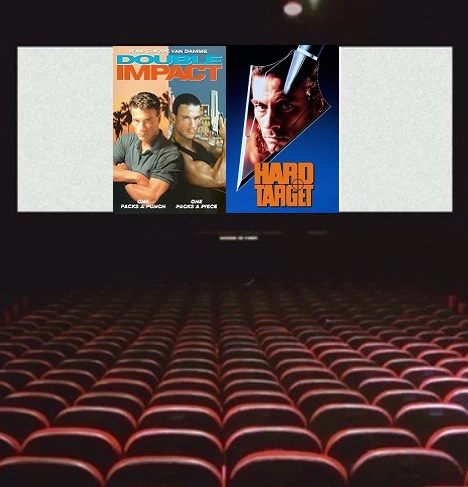
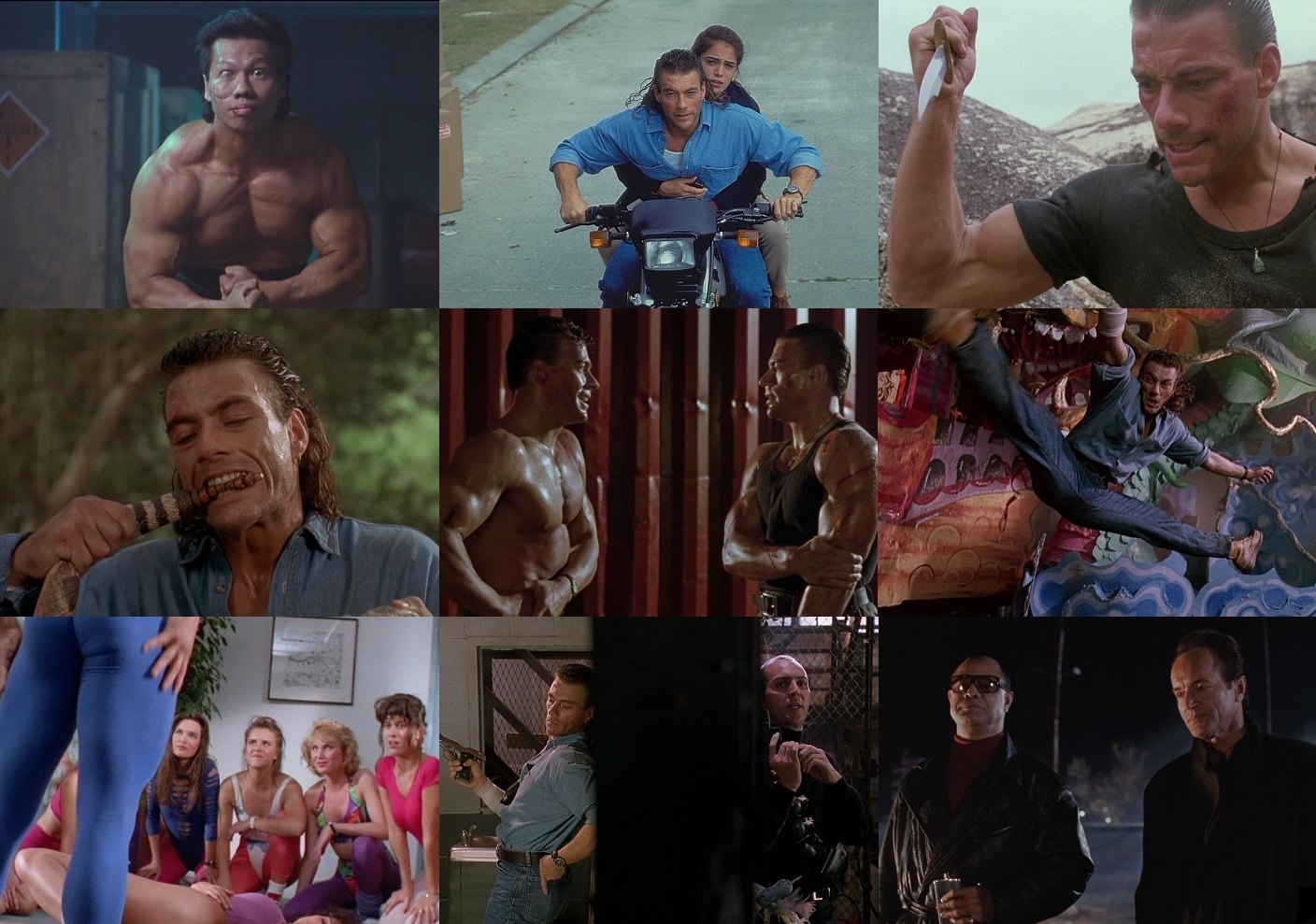
The eighties and nineties, the decades in which I grew up in, was the era of the action movie. And one of its main heroes was Jean-Claude Van Damme (real name: Jean-Claude Van Varenberg). For this Double Bill, I rewatched two of his most enjoyable and nostalgic movies of this period: Double Impact (1991) and Hard Target (1993). In the first one he plays a set of twin brothers, so it has double the Van Damage. The brothers go after a bunch of gangsters in Hong Kong who murdered their parents when they were babies. It has great bad guys, who are stylishly dispatched by the two Van Damme characters using both martial arts and a variety of firearms. The greatest threat is the triad member played by Bolo Yeung, a legendary Chinese martial arts expert who is also in Enter the Dragon and Van Damme’s Bloodsport. The final duel with him is one of the highlights of the movie. The film’s director Sheldon Lettich also directed Wrong Bet in 1990, another Van Damme classic. He is no John Woo, but skillful enough to give the audience what it wants: violent, bloody action and some humor on the side. Hard Target has plenty of this as well, but the choreography of the action scenes is of a whole different level. Van Damme takes on a gang of despicable white men, led by Lance Henriksen, who organize manhunts for the rich and bored. Van Damme’s character Chance grew up in the New Orleans Bayou and knows a thing or two about survival and asskicking. When he becomes the quarry of their next hunt, the roles are quickly reversed and we get to witness some of the most satisfying kills of Van Damme’s career. Hong Kong director John Woo’s American debut was produced by Robert Tappert and Sam Raimi (of Evil Dead fame). It is easy to see why they liked this project: Woo’s visual style is so immensely cool it matches Raimi’s. His action is an art form, a ballet of blood, bullets, explosions, falling bodies and flying kicks in slow motion. These are two classics of the era and highly enjoyable as a Double Bill.
Tagarchief: New Orleans
Bad Lieutenant: Port of Call New Orleans
Director: Werner Herzog
Written by: William M. Finkelstein
Cast: Nicolas Cage, Eva Mendes, Val Kilmer
Year / Country: 2009, USA
Running Time: 122 mins.
Loose remake of Abel Ferrara’s 1992 cult classic. Ferrara was pretty pissed when he heard about it and said he wanted the makers to ‘die in hell’. Nicolas Cage is the deranged central character who uses his badge to do bad things.
In the aftermath of the hurricane Katrina, Terence McDonagh (Cage) saves a convict from drowning which earns him a medal and a major back injury. He starts to take huge amounts of drugs for the pain. It starts with Vicodin, but soon he turns to heroin, cocaine and crack.
After he is promoted to lieutenant, McDonagh starts investigating the murder of a Senegalese family which eventually leads him to local dope boss Big Fate. His increased drug intake in the meantime, causes him to lose grip on reality. He also has a gambling debt that is getting way out of control.
Herzog’s version is a little lighter than Ferrara’s although there are some intense scenes as well, like the one in which McDonagh withholds oxygen from an old lady in a wheelchair to get information out of her. Another difference is that Keitel’s character is terrible from the beginning, while McDonagh degenerates more gradually during the film.
Cage is in one of his more weird modes, and it is a lot of fun to watch. So are his hallucinations of lizards and the sweet interactions with his girlfriend, the prostitute Frankie (Eva Mendes). Around her, he’s a different character. Cage and Mendes have a great chemistry.
This remake was perhaps a strange choice for a renowned filmmaker such as Herzog. It is not amongst his finest works, but it does have a lot of quality. Ferrara and Herzog met years after its release at the Locarno Film Festival and made peace. Despite its sound reviews, Bad Lieutenant: Port of Call New Orleans was a box office flop.
Rating:
![]()
Biography: The German filmmaker Werner Herzog (1942, Munich) is considered as one of the most important directors alive. In 1961, when Herzog was 19, he started work on his first short film Herakles. He has since produced, written, and directed over 60 films and documentaries. Among his most important films are Aguirre, the Wrath of God (1972), Fitzcarraldo (1982), and the documentary Grizzly Man (2005).
Filmography (a selection): Herakles (1962, short) / Lebenszeichen (1968) / Auch Zwerge haben klein angefangen (1970) / Fata Morgana (1971) / Aguirre, der Zorn Gottes (1972) / Kaspar Hauser (1974) / Herz aus Glas (1976) / Stroszek (1977) / Nosferatu: Phantom der Nacht (1979) / Woyzeck (1979) / Fitzcarraldo (1982) / Wo die grünen Ameisen träumen (1984) / Cobra Verde (1987) / Echos aus einem düsteren Reich (1990) / Glocken aus der Tiefe – Glaube und Aberglaube in Rußland (1993) / Little Dieter Needs to Fly (1997) / Invincible (2001) / Wheel of Time (2003) / Grizzly Man (2005) / Rescue Dawn (2006) / Bad Lieutenant: Port of Call New Orleans (2009) / Into the Abyss (2011) / Lo and Behold: Reveries of the Connected World (2016, doc)
The 10 Greatest TV-Show Covers
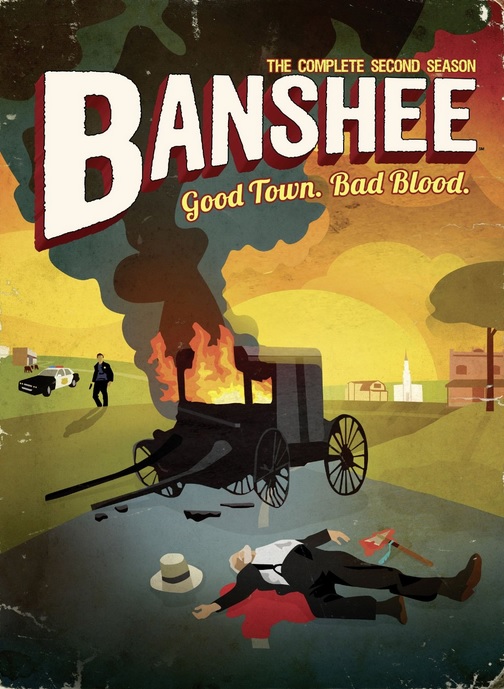
10. Banshee – Season 2

The ultimate capture of small town violence. Too bad the show aint half as good as this poster.
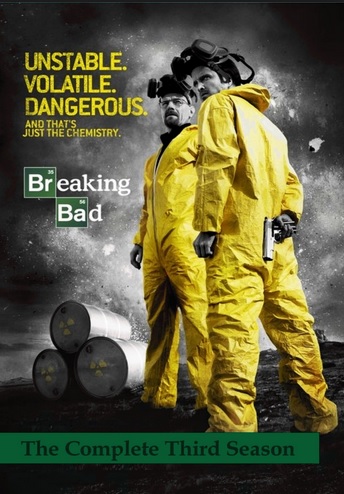
9. Breaking Bad – Season 3

Unstable. Volatile. Dangerous. Those words couldn’t ring truer for any programme. ‘And that’s just the chemistry’ it adds. Exactly, chemistry is the metaphor for everything going on this show. Different combinations of elements can lead to explosive results.
8. Homeland – Season 4

Carrie Mathison, one of the finest TV-characters of our time, finds herself in a tight spot by the looks of it. This promises high tension in this season of ‘Homeland’, a show with a highly actual central theme – the threat of fundamentalist Islam – that is already charged with hyper tension.
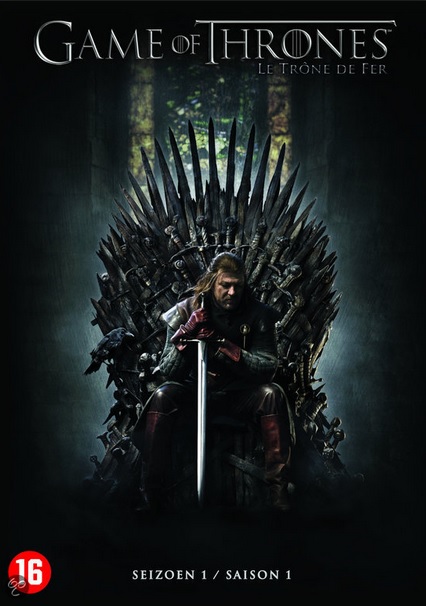
7. Game of Thrones – Season 1

That Iron Throne is really something… And that’s Sean Bean sitting on it, an actor that our (un)conscious minds immediately connect to the fantasy genre. This promises to be one hell of a show.
6. The Walking Dead – Season 1

A full blown zombie apocalypse visualised in one beautiful image. Stunning.
5. The Sopranos – Season 5

‘Hell’ in modern New Jersey has always been a theme of the complex and mysterious ‘The Sopranos’. For its fifth season, this theme is captured perfectly in a painting-like cover that could be the work of Leonardo Da Vinci himself.
4. Mad Men – Season 1

For a show that is all about design (and big ego’s), they managed to completely nail the art direction. Simplicity never worked better than in this small masterpiece of a cover.
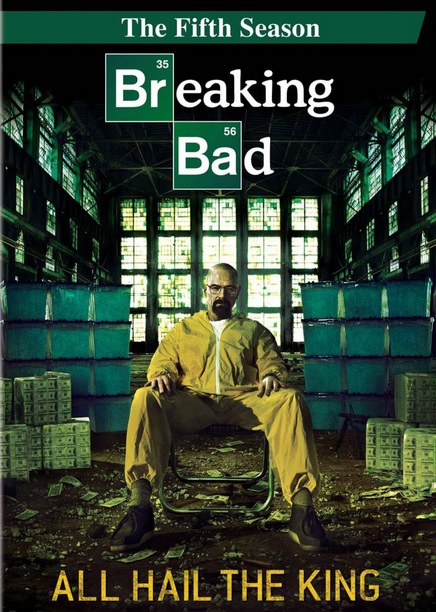
3. Breaking Bad – Season 5

This is brilliant for how much it tells. Being a king in the meth world is so not appealing; the emptiness, the loneliness… You can tell from Walter’s face how he feels and it’s not so good either. But he can’t stop. Not any more.
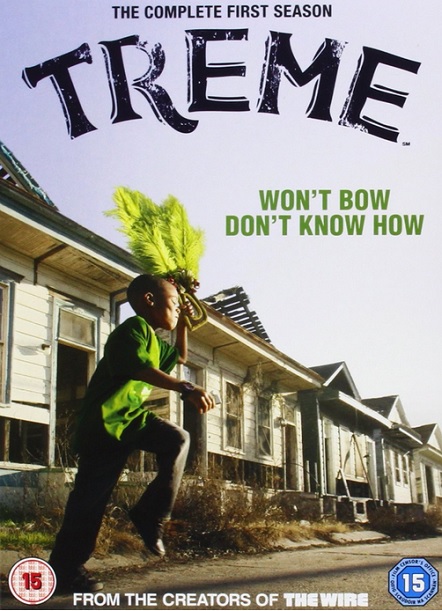
2. Treme – Season 1

The perfect New Orleans photo. Immediately throws you into the mood of the show. And that green is truly entrancing.
1. The Wire – Season 3

The show with the best faces on television present four of their best – Avon, Stringer, Kima and McNulty in a fabulous composition. The cops are going after the players again and this promises to be one hell of a showdown. It’s all in the Game yo.
De opkomst van geld (4)
Door Jeppe Kleijngeld
Documentaire, 2008
Regie: Adrian Pennick
Script/presentator: Niall Ferguson (gebaseerd op zijn boek)
In de documentaire The Ascent of Money laat professor Niall Ferguson ons zien waar geld vandaan komt. Zie ook Deel 1 – De opkomst van banken, Deel 2 – De opkomst van obligatiemarkten en Deel 3 – De opkomst van aandelenmarkten.
Deel 4 – De opkomst van verzekeren
Een belangrijk aspect van finance is risk. Hoe kunnen we ons verzekeren tegen rampspoed zoals de overstroming in New Orleans? Weinig tot niets, zo blijkt uit deel 4 van The Ascent of Money. De St. Bernard Parochie in New Orleans heeft nog maar de helft van het aantal oorspronkelijke inwoners over omdat huizen niet meer te verzekeren zijn.
Waar komt het idee van verzekeren vandaan? Misschien is het omdat het er altijd slecht weer is, maar het eerste verzekeringsfonds komt uit Schotland. Robert Wallace en Alexander Webster begonnen een verzekeringsplan voor de weduwen van de dominees van de Schotse kerk mocht ze iets overkomen. Ferguson toont oude rekenmodellen die ze gebruikten om uit te rekenen wat hun levensverwachting was, dus hoeveel geld ze nodig hadden. De beschikbare premies investeerden ze succesvol in het bedrijfsleven.
Er waren alleen mensen in de maatschappij voor wie private verzekeringen te duur waren. Ook die mensen hebben geld nodig voor hun pensioen, een minimum inkomen bij ziekte en een bedrag voor hun familie als ze overlijden. De oplossing bleek de welvaartstaat, ook bekend als de verzorgingstaat, die zijn oorspong heeft in Japan. De Japanners gebruikten het alleen om soldaten te werven voor hun oorlogen. Na de verwoesting van de Tweede Wereldoorlog bleek het systeem echter onbetaalbaar toen een derde van de bevolking dakloos was geworden na vernietigende bombardementen van de Amerikanen.
De welvaartstaat in Japan werd hervormd tot nationaal vangnet met zaken als gezondheidszorg, onderwijs, werkgelegenheid en sociale zekerheid geregeld door de Staat. Dit ging lange tijd goed en Japan werd een schoolvoorbeeld voor de rijke, geïndustrialiseerde wereld. Echter, het systeem bleek gebaseerd op de hoge economische groeiverwachtingen van het land en die bleken niet uit te komen. Hier komt het fundamentele probleem van verzekeren duidelijk naar voren; de toekomst is zeer onvoorspelbaar. In Japan zorgde de lage economische groei en oplopende vergrijzing ervoor dat het systeem niet meer werkte. Een nog groter probleem was dat de beloningen voor hard werkende mensen werden weggenomen en uitgedeeld aan diegene die onvoldoende bijdroegen. Stagflatie was het resultaat: een zeer traag groeiende productie per hoofd van de bevolking gekoppeld aan oplopende inflatie. In veel Westerse landen gebeurde hetzelfde.
Nobelprijswinnaar Milton Friedman kwam met een oplossing voor de falende welvaartstaat. Hij gebruikte Chili als laboratorium om het pensioenstelsel te hervormen. Werknemers kregen de keuze tussen het staatspensioenfonds of over te schakelen naar een privé pensioenfonds. 80 procent koos voor het laatste en de met elkaar concurrerende fondsen wisten de premies zeer succesvol te investeren in de Chileense economie.
Het laatste onderwerp in dit deel van de documentaire is ‘hedgen’, iets dat weinigen echt begrijpen. Hedgen is een methode om risico’s af te dekken, maar wordt ook vaak gebruikt om winsten te maken. Iedereen kent de verhalen van stinkend rijke hedgefund managers. Hedgen heeft zijn oorspong gek genoeg in de agrarische sector. Boeren spraken van te voren een bodemprijs af voor hun landbouwproducten en afnemers een plafondprijs. Dit verschafte beide partijen zekerheid. Deze vorm van hedgen is vervolgens geëvolueerd tot de complexe beleggingsproducten ‘derivaten’. Een derivaat is een financieel product waarvan de prijs afhankelijk is van de waarde van een gerelateerd onderliggend (financieel) product. Dat kunnen aandelen zijn, of olie, valuta of rente- en kredietproducten. Met een derivaat in bezit heb je een plicht (future) of een recht (optie) om het onderliggende product op een bepaald moment in de toekomst te kopen of verkopen. Topbelegger Warren Buffett noemde derivaten ‘weapons of mass destruction’.
Hedgefund manager Kenneth Griffin (oprichter en CEO van Citadel LLC), wiens salaris in 2007 zo’n 700 miljoen dollar bedroeg, vertelt het geheim van zijn investeringsfirma in het gokken met derivaten. Niks blijft ooit zoals het is en zijn mensen moeten intuïtief weten wat er gaat gebeuren – of niet gebeuren. Wiskundige ondersteuning is belangrijk omdat die aantoont dat je een probleem begrijpt, maar het intuïtieve gevoel is het belangrijkste dat er is voor een hedgefund dat waarde zoekt in het economische systeem.
Dat het speculeren met derivaten en dergelijke producten ook zeer gevaarlijk kan zijn bewijst de ondergang van verzekeraar AIG, die tijdens het hoogtepunt van de kredietcrisis gered moest worden door de Centrale Bank en Amerikaanse overheid. Mensen zijn zich ondertussen weer ‘veilig’ gaan verzekeren tegen slecht weer in de toekomst. In hun huizen. Dit is het onderwerp van het volgende deel van The Ascent of Money.