Mijn Top 20 favoriete filmmakers

1. Martin Scorsese
Verantwoordelijk voor mijn favoriete film aller tijden: GoodFellas. Maar maakte talloze andere meesterwerken; Raging Bull, Taxi Driver, Casino, en vele anderen. Scorsese is een echte maestro die nooit teleur stelt.
Beste film: GoodFellas

2. Sergio Leone
Leefde te kort om een enorm portfolio na te laten, maar alles wat hij gedaan heeft is te gek. The Dollars Trilogy met Eastwood zijn de coolste films ooit en Once Upon a Time in America is een geniaal gangster epos.
Beste film: Once Upon a Time in the West

3. Quentin Tarantino
Maakt originele & uber coole films die hij baseert op onbekende pareltjes. Zijn meesterwerk is nog altijd Pulp Fiction, maar Reservoir Dogs en Kill Bill zijn bijna net zo briljant. Maakt nooit iets ondermaats.
Beste film: Pulp Fiction

4. Peter Jackson
Wist de onmogelijke missie om The Lord of the Rings te verfilmen tot een onvoorstelbaar succes te maken. Was daarvoor al een geweldig regisseur die Nieuw-Zeelandse splatter horror films maakte zoals Bad Taste en Braindead.
Beste film: The Lord of the Rings: The Two Towers

5.
The Coen Brothers
Hun oog voor bizarre personages is hyper ontwikkeld, hun humor onovertroffen en hun pen vlijmscherp. Ze maken om de twee jaar een te gekke film al zo’n 25 jaar lang, met hun hoogtepunt in de jaren 90 toen ze achtereenvolgens Fargo, The Big Lebowski en O Brother, Where Art Thou? maakte.
Beste film: Miller’s Crossing
6. Stanley Kubrick
De perfectionist. Leverde meesterwerken af die voor altijd verankerd zijn in de filmgeschiedenis. Wist uit te blinken in verschillende genres waaronder sci-fi (2001: A Space Odyssey), oorlog (Full Metal Jacket) en misdaad (The Killing)
Beste film: A Clockwork Orange

7. Steven Spielberg
Objectief de beste regisseur ter wereld. Weet de magie van film te pakken als geen ander. Heeft talloze klassiekers op zijn staan waaronder E.T.: The Extra-Terrestrial, Close Encounters of the Third Kind, Schindler’s List en Jurassic Park.
Beste film: Raiders of the Lost Ark

8.
Alfred Hitchcock
Hitchcock weet van een kartonnen doos nog tot een super spannend voorwerp te maken. Ze noemen hem niet voor niets de Master of Suspense. Is waarschijnlijk de meest invloedrijke regisseur ooit. Talloze scènes uit zijn oeuvre staan voor altijd op mijn netvlies gebrand.
Beste film: Rear Window

9. Sam Raimi
Maakte de hoogst vermakelijke Spider Man films, maar waar hij zichzelf wat mij betreft mee onsterfelijk heeft gemaakt is de Evil Dead trilogie. Heerlijke films. Maakte met The Quick and the Dead ook een fantastische western.
Beste film: Evil Dead II

10. Francis Ford Coppola
Hey, hij regisseerde The Godfather trilogie, hoe ga ik hem niet in mijn Top 10 zetten? Was ook verantwoordelijk voor de beste oorlogsfilm aller tijden met Apocalyse Now. Fenomenaal.
Beste film: The Godfather

Daarna volgen:
11. George Lucas (Beste Film: Star Wars: Episode IV – A New Hope)
12. James Cameron (Beste Film: Terminator 2: Judgment Day)
13. Danny Boyle (Beste Film: Trainspotting)
14. Brian De Palma (Beste Film: The Untouchables)
15. Akira Kurosawa (Beste Film: Throne of Blood)
16. Paul Verhoeven (Beste Film: RoboCop)
17. Robert Zemeckis (Beste Film: Back to the Future Part II)
18. Richard Linklater (Beste Film: Dazed and Confused)
19. Robert Rodriguez (Beste Film: Sin City)
20. Jim Jarmusch (Beste Film: Ghost Dog: The Way of the Samurai)


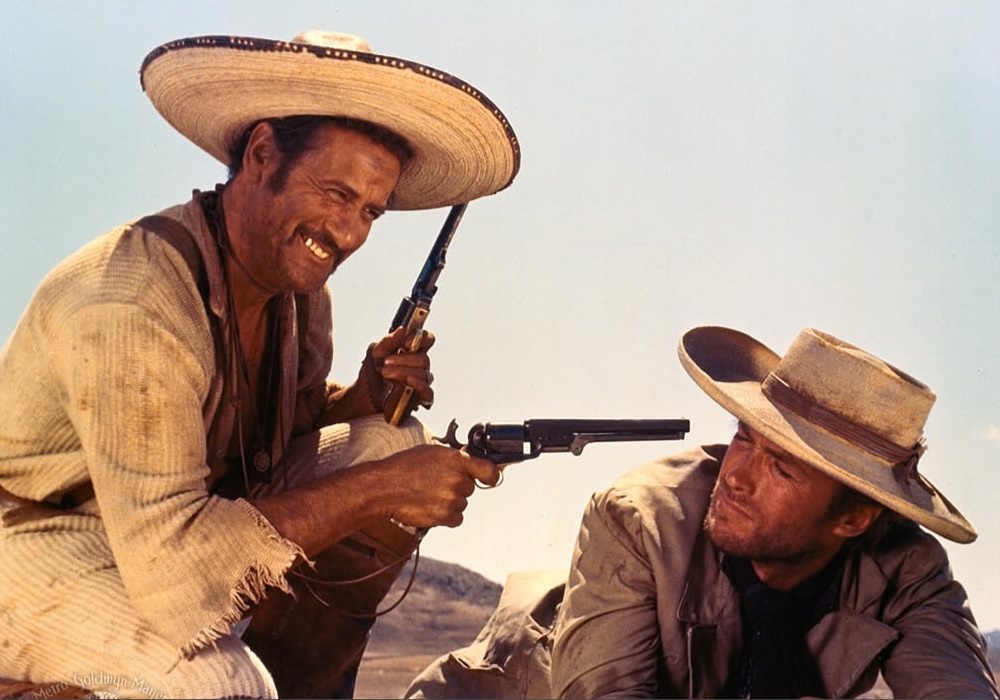
The Good, the Bad and the Ugly

Director: Sergio Leone
Written by: Agenore Incrocci, Furio Scarpelli, Luciano Vincenzoni, Sergio Leone
Cast: Clint Eastwood, Lee Van Cleef, Eli Wallach

Year / Country: 1966, Italy, Spain, West Germany
Running Time: 171 mins.

The final installment of Sergio Leone’s ‘Dollars Trilogy’ is a critically acclaimed masterpiece. Set against the backdrop of the American Civil War, three men are on a relentless quest for a fortune in hidden gold. While soldiers fight to determine the fate of a nation, these men pursue only their own interests. They are the Good, the Bad, and the Ugly. While the last two labels are fitting, the first is somewhat misleading – Eastwood’s character, Blondie, may be more principled than the others, but he doesn’t hesitate to kill when it serves his purpose.

Blondie and Tuco (the Ugly, played by Eli Wallach) form a crooked partnership built on mutual betrayal. After one double-cross nearly costs Blondie his life, they’re forced into a reluctant alliance when each comes into possession of a crucial piece of information that could lead them to the buried treasure. Meanwhile, Angel Eyes (the Bad, portrayed by Lee Van Cleef) is hot on their trail, determined to claim the gold for himself. The three men converge on a remote graveyard, where their fates – and the money – await.

Compared to the earlier two films in the trilogy, The Good, the Bad and the Ugly offers a surprisingly human touch. Eastwood’s Blondie reveals a gentler side, cradling a kitten in his hat and comforting a dying soldier with a cigar. Tuco, though undeniably a scoundrel, becomes unexpectedly poignant during a visit to the monastery where he confronts his estranged brother. This and other scenes flesh out Tuco into the trilogy’s most fully realized character, brought to life in a brilliant performance by Wallach. Despite the emotional depth, Leone doesn’t abandon his signature blend of dark humor and biting cynicism.

Visually, the film is a triumph. Leone’s mastery shines in the rhythmic interplay between intimate close-ups and sweeping, war-torn landscapes that seem to take on a character of their own – harsh and unforgiving, especially evident in the desert sequence where Blondie’s face is scorched by the sun. From the bold, stylized opening credits to the iconic, ritualistic cemetery shootout, the cinematography and editing are innovative and arresting. Add to that Ennio Morricone’s legendary score, and you have one of the most influential films of all time.

The Good, the Bad and the Ugly has been released in various versions, but nothing less than the full three-hour cut does it justice. Only in its complete form does this epic ‘horse opera’ truly come into its own. This is cinema as it was meant to be.

Rating:

Biography: Sergio Leone (1929, Rome – 1989, Rome) made his debut in the cinema working as a voluntary assistant and extra, among other things, in The Bicycle Thieves by Vittorio de Sica. Later, he became assistant director to Mario Bonnard. In 1959, when Bonnard was ill, he took over from him on the set of The Last Days of Pompeii. In 1961 he directed his first full-length film: The Colossus of Rhodes. But the film that was to bring him to the general attention came out in 1964: A Fistful of Dollars. His next films, For a Few Dollars More and The Good, The Bad and the Ugly complete what came to be known as the Dollars Trilogy and were a great box-office success. He would only make three more films before tragically passing away in 1989. He was taken from us by a heart attack in his house in Rome, while working on an ambitious project for a film on the Siege of Leningrad.

Filmography: The Colossus of Rhodes (1961), A Fistful of Dollars (1964), For a Few Dollars More (1965), The Good, The Bad and the Ugly (1966), Once Upon a Time in the West (1968), A Fistful of Dynamite (1971), Once Upon a Time in America (1984)


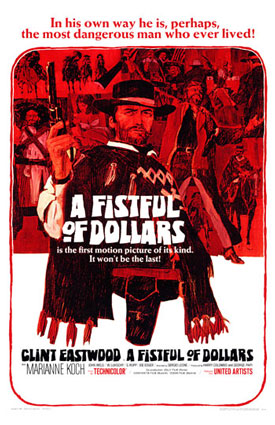
A Fistful of Dollars

Director: Sergio Leone
Written by: Victor Andrés Catena, Jaime Comas, Sergio Leone
Cast: Clint Eastwood, Marianne Koch, Gian Maria Volontè, Wolfgang Lukschy

Year / Country: 1964, Italy / Spain / West Germany
Running Time: 96 mins.

During the filming of The Last Days of Pompeii in Europe, directors Sergio Leone and Sergio Corbucci were struck by the idea of using the landscapes they encountered as the backdrop for a western. Five years later, A Fistful of Dollars arrived – a groundbreaking and hugely influential film that launched both Leone’s and Clint Eastwood’s international careers.

For its plot, Leone drew inspiration from Akira Kurosawa’s classic samurai film Yojimbo. A mysterious stranger arrives in a desolate town where no one works except the coffin maker. The town is controlled by two rival gangs – the Baxters and the Rojos – who each try to buy his loyalty. But the stranger is playing his own game. Instead of choosing a side, he orchestrates a deadly conflict to eliminate both gangs and free the town from their oppression.

At the time, Eastwood was virtually unknown, with his biggest credit being the TV show Rawhide. Leone had considered other actors for the role – James Coburn, Charles Bronson, Lee Marvin, and Henry Fonda – but ultimately, Eastwood’s brilliant performance became a key factor in the film’s success. As the enigmatic gunslinger, he exudes effortless cool. With his cobra-quick draw, sharp intellect, and signature poncho, hat, and cigar, he creates an unforgettable character. Despite his stoic presence and minimal dialogue, he also delivers moments of dry humor, particularly in the scene where he demands apologies from four outlaws for scaring his horse – a comic masterpiece.

From the opening animated credit sequence, A Fistful of Dollars pulls you in. Leone’s direction is flawless, blending breathtaking widescreen cinematography with expertly staged duels that brim with tension. Despite the film’s modest budget, its visual and narrative execution mask any limitations. A major part of its success is owed to Ennio Morricone’s unforgettable score – one of his early masterpieces – that elevates the film’s atmosphere and impact.

Initially, A Fistful of Dollars developed a cult following in Italy before becoming a mainstream box-office sensation. Word spread quickly – this was the must-see film of the year. It was soon followed by two sequels, For a Few Dollars More and The Good, the Bad and the Ugly, completing what would become the legendary Dollars Trilogy.

Rating:

Biography: Sergio Leone (1929, Rome – 1989, Rome) made his debut in the cinema working as a voluntary assistant and extra, among other things, in The Bicycle Thieves by Vittorio de Sica. Later, he became assistant director to Mario Bonnard. In 1959, when Bonnard was ill, he took over from him on the set of The Last Days of Pompeii. In 1961 he directed his first full-length film: The Colossus of Rhodes. But the film that was to bring him to the general attention came out in 1964: A Fistful of Dollars. His next films, For a Few Dollars More and The Good, The Bad and the Ugly complete what came to be known as the Dollars Trilogy and were a great box-office success. He would only make three more films before tragically passing away in 1989. He was taken from us by a heart attack in his house in Rome, while working on an ambitious project for a film on the Siege of Leningrad.

Filmography: The Colossus of Rhodes (1961), A Fistful of Dollars (1964), For a Few Dollars More (1965), The Good, The Bad and the Ugly (1966), Once Upon a Time in the West (1968), A Fistful of Dynamite (1971), Once Upon a Time in America (1984)