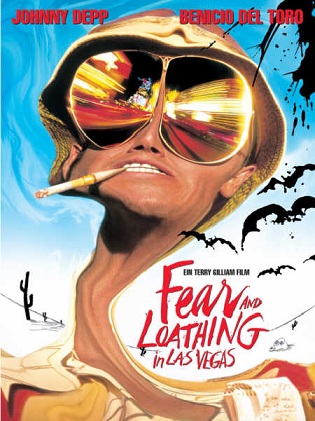
Fear and Loathing in Las Vegas

Director: Terry Gilliam
Written by: Hunter S. Thompson (book), Terry Gilliam (screenplay), Tony Grisoni (screenplay), Tod Davies (screenplay), Alex Cox (screenplay)
Cast: Johnny Depp, Benicio Del Toro, lot’s of cameo’s including; Tobey Maguire, Gary Busey, Ellen Barkin, Christina Ricci, Cameron Diaz, Flea and Harry Dean Stanton

Year / Country: 1998, USA
Running Time: 118 mins.

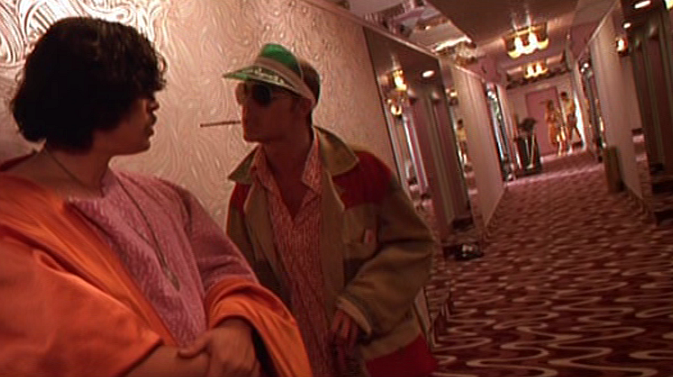
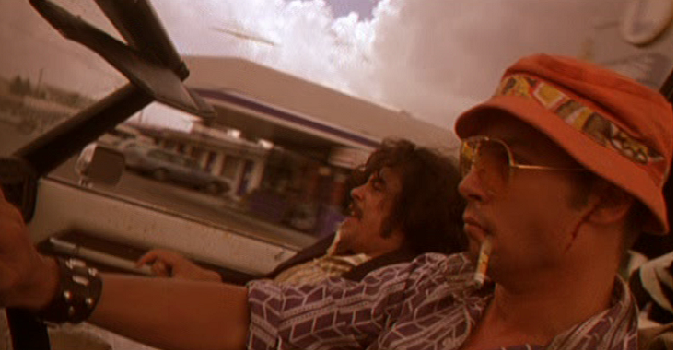
It is the foul year of our lord 1971 and Gonzo journalist Hunter S. Thompson (Raoul Duke in the story) and his Samoan attorney Dr. Gonzo decide to undertake the ultimate trip of the seventies. The official assignment is to cover the Mint 400 desert race in Las Vegas, but they have something bigger in mind. They want to find the American dream. Armed to the teeth with highly dangerous narcotics, they head out to Las Vegas in their fire red convertible… Some trip it’s gonna be…

While searching for the American dream, Thompson and Dr. Gonzo only find fear and loathing. Intolerable vibrations in a town not at all suitable for the use of psychedelic drugs. The atmosphere is extremely menacing, but as they behave as animals, nobody even notices them. Vegas turns out to be a savage town. And while soldiers are dying in Vietnam, used car dealers from Dallas throw their money in the slot machines, Debbie Reynolds sings in the Desert Inn and the national police force meets at a congress about marijuana. Thompson and Dr. Gonzo are there.

Thompson’s novel ‘Fear and Loathing in Las Vegas’, which was first published in two parts in Rolling Stone Magazine, became a cultural phenomenon (and my personal favorite book of all time). The movie adaptation by Terry Gilliam is a literal one. Thompson wrote his famous novel Gonzo style, which means the events are told through the eyes and vision of the author who fully participates in the story himself. Since Thompson was heavily under the influence during the writing process, he claims he can’t fully remember which parts truly happened and which ones did not (fully). Therefore this literal adaptation is a highly enjoyable blast, though not always realistic.

There is one downside to director Gilliam’s literal approach. In the novel, all the psychedelic escapades form an integral part of what is obviously a literary masterpiece. In the translation to film however, these escapades sometimes appear to be useless fuckarounds, especially during the final part of the film. However, that is a minor criticism for this is obviously a highly enjoyable movie. Depp and Del Toro are both terrific in their method acting approaches to their roles. Thompson’s poetic writing, beautifully narrated by Depp in voice-over, runs through the movie that captures the era and hallucinogenic nightmare perfectly. Combined with a beautiful seventies soundtrack and Grade A settings, the great time capsule that is Fear and Loathing in Las Vegas is complete. Also, it is one of the funniest movies of all time. So buy the ticket and take the ride.

Rating:

Biography: Terry Gilliam (1940, Minneapolis) started his career as the only American member of the British comedy group Monty Python. As animator, he was responsible for the bizarre cartoons used in the sketches. In 1975 he directed his first movie for Monty Python, namely Monty Python and the Holy Grail. After his period with Monty Python, he moved on as independent director and had remarkable success with his bizarre masterpiece Brazil in 1985. After that success, things went downhill for Gilliam; The Adventures of Baron Munchausen became an expensive flop and the disastrous production of the never completed Don Quichotte became legendary. Despite these problems, Gilliam returned and directed a number of valuable contributions to cinema, including sci-fi masterpiece Twelve Monkeys and cult classic Fear and Loathing in Las Vegas.

Filmography: Storytime (1968, short) / The Miracle of Flight (1974, short) / Monty Python and the Holy Grail (1975) / Jabberwocky (1977) / Time Bandits (1981) / The Crimson Permanent Assurance (1983, short) / The Adventures of Baron Munchausen (1988) / The Fisher King (1991) / Twelve Monkeys (1995) / Fear and Loathing in Las Vegas (1998) / The Brothers Grimm (2005) / Tideland (2005) / The Imaginarium of Doctor Parnassus (2009) / The Legend of Hallowdega (2010, short) / The Wholly Family (2011, short) / The Zero Theorem (2013) / The Man Who Killed Don Quixote (2018)

The Rum Diary


Director:
Bruce Robinson
Written by: Bruce Robinson (screenplay), Hunter S. Thompson (novel)
Cast: Johnny Depp, Amber Heard, Michael Rispoli, Aaron Eckhart

Year / Country: 2011, USA
Running Time: 115 mins.

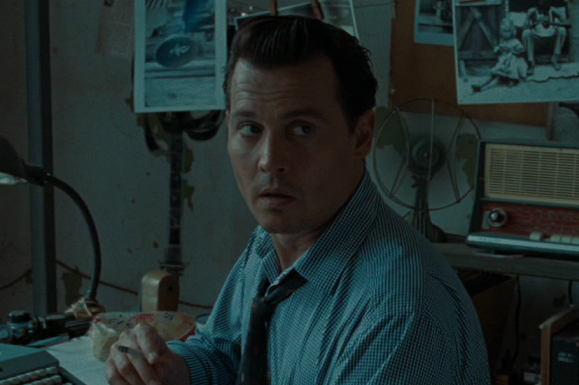
The title ‘The Rum Diary’ can mean two things. Hunter S Thompson’s novel that is told in this movie or The San Juan Star, the near bankrupt Puerto Rican newspaper where main character Paul Kemp (Thompson’s alter ego) takes a job as journalist. Why? Because the entire writing staff is completely drunk. The same seems to apply for the whole population of Puerto Rico in the 1960’s, the setting of The Rum Diary.

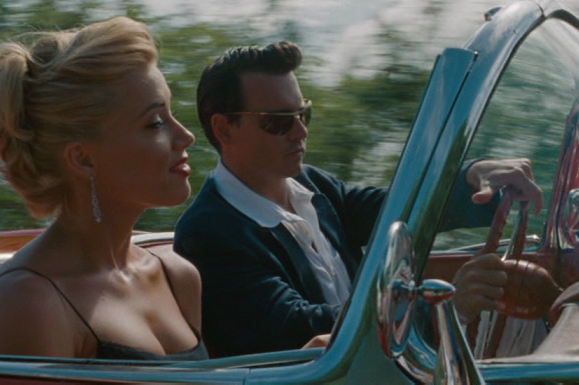
This is a story about alcohol and lots of it. But, whenever Kemp takes time off of drinking, he engages in a compelling journalistic endeavor, shining light on the culture and problems of the relatively unknown country he resides in. This is also a love story. Kemp falls head over heels for the stunning Chenault, the girlfriend of corrupt businessman Sanderson, who wants Kemp to write stories in favor of his unethical real estate plans.

Kemp’s dilemma, going along with the flow or exposing the ‘bastards’ as he puts it, is the backbone of this movie. The pace is as relaxed as the setting and director Robinson succeeds well in translating the mood of Thompson’s novel to the white screen. The cast is on a roll as well. Depp, who once said he would like to play Thompson every few years, is solid as always. He gets excellent comic support from press associates Michael Rispoli, Richard Jenkins and Giovanni Ribisi. Amber Heard and Aaron Eckhart play Chenault and Sanderson, whose characters add the necessary intrigue and substance to the story.

Obviously this is no Fear and Loathing in Las Vegas and the drug fuelled craziness portrayed in that movie is largely absent. This is Thompson Light; a smaller movie without too much excessive behavior. Director Robinson did add one pretty funny drug scene that can be considered as a wink to big brother Fear and Loathing. In The Rum Diary, the author Thompson is still searching for his unique voice and it is pleasant to join him on this quest. It is best to keep some rum within reach though as you might get thirsty underway.

Rating:

Biography: Bruce Robinson (1946, Broadstairs, Kent) started his career as an actor, but did not find it fulfilling nor lucrative. He started writing screenplays and in 1984, his Cambodia script The Killing Fields was turned into a memorable war movie by Roland Joffé. With his second script, he chose to direct himself. Withnail & I, which is largely autobiographical, became a cult classic. Robinson’s subsequent films, the advertising satire How To Get Ahead in Advertising and the serial-killer thriller Jennifer 8, while less memorable than his debut, still showed Robinson’s talents. In 2011 he brought The Rum Diary, a novel by legendary writer and Gonzo journalist Hunter S. Thompson, to the screen which received mixed reviews.

Filmography: Withnail & I (1987) / How to Get Ahead in Advertising (1989) / Jennifer Eight (1992) / The Rum Diary (2011)

The Hobbit: Een persoonlijke reis

19 december 2001 – Ik had een dag vrijgenomen van de opleiding journalistiek die ik toen volgde om naar één van de belangrijkste films van mijn leven te gaan; The Lord of the Rings: The Fellowship of the Ring. Het was een woensdag en ik ging in mijn eentje naar Pathe City in Amsterdam en heb de voorstelling van mijn leven gehad. Wat een fantastische filmervaring. Fantastisch in termen van schaal en visueel spektakel. Zonder twijfel, maar belangrijker voor de beleving is uiteindelijk het verhaal over wezens die hun lotsbestemming moeten ontdekken en de moed die dat van ze vergt.

Het is inmiddels 11 jaar geleden – een lange tijd – maar tegelijk lijkt het zo ontzettend kort. Ik wist toen nog niet wat mijn eigen lotsbestemming was, met wie ik zou eindigen en waar. Ik kende haar gek genoeg al wel… Inmiddels is mijn leven behoorlijk veranderd. Ik ben bijna 10 jaar samen met Loesje, we hebben een kind samen, een huis, een eiland, veel dieren. Ik ben opleidingen begonnen en heb ze afgesloten, ik heb een baan – al vijf jaar, Loesje heeft een konijnenopvang. We hebben nieuwe mensen leren kennen, anderen zijn afgevallen…

Op filmgebied is er ook veel veranderd. Sinds Avatar is het de normaalste zaak van de wereld om met een 3D-bril op je hoofd in de bioscoop te zitten. In The Hobbit: An Unexpected Journey gebruiken de makers voor het eerst een ‘48 frames per seconde techniek’, die de film een geweldige diepte en scherpte meegeeft. In scènes waar letterlijk honderden karakters tegelijk alle kanten op bewegen is de dynamische actie met gemak te volgen. Geslaagd experiment dus; voer dit maar in bij alle 3D spektakels.

12 december 2012 – Bijna exact 11 jaar na dato zit ik in de Pathe City voor The Hobbit: An Unexpected Journey. Geregisseerd door één van mijn grootste filmhelden: Peter Jackson, die met The Lord of the Rings trilogie, een tijdloze en monumentale fantasievisie neerzette. Dit zijn de films die ik met mijn kinderen wil kijken op winterse zondagen. The Hobbit sluit hier naadloos bij aan.

The Hobbit

Vanaf de eerste minuut, waarin Bilbo ons meeneemt in de fascinerende geschiedenis van de dwergen, was ik weer helemaal terug in Midden-Aarde. Qua opbouw en structuur lijkt me film exact op The Fellowship of the Ring. Na de geschiedenis van de dwergen is de missie duidelijk en stelt tovenaar Gandalf wederom een curieus gezelschap samen om de reis mee te gaan maken. Een cruciaal lid van het gezelschap wordt wederom een hobbit – Bilbo Baggins ditmaal – die eigenlijk niet gewend is veel buiten zijn comfortabele hobbithol te komen. Onderweg komen ze het ene gevaar na het andere tegen – orks, goblins, wargs, reuzen, trollen en donkere magie – terwijl ze dichter bij hun bestemming komen: the lonely mountain (Erebor) waar de magnifieke draak Smaug zich schuilhoud met zijn veroverde goudschat van de dwergen.

Ik was een beetje bang dat de film te lang zou duren sinds Jackson had aangekondigd dat hij The Hobbit in drie delen zou uitbrengen. Het bronmateriaal bedraagt namelijk maar zo’n 250 pagina’s (ter vergelijking: The Lord of the Rings heeft 1300 pagina’s). Mijn angst bleek volledig ongegrond. De film vloog voorbij en iedere scene – of hij nu wel of niet uit het boek kwam – voelde volledig gerechtvaardigd. Wat geweldig dat ons de komende twee jaar rond kerstmis nog zo’n ervaring wacht.

Missie geslaagd dus. Waar Jackson wat mij betreft vooral veel waardering voor verdiend is hoe hij zijn personages zo écht weet te maken. Dat is namelijk cruciaal om publiek mee te krijgen in een fantasiewereld, hoe overtuigend de visuele effecten ook mogen zijn. Slechts weinig filmmakers slagen hier zo goed in als Jackson. De 13 dwergen zijn fantastisch neergezet, en de relatie tussen Bilbo, Gandalf en dwergenleider Thorin Oakenshield is oprecht ontroerend. Geweldig gespeeld door deze drie hoofdpersonen ook, met precies de juiste balans tussen drama en humor. The Hobbit maakt nu al – ik veronderstel bij vele fans van deze films – meteen al een belangrijk deel uit van mijn eigen reis door het leven. Daarom is de titel ‘An Unexpected Journey’ ook zo goed. Het gaat niet alleen om de letterlijke reis die Bilbo gaat maken, maar de reis die ieders leven is. Soms komt er iets op je pad waar je niet om gevraagd hebt, en dan moed tonen en de juiste keuzes maken is wat je maakt als mens – en als hobbit.

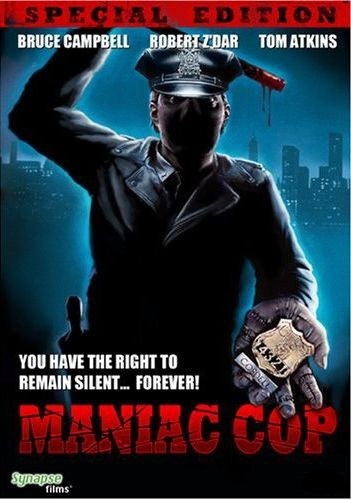
Maniac Cop

Director: William Lustig
Written by: Larry Cohen
Cast: Tom Atkins, Bruce Campbell, Laurene Landon

Year / Country: 1988, USA
Running Time: 85 mins.

In the eighties many, many (perhaps too many) slasher movies saw the light of day, trying to profit from the popularity of genre classics such as Halloween (1978) and Friday the 13th (1980). Many lacked the true passion for the art of exploitation filmmaking though and were merely cash-ins. This can not be said about Maniac Cop, because two inspired exploitation film makers are behind it. Larry Cohen produced and wrote the screenplay and William Lustig directed. Cohen was at the time mostly known as director of blaxploitation flicks Black Caesar and Hell Up in Harlem and the It’s Alive horror trilogy, while Lustig made the controversial Maniac in 1980.

The potential for a real cult treat was certainly there. Besides Cohen and Lustig, the cast had Bruce Campbell and Richard Roundtree in it, enough to make cult fans drool. The concept is also promising: police brutality offers plenty of opportunity for both humour and scares. The poster and tagline really sell this flick: ‘You have the right to remain silent. Forever!’ Great!!! Let’s watch this.

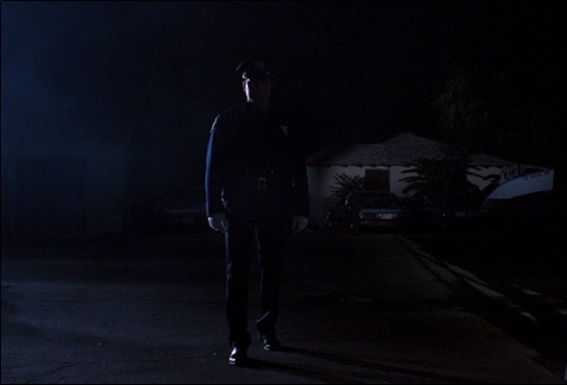
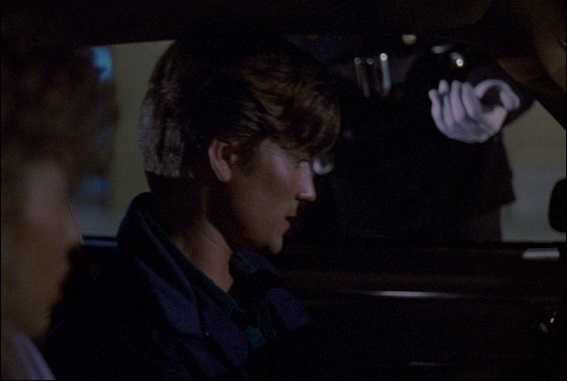
Unfortunately the execution of Maniac Cop is disappointing. As much as I wanted to enjoy this, it fell short on delivery. The positive critique is that the suspense is adequately delivered. The story is what you would expect it to be. A six foot tall cop is killing innocent people in New York and panic spreads through the city. Bruce Campbell’s cop Jack Forrest is wrongfully accused of the killings and he and a few accomplices have to discover the (supernatural) truth and stop the killer.

Why it is disappointing, is mostly because so much potential is wasted. There are no moments in which the police brutality angle is put to good use. There is hardly any humour in the movie and when you have Campbell in your cast that is a deadly sin. The action-packed finale of the film also fails to offer a satisfactory conclusion.

Perhaps part 2, which is said to be Lustig’s favourite entry in the trilogy, has more to offer. The third instalment Maniac Cop 3: Badge of Silence (1993) is best left alone though. When voodoo comes into play, it won’t do much good to this concept.

Rating:

Biography: William Lustig (1955, New York) always enjoyed exploitation flicks and wanted to pursue a career as filmmaker. After working as assistant on a few films, including Michael Winner’s Death Wish, he directed two porn movies under the alias Billy Bagg. In 1980, Lustig found himself at the center of a storm of controversy when he made the disturbing slasher film Maniac. Throughout the eighties and nineties he would continue to make exploitation films, including the Maniac Cop trilogy.

Filmography: Maniac (1980), Vigilante (1983), Maniac Cop (1988), Hit List (1989), Relentless (1989), Maniac Cop 2 (1990), Maniac Cop 3: Badge of Silence (1993), The Expert (1995), Uncle Sam (1996), Conducting Dario Argento’s ‘Opera’ (2011, short doc)