Mijn Top 20 favoriete filmmakers

1. Martin Scorsese
Verantwoordelijk voor mijn favoriete film aller tijden: GoodFellas. Maar maakte talloze andere meesterwerken; Raging Bull, Taxi Driver, Casino, en vele anderen. Scorsese is een echte maestro die nooit teleur stelt.
Beste film: GoodFellas

2. Sergio Leone
Leefde te kort om een enorm portfolio na te laten, maar alles wat hij gedaan heeft is te gek. The Dollars Trilogy met Eastwood zijn de coolste films ooit en Once Upon a Time in America is een geniaal gangster epos.
Beste film: Once Upon a Time in the West

3. Quentin Tarantino
Maakt originele & uber coole films die hij baseert op onbekende pareltjes. Zijn meesterwerk is nog altijd Pulp Fiction, maar Reservoir Dogs en Kill Bill zijn bijna net zo briljant. Maakt nooit iets ondermaats.
Beste film: Pulp Fiction

4. Peter Jackson
Wist de onmogelijke missie om The Lord of the Rings te verfilmen tot een onvoorstelbaar succes te maken. Was daarvoor al een geweldig regisseur die Nieuw-Zeelandse splatter horror films maakte zoals Bad Taste en Braindead.
Beste film: The Lord of the Rings: The Two Towers

5.
The Coen Brothers
Hun oog voor bizarre personages is hyper ontwikkeld, hun humor onovertroffen en hun pen vlijmscherp. Ze maken om de twee jaar een te gekke film al zo’n 25 jaar lang, met hun hoogtepunt in de jaren 90 toen ze achtereenvolgens Fargo, The Big Lebowski en O Brother, Where Art Thou? maakte.
Beste film: Miller’s Crossing

6. Stanley Kubrick
De perfectionist. Leverde meesterwerken af die voor altijd verankerd zijn in de filmgeschiedenis. Wist uit te blinken in verschillende genres waaronder sci-fi (2001: A Space Odyssey), oorlog (Full Metal Jacket) en misdaad (The Killing)
Beste film: A Clockwork Orange

7. Steven Spielberg
Objectief de beste regisseur ter wereld. Weet de magie van film te pakken als geen ander. Heeft talloze klassiekers op zijn staan waaronder E.T.: The Extra-Terrestrial, Close Encounters of the Third Kind, Schindler’s List en Jurassic Park.
Beste film: Raiders of the Lost Ark

8.
Alfred Hitchcock
Hitchcock weet van een kartonnen doos nog tot een super spannend voorwerp te maken. Ze noemen hem niet voor niets de Master of Suspense. Is waarschijnlijk de meest invloedrijke regisseur ooit. Talloze scènes uit zijn oeuvre staan voor altijd op mijn netvlies gebrand.
Beste film: Rear Window

9. Sam Raimi
Maakte de hoogst vermakelijke Spider Man films, maar waar hij zichzelf wat mij betreft mee onsterfelijk heeft gemaakt is de Evil Dead trilogie. Heerlijke films. Maakte met The Quick and the Dead ook een fantastische western.
Beste film: Evil Dead II

10. Francis Ford Coppola
Hey, hij regisseerde The Godfather trilogie, hoe ga ik hem niet in mijn Top 10 zetten? Was ook verantwoordelijk voor de beste oorlogsfilm aller tijden met Apocalyse Now. Fenomenaal.
Beste film: The Godfather

Daarna volgen:
11. George Lucas (Beste Film: Star Wars: Episode IV – A New Hope)
12. James Cameron (Beste Film: Terminator 2: Judgment Day)
13. Danny Boyle (Beste Film: Trainspotting)
14. Brian De Palma (Beste Film: The Untouchables)
15. Akira Kurosawa (Beste Film: Throne of Blood)
16. Paul Verhoeven (Beste Film: RoboCop)
17. Robert Zemeckis (Beste Film: Back to the Future Part II)
18. Richard Linklater (Beste Film: Dazed and Confused)
19. Robert Rodriguez (Beste Film: Sin City)
20. Jim Jarmusch (Beste Film: Ghost Dog: The Way of the Samurai)
De oorlog van een pacifist

Het mooie van The Big Lebowski, of eigenlijk van alle films van de gebroeders Coen (o.a. Raising Arizona, Miller’s Crossing, Fargo), is dat alles – elk zinnetje – bijdraagt aan de thematiek die in de betreffende film verwrongen zit. Ze kiezen nooit de gemakkelijke weg door er maar wat dialoog in te gooien, simpelweg om het verhaal voort te stuwen.

Een prachtig voorbeeld hiervan zit in The Big Lebowski. In het begin van de film legt een onbekende verteller uit dat het verhaal van hoofdpersoon ‘The Dude’ (not a name someone from Texas would self-apply) zich afspeelt gedurende begin jaren 90’, de tijd dat Amerika een conflict had met Saddam Hoessein en de Irakezen.

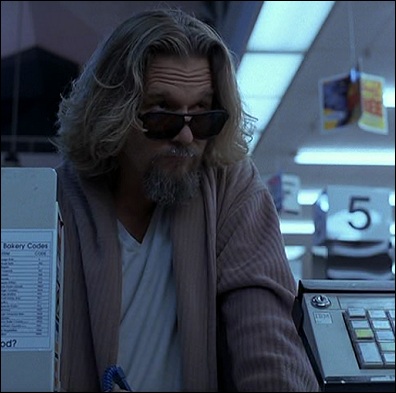
In een scène iets later staat de held van de film, de uitermate luie en relaxte Dude (echte naam Jeffrey Lebowski), in een supermarkt een pak melk af te rekenen met een cheque van 0.69 dollarcent. Terwijl hij dit doet, valt zijn blik op een televisie waarop toenmalig President Bush (de oude) te zien is. Bush zegt; ‘This will not stand, this aggression against Kuwait.’ Oftewel; we pikken die brutale houding van Irak niet langer. De Golfoorlog is een feit.


Let ook op de datum.

Iets later begint de Dude zijn eigen avontuur. Twee nietsnutten komen naar zijn huis en pissen over zijn tapijt heen, omdat ze hem verwarren met naamgenoot en miljonair Jeffrey Lebowski wiens vrouw schulden heeft hij de werkgever van de nietsnutten. Dit is de Dude zijn favoriete tapijt. Het maakte de kamer helemaal af. Zelf voor een stoner als Lebowski is dit moeilijk te verkroppen.

Hij besluit compensatie te gaan halen bij de miljonair Lebowski. Als deze weigert te betalen voert de Dude de druk op en gebruikt hij dezelfde tekst als Bush: ‘This will not stand, you know. This aggression will not stand, man.’

Schitterend dat hij deze tekst heeft opgeslagen, vooral omdat de Dude het compleet tegenovergestelde is van de republikeinse en oorlogszuchtige Bush.

Dit is de Dude zijn eigen oorlog. Op het spel staat een tapijt en de Dude gaat de strijd aan. Overwint hij? Nee. Tenminste niet in materiële zin. El Duderino verliest alleen maar geld tijdens zijn belevenissen. Maar door de gebeurtenissen ontmoet hij wel Maude Lebowski, die hij zwanger maakt, zodat de schitterende geest van de Dude blijft voortleven. ‘The Dude abides’. En dat is een miljoen keer meer waard dan alle Perzische tapijten ter wereld.

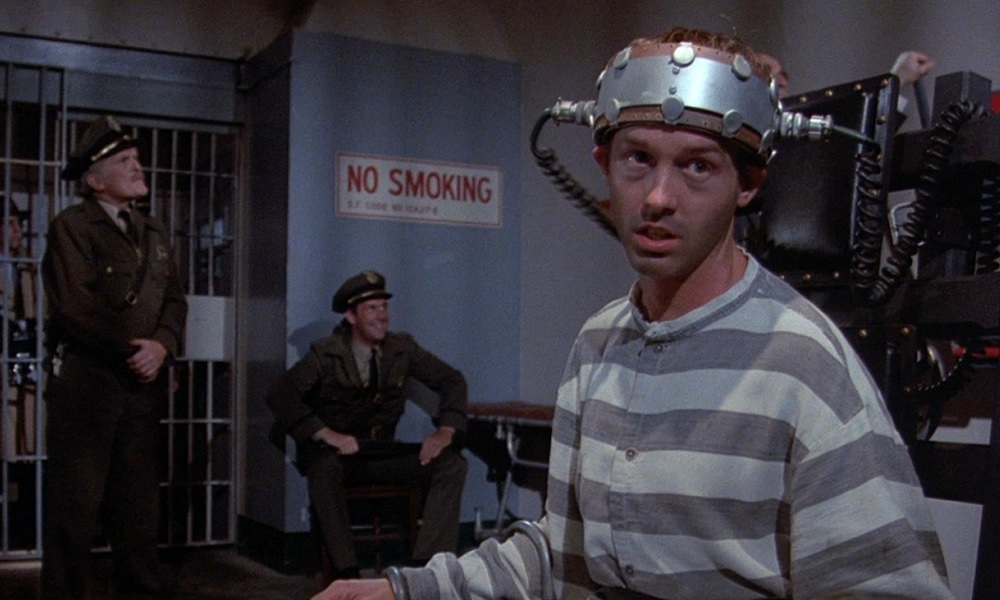
Crimewave

Director: Sam Raimi
Written by: Ethan Coen, Joel Coen, Sam Raimi
Cast: Reed Birney, Sheree J. Wilson, Paul L. Smith, Brion James

Year / Country: 1985, USA
Running Time: 79 mins.

Victor Ajax, an electric repairman, is scheduled to be executed in the electric chair for a series of murders he didn’t commit. With five minutes to midnight, the hapless Ajax flashes back to the events that brought him to this precarious situation. Thanks to his former boss’s murderous schemes, he finds himself tangled up with a pair of maniacal exterminators, but also crosses paths with the woman of his dreams.

Raimi’s second feature film explores faith, fate, electricity, and the extermination business. Not only did Raimi direct Crimewave, but he co-wrote the screenplay with the Coen brothers. With that kind of talent involved, I was expecting something spectacular. In that sense, it was a letdown. But on re-watch, I found plenty to appreciate.

At this point in their careers, both Raimi and the Coens were still discovering their voices. Crimewave showcases Raimi’s trademark razzle-dazzle camerawork, while the Coens supply a parade of idiotic characters, absurd jokes, and bizarre scenarios. Still, it lacks the razor-sharp precision they would later master. Fans, however, will have a blast spotting the references, quirks, and trademarks that foreshadow their later work.

The budget here was clearly bigger than Raimi’s debut, The Evil Dead, and it shows in several standout set pieces. The sequence where Paul L. Smith stalks Louise Lasser through a corridor lined with doors is a highlight, and the film climaxes with a long, spectacular car chase reminiscent of a scene later perfected in Raising Arizona.

The casting is another strength. Paul L. Smith and Brion James are especially memorable in their feral performances as rat exterminators, while Bruce Campbell is very funny as a smooth skirt chaser. The Coen brothers themselves also briefly appear as journalists.

Rating:

Biography: Sam Raimi (1959, Royal Oak, Michigan) started making 8mm films when he was around ten years old. In his teenage years he first collaborated with his good friend Bruce Campbell, who would later appear in almost all of his films. The style of Raimi is influenced by the Three Stooges, of whom he is a huge fan. By making the short movie Within the Woods he managed to raise the required funds to make his first feature; the outrageous horror flick The Evil Dead. After that he made similar films with varying commercial success. In his films Raimi displays a great talent for creating inventive visuals. Most of his movies also feature slapstick and comic book elements. In 2002 Raimi made Spiderman, his biggest film to date. It was an enormous box-office success and Raimi would go on to make two sequels. Throughout his career Raimi has also produced many films and TV-series, mostly in the horror/fantasy genre. He remains a director with a huge fan base and many exciting future prospects.

Filmography (a selection): It’s Murder! (1977, short), Within the Woods (1978, short), Clockwork (1978, short), The Evil Dead (1981), Crimewave (1985), Evil Dead II (1987),  Darkman (1990), Army of Darkness (1992), The Quick and the Dead (1995), A Simple Plan (1998), For Love of the Game (1999), The Gift (2000), Spider-Man (2002), Spider-Man 2 (2004), Spider-Man 3 (2007), Drag Me to Hell (2009)

Miller’s Crossing (1990)


‘Up is down, black is white, and nothing is what it seems’

Directed by:
Joel Coen

Written by:
Joel Coen
Ethan Coen

Cast:
Gabriel Byrne (Tom Reagan), Marcia Gay Harden (Verna), John Turturro (Bernie Bernbaum), Jon Polito (Johnny Caspar), J.E. Freeman (Eddie Dane), Albert Finney (Leo), Mike Starr (Frankie), Al Mancini (Tic-Tac), Steve Buscemi (Mink), Richard Woods (Mayor Dale Levander)

‘I’m talkin’ about friendship. I’m talkin’ about character. I’m talkin’ about—hell, Leo, I ain’t embarrassed to use the word—I’m talkin’ about ethics.’ That’s how Italian crime boss Johnny Caspar (Jon Polito) begins his speech to Irish kingpin Leo O’Bannion (Albert Finney) in the opening of Miller’s Crossing. It immediately recalls the first scene of The Godfather, where undertaker Bonasera appeals in much the same way to Don Vito Corleone.

The favor Caspar asks of O’Bannion is permission to whack two-timing bookie Bernie Bernbaum (John Turturro). Leo refuses, since Bernie is the brother of Verna (Marcia Gay Harden), the woman he’s fallen in love with. Of course, Caspar wasn’t really asking permission—he was informing Leo as a courtesy, as he angrily makes clear after being turned down. Gangsters with ethics toward one another: that’s the foundation of Miller’s Crossing. When Leo breaks this unspoken code among the city’s corrupt rulers, the result is all-out war.

The theme of crooks with ethics is embodied in Leo’s right-hand man Tom Reagan (Gabriel Byrne), the film’s central character. He follows a personal code that only he fully understands. Though secretly having an affair with Verna, Tom – unlike Leo – believes Bernie should be handed over to the Italians. He knows that breaking the underworld code is bad for business. But Leo is stubborn, and their disagreement grows until Tom finally confesses the affair. Leo cuts ties, and Tom immediately shifts allegiance to Caspar. His motive, however, is not self-interest. Though finished with Leo, Tom’s loyalty to his old friend remains.

The web of deceit that quickly unfolds in Miller’s Crossing is complex enough to merit a second viewing. Adding to the intricacy are numerous characters referenced but rarely seen. Still, the story – drawn from Dashiell Hammett novels like ‘The Glass Key’ and ‘Red Harvest’, and infused with classic gangster and neo-noir elements – is masterfully told. The Coens integrate these influences into a killer script, ironically born from a period of writer’s block. Their trademark humor and eccentric characters are on full display, while the dialogue carries a poetic cadence that might even make Shakespeare jealous.

The plotlines themselves may not be original, but the Coens conjure a dreamlike world where, as the tagline promises, nothing is what it seems. The mood is unmistakably Irish – you can almost smell the whiskey. Carter Burwell’s haunting score, the gorgeous cinematography, and evocative settings all heighten the effect. The tone shifts effortlessly from cartoonish to brutally violent, without warning or transition.

The cast is uniformly excellent. Gabriel Byrne makes Tom a sympathetic bastard it’s hard not to root for; if I had to trade places with a Prohibition-era gangster, I’d pick him without hesitation. The supporting roles are just as strong, with John Turturro delivering a powerhouse turn as Bernie, a spineless schemer whose lack of ethics drives the story. Miller’s Crossing also reinvents the use of hats and overcoats. Not that there’s any hidden meaning – there’s nothing’s more foolish than looking for meaning in a hat.

Features a terrific cameo from the Coen’s friend Sam Raimi as a trigger happy cop.

Rating:

Quote:
Tom Reagan: Nobody knows anybody. Not that well.

Trivia:
The Coen Brothers suffered writer’s block while working on the script for Miller’s Crossing. They took a three-week break and wrote the script for their next movie Barton Fink during that time, about a writer with writer’s block. There are two references to Barton Fink in this film. The first one is the name of Tom Reagan’s residence called ‘The Barton Arms’. The second is a newspaper article that reads ‘Seven Dead in Hotel Fire’.