10 Reasons the Nineties’ Cinema Kicked Ass

I was a little young to realize what a terrific time for cinema the nineties were. Holy crap. Around forty percent of my favorite movies come from the nineties, including my number one of all time: GoodFellas. In this article, I will give you 10 reasons why the nineties kicked complete ass as a movie decade.

1. Tarantino’s Arrival
In 1992, a young film maverick silently arrived with Reservoir Dogs. Many viewers and critics were a little off-put by the violence and immoral characters, but yet loved the non-chronological storytelling, the brilliant dialogues and the awesome performances. The talent of this new writer/director named Quentin Tarantino was undeniable.

Two years later he blew critics and audiences away with his epic Pulp Fiction. Tarantino was for the nineties what Scorsese was for the seventies; a significant promise. And he delivered. The nineties saw him direct an excellent third movie, Jackie Brown (1997), and two of his screenplays were turned into memorable films: True Romance (1993) and Natural Born Killers (1994). In 1996 he also made From Dusk Till Dawn with another promising young director from Texas. Robert Rodriguez had debuted in 1992 with the low budget miracle El Mariachi which he followed up with Desperado (1995). A duo was formed…

2. It Was a Time to Thrill
The nineties was the decade of the thriller. Especially the detective versus serial killer genre flourished with The Silence of the Lambs (1991) and Se7en (1995). Of course these two spawned countless imitations, but none as good. Another excellent movie in the psychopath category is Rob Reiner’s adaptation of Stephen King’s Misery in 1990. That movie’s villain Annie Wilkes (played by Kathy Bates) is probably even scarier than Hannibal Lecter, Buffalo Bill and John Doe combined.

The nineties also had more than its share in fantastic crime thrillers. Top examples include Brian de Palma’s Carlito’s Way (1993), Luc Besson’s Leon (1994), Michael Mann’s Heat (1995), Brian Singer’s The Usual Suspects (1995) and Curtis Hanson’s L.A. Confidential (1997). Special mention in the Thriller department goes to Paul Verhoeven’s erotic contribution Basic Instinct (1992), an absolute classic in its genre.

3. Glory Days For the Coens
They already made an impression as independent filmmakers in the 1980’s. Both their debut Blood Simple and second feature Raising Arizona tasted like more. In the 1990’s they really became film-buffs’ favorites. Miller’s Crossing (1990) is a perfect take on Dashiell Hammett and possibly their finest crafted work. Later, this decade, they had a brilliant black comedy run with the unforgettable classics Fargo (1996) and The Big Lebowski (1998). These Coen Brothers are absolutely terrific.

4. History Can Be Fun
Sure, every period has produced great historical movies, but the nineties had a very impressive reaping in the War / History genre. Way above average to be sure. In 1990 a certain Kevin Costner brought the American frontier to the big screen with the Oscar-winning epic Dances With Wolves. It was a marvelous revitalization of the Western genre. World War 2 is also captured in several Oscar-winning pictures, most notably Steven Spielberg’s Schindler’s List (the ultimate WWII film), but also in Saving Private Ryan (also by Spielberg), La Vita E Bella (by Roberto Benigni) and The Thin Red Line (by Terrence Malick).

Another great war story is spectacularly told in Braveheart (1995), the bloody epic that showed that Mel Gibson is a highly competent director. A number of excellent historical biographies also saw the light of day, most notably JFK (1991, Oliver Stone) and Ed Wood (1994, Tim Burton). And last but least, Titanic (1997, James Cameron) and Forrest Gump (1994, Robert Zemeckis) came out and successfully combined fictional stories with historic events.

5. Great Stand Alone Triumphs
While many masterpieces made in the nineties are part of a larger oeuvre or movement, there were also loads and loads of standalone triumphs. Movies that seemingly came out of nowhere and surprised friend and foe. Below, I picked one of my favorites of these surprises for each year of the nineties. Choosing just one was very difficult in some cases…

1990 Edward Scissorhands (Tim Burton)
1991 Thelma & Louise (Ridley Scott)
1992 Hard Boiled (John Woo)
1993 Groundhog Day (Harold Ramis)
1994 The Shawshank Redemption (Frank Darabont)
1995 Toy Story (John Lasseter)
1996 Bound (Lana Wachowski, Lilly Wachowski)
1997 Boogie Nights (Paul Thomas Anderson)
1998 Festen (Thomas Vinterberg)
1999 Fight Club (David Fincher)

6. Harvest of Horror
O.k., so the eighties ruled in the Horror territory. That doesn’t mean the nineties sucked. What is so great about it then? Well, Wes Craven’s re-invention of the slasher genre with Scream (1996) and Scream 2 (1997) was a terrific postmodern treat leading to many new series, such as I Know What You Did Last Summer (1997), and new installments of old horror series like Bride of Chucky (1998). It goes without saying that some of these were better than others.

Abel Ferrara made a significant contribution to the genre with Body Snatchers (1993), a very effective remake of the classic Invasion of the Body Snatchers, and The Addiction (1995), a great original take on the vampire genre. Speaking of vampires, what to think of Bram Stoker’s Dracula (1992) by Francis Ford Coppola? It’s the best version since Tod Browning’s original from 1931.

The formidable Sam Raimi completed his magnificent Evil Dead trilogy with Army of Darkness, the funniest installment yet. Peter Jackson also combined humor and supreme gore in Braindead (1992) and also delivered The Frighteners (1996). Anything else? Certainly. A selection: Joe Dante’s Gremlins 2 (1990), Adrian Lyne’s Jacob’s Ladder (1990), Ron Underwood’s Tremors (1990), David Fincher’s Alien 3 (1992), Jean-Pierre Jeunet’s Alien: Resurrection (1997) and Taylor Hackford’s The Devil’s Advocate. Last but not least, Daniel Myrick and Eduardo Sánchez’s The Blair Witch Project (1999) spawned a new horror genre with its handheld camera. It’s also the first movie that successfully used the internet to create a hype.

7. The Brits are Back in Town
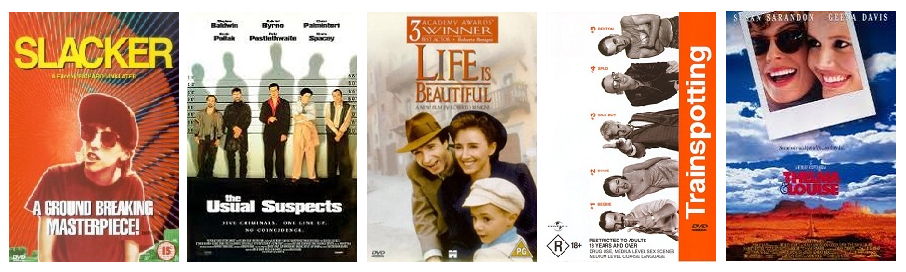
After a period of recession, the British film industry bloomed again in the nineties. Four Weddings and a Funeral (1994) launched the career of Hugh Grant and was a smash hit at the box office. In 1995 James Bond returned after a long period in the pretty awesome Goldeneye. What’s really great about British cinema in the nineties is the emergence of new talent though. The trio John Hodge, Danny Boyle and Andrew MacDonald made a terrific debut with Shallow Grave (1994) and followed it up with one of the best films of the decade: Trainspotting (1996). In 1998 Guy Ritchie was another positive British surprise with the very funny and exciting Lock, Stock and Two Smoking Barrels.
8. Scorsese Scores Big-time
He delivered brilliant work in the seventies (Mean Streets, Taxi Driver) and eighties (Raging Bull). In the early nineties the maestro showed that he could deliver masterpieces in every decennium. He started by breaking all cinematic conventions in GoodFellas (1990), the greatest film ever made about the real Mafia. Then he made the highly influential thriller Cape Fear (1991) and the excellent costume drama The Age of Innocence (1993) before returning to the mob genre with the superbly realized Casino (1995). He ended the decade with the underrated Bringing Out the Dead (1999).

9. Indie Cinema to the Max
Tarantino and the Coens are already honored in this overview, but there are many other great independent American directors who made their entrance in the nineties or definitely established themselves as masters. In the debut department, we saw Richard Linklater arrive with Slacker (1991), Dazed and Confused (1993) and Before Sunrise (1995). Kevin Smith also made a super impression with the low budget comedy Clerks (1994).

Other indie directors delivered some of their finest work in the nineties. For instance, Jim Jarmusch made Dead Man (1995) and Ghost Dog: Way of the Samurai (1999), David Lynch made Lost Highway (1997) and The Straight Story (1999), Steven Soderbergh made King of the Hill (1993) and Out of Sight (1998) and Todd Solondz made Happiness (1998). If we could only go back to re-experience this richness in indie cinema again. Oh boy.

10. Sci-Fi is Booming
The early nineties saw Schwarzenegger star in two of the most kick-ass Sci-Fi / Action movies of our time: Total Recall (1990) and Terminator 2: Judgment Day (1991). The director of the first one, Paul Verhoeven, would write more sci-fi history in 1997 with Starship Troopers (1997). Other excellent movies in this genre that came out in the nineties are: Robert Zemeckis’ Back to the Future III (1990), Steven Spielberg’s Jurassic Park (1993), Terry Gilliam’s Twelve Monkeys (1995), Roland Emerich’s Independence Day (1996), Luc Besson’s The Fifth Element (1997), Paul W.S. Anderson’s Event Horizon (1997), David Cronenberg’s ExistenZ (1999) and Dean Parisot’s Galaxy Quest (1999).

The final year of the millennium also saw Star Wars return to the big screen, but Star Wars: Episode I – The Phantom Menace (1999) was not an all positive experience. It was another sci-fi film released in 1999 that formed the perfect transition into the new millennium: the cyberpunk story The Matrix by the Wachowski brothers (now sisters). An exciting (and very, very good) surprise hit and the greatest ending imaginable for a movie decade that completely rocked.
Light & Magic: The Making of Cinema Magic

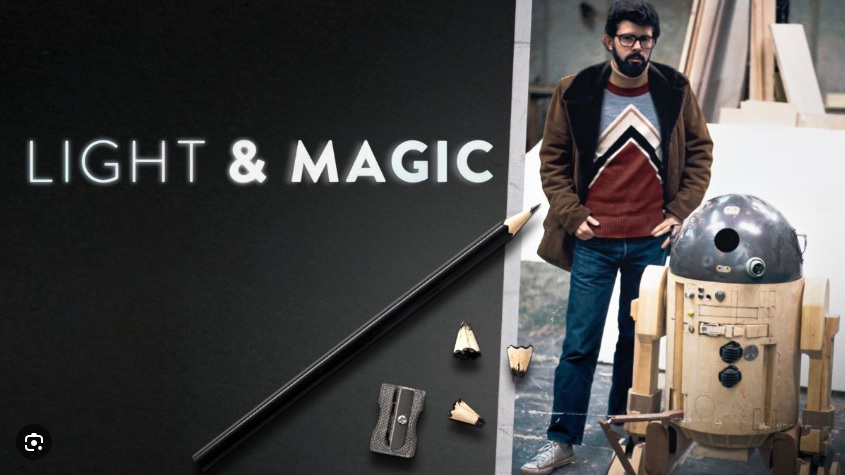
Special effects have always been a huge part of movies. From King Kong (1933), to the Ray Harryhousen films with the brilliant stop-motion effects, to the stunning 2001: A Space Odyssey (1968). Movies offer viewers the chance to see things that cannot be seen any other way. The six-part Disney Plus documentary Light & Magic tells the story of Industrial Light & Magic (ILM) that played an enormous part in the evolution of visual effects in Hollywood movies. The company was founded by George Lucas when he was working on his first Star Wars movie in 1977. He visited every optical effects company in the industry, but found none that could deliver what he had in mind.

2001: A Space Odyssey had really pushed the boundaries in what could be achieved in visual effects, but the movie was slow. Lucas wanted to create speed and energy. He wanted to see dog flights in space. He met a special effects man called John Dykstra, who was part of a small community of special effects people. He hired him to set up the team of model makers, storyboard artists and camera and light people at the newly founded ILM.

The first two episodes show the extremely challenging process of getting the first Star Wars film made. Thousands of elements had to be combined into extremely complicated shots. There were many desperate moments, but the end result was amazing and audiences and industry experts were blown away. Nobody but the people at ILM could have done it back then. It inspired many directors to also push the envelope in special effects the following years and decades, like James Cameron: “I went home, and said to my wife; ‘I quit my job. You have to pay the bills for a while, cause I’m gonna make a film’.”

The third episode is about ILM’s challenge to create a worthy sequel: The Empire Strikes Back (1980). This classical space opera had even more complicated special effects to accomplish. Like always with sequels, the scale was much larger than the first movie. The team also got other assignments than Star Wars, namely Raiders of the Lost Ark (1981), Dragonslayer (1981) and ET: the Extra-Terrestrial (1982). Movies that were nominated for or won Academy Awards for their amazing visual effects.

Lucas also got interested in computers and he hired Ed Catmull to digitize processes. The computer team made the impressive terraforming sequence in Star Trek 2: The Wrath of Kahn (1982) and this can be seen as the beginning of computer generated effects in movies. This inspired Lucas and the ILM people to get into it. Catmull’s division (Pixar) was later sold to Steve Jobs and they turned it into a cartoon company.

The next major project was Return of the Jedi (1983), the most complex movie in terms of visual effects ever conceived. “It was not a fun movie to make”, says one of the team members. But the result surely was fun to watch. Each of the 900 visual effects shots was a triumph for the ILM team. It was followed up by a number of other eighties classics: Indiana Jones and the Temple of Doom (1984), The Goonies (1985) and Back to the Future (1985). Each new project had its own challenges, and the attitude at ILM always was: ‘let’s do something that’s never been done before.’

In episode 5 titled ‘Morphing’, the computer era is really about to take off. The first successful computer effect was the water creature in James Cameron’s The Abyss (1989). Now that film could be translated into pixels that could be manipulated, anything became possible. But the industry needed a proof of concept and the 90 seconds sequence in The Abyss was just that. But as always with new technology, there is resentment at first. They called digital ‘the dark side’. Digital wasn’t yet seen as the main thing, but as an addition to old school effects. The model shop remained the central place in ILM’s laboratory.

Then one day, James Cameron called and he wanted to do something way bigger than The Abyss. He pitched them: Terminator 2: Judgment Day (1991). A liquid metal man was a huge leap from a water snake. The team had only nine months to create the T-1000. They first had to capture actor Robert Patrick in data. They filmed his muscles and how he moved. Once they had him digital, they combined all special effects with the right lighting, so it all seems to be part of the same world. The end result was stunning. One ILM guy recalls the T-1000 walking through the bars in the mental institution; an impossible shot. This was truly groundbreaking stuff.

The following year, another major movie would truly signal the end of traditional special effects. They had planned to create the dinosaurs in Jurassic Park (1993) with advanced stop motion animation. Spielberg hired the best guys in the business. Stan Winston would design the creatures and Phil Tippett would animate them. He also hired Michael Lantieri, a practical effects genius and Dennis Muren, a visual effects wizard. The team had already built the dinosaurs, and Light & Magic gives us a few images of what the Velociraptors looked like with stop-motion. They’re certainly impressive, but since we are now used to digital effects, the unrealness becomes an issue. Once they did a successful test with a digital T-Rex running through a landscape everybody knew: visual effects will never be the same again. “I feel extinct”, said Tippett, and Spielberg used that line in the movie.

So 1993 was the year of the big breakthrough of digital effects, and they would be used for many successful movies in the nineties, like The Mask (1994), Forrest Gump (1994), Jumanji (1995) and Star Wars Episode I: The Phantom Menace (1999). The documentary series ends with the final innovation that the visionary George Lucas had anticipated all along. The tv-series The Mandalorian (2019) is shot entirely in a round set called ‘The Volume’. This is ILM’s replacement for the green-screen. It uses a massive, curved LED screen to create photorealistic backdrops, circumventing the need for outdoor locations or extensive physical sets. Due to this innovation, The Mandalorian is able to deliver Star Wars effects on a tv-schedule and budget. ILM, which had started with a group of creative designers in a warehouse at Van Nuys, is still pushing the boundaries in creating cinema magic today, now also for the small screen.

George Lucas, Not Guilty

Today, on the premiere of ‘The Last Jedi’ – the eighth official episode in the Star Wars saga, creator of Star Wars – Mr. George Lucas – stands trial. He is accused of being a hack.

The prosecution (The internet)
Of the many things that catch blame for ‘ruining’ the Star Wars prequels – Jar Jar Binks, midi-chlorians, almost every line of dialogue George Lucas wrote for Padme and Anakin – there is one moment that makes almost every fan cringe, no matter how dedicated. We’re talking about Anakin Skywalker’s transformation into Darth Vader, literally the jumping-off point of the entire Star Wars saga.

In this moment, Vader learns that he has lost his wife and unborn children…and has been transformed into, like, a Space Robocop. So, what does he do? He breaks free from his shackles and lets out the now infamous, “NOOOOOOO!” that felt like it had a Kanye-level of autotune to it. It felt ridiculous when it should have been the defining moment of the prequels. What the hell was Lucas thinking?

The defense (Johnny Cochran)

This defense will be short and easy. This is the man who gave us Star Wars after all. The original Star Wars films still form the best trilogy ever created hands down. Even the third part – which is never the best in any series – is in case of Star Wars nearly perfect: ‘Return of the Jedi’ contains some of the best stuff of the series. Legendary film critic Roger Ebert (1942 – 2013) gave each of the three original films the maximum rating of four stars (read his awesome reviews here, here, and here).

So why is Lucas so hated despite being the man who gave us Darth Vader, Yoda, Han Solo, Princess Leia and Luke Skywalker amongst many others? Because he also gave us Jar Jar Binks? Because he writes remarkably terrible love scenes? So what? Didn’t the other great filmmakers of his generation make similar mistakes? Francis Ford Coppola cast his daughter in ‘The Godfather: Part III’ and it nearly ruined the film. Yet, he is never criticized in the way Lucas is.

Statistically, after sunshine comes rain. Lucas gave us the best trilogy ever made, so the prequels were never going to top that. Still, that is no excuse for not making better movies. But are they really so terrible?

Episode I: The Phantom Menace is the worst, most will agree. But look at what it does have: the pod race, Darth Maul (IMDb-poll names him the second greatest SW villain after Vader), and the return of many great characters: Palpatine, Yoda and Obi-Wan (Ewan McGregor is perfect casting as a young Alec Guinness). There is also fun foreshadowing going on of all that is to come. Finally, the world building is spectacular and unforgettable.

Roger Ebert – who gave ‘The Phantom Menace’ 3,5 stars out of 4 – concluded: “Mostly I was happy to drink in the sights on the screen, in the same spirit that I might enjoy ‘Metropolis’, ‘Forbidden Planet’, ‘2001: A Space Odyssey’, ‘Dark City’ or ‘The Matrix’. The difference is that Lucas’ visuals are more fanciful and his film’s energy level is more cheerful; he doesn’t share the prevailing view that the future is a dark and lonely place.”

Episode II: Attack of the Clones – The greatest weakness is the love story, we can be clear about this. But it would be a shame to let that ruin the whole movie experience, because episode II has a lot going for it. First of all, it has a terrific Raymond Chandler-style mystery plot. Also, there is a great sense of urgency; the battle for the galaxy has now really begun. And the filmmaking in general – the editing, sound, production design, music, etc – are all A-grade. There are few filmmakers with such imagination, and with the ability to bring it to the screen, like Lucas.

As for villains, usually the best thing about a Star Wars-film, I don’t like Jango Fett so much, but Count Dooku – played the uncanny Christopher Lee – is terrific, and so is his lightsaber duel with Yoda. The dark side is really prevailing now and Lucas effectively uses the principles of Eastern Philosophy to craft the story development. People may not like Hayden Christensen, but what is actually accomplished by his performance is that we get an uneasy feeling about Anakin. The air gets thick in the confrontational scenes. Unlike Obi-Wan – who was the perfect Jedi-student in episode I – Anakin is the pupil you always have to worry about. And these foreshadowing shots with Palpatine are grand. His quest to the dark side is thus very well handled.

Episode III: Revenge of the Sith  Episode III is a return to the classic space opera style that launched the series, and many agree that Lucas really approaches old trilogy greatness here. In the saga’s darkest chapter, Anakin really journeys to the dark side under the influence of the demonic Palpatine. Aside from the infamous ‘Noooo’-moment, episode III is a thoroughly exciting and enjoyable film with some of the best action sequences in the series.

And so, ladies and gentlemen of the jury, if George Lucas is a hack, then Chewbacca lives on Endor, and therefore you must acquit! The defense rests.

So let us all shut the hell up and enjoy Lucas’ legacy.