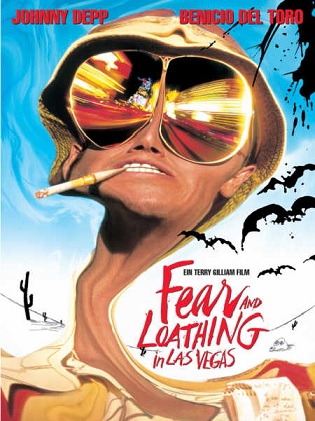
Fear and Loathing in Las Vegas

Director: Terry Gilliam
Written by: Hunter S. Thompson (book), Terry Gilliam (screenplay), Tony Grisoni (screenplay), Tod Davies (screenplay), Alex Cox (screenplay)
Cast: Johnny Depp, Benicio Del Toro, lot’s of cameo’s including; Tobey Maguire, Gary Busey, Ellen Barkin, Christina Ricci, Cameron Diaz, Flea and Harry Dean Stanton

Year / Country: 1998, USA
Running Time: 118 mins.

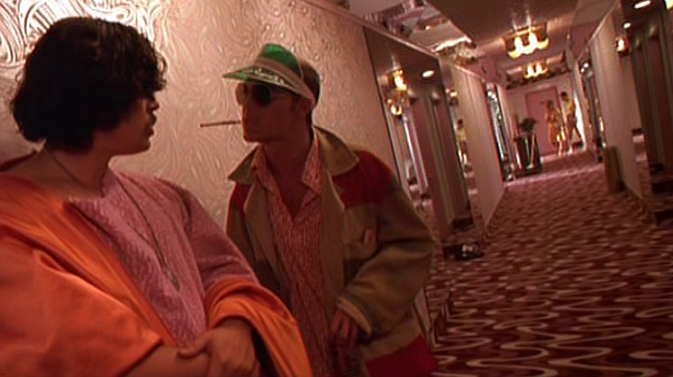
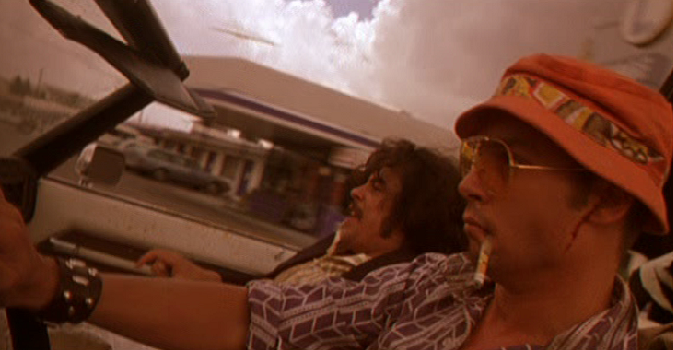
It is the foul year of our lord 1971 and Gonzo journalist Hunter S. Thompson (Raoul Duke in the story) and his Samoan attorney Dr. Gonzo decide to undertake the ultimate trip of the seventies. The official assignment is to cover the Mint 400 desert race in Las Vegas, but they have something bigger in mind. They want to find the American dream. Armed to the teeth with highly dangerous narcotics, they head out to Las Vegas in their fire red convertible… Some trip it’s gonna be…

While searching for the American dream, Thompson and Dr. Gonzo only find fear and loathing. Intolerable vibrations in a town not at all suitable for the use of psychedelic drugs. The atmosphere is extremely menacing, but as they behave as animals, nobody even notices them. Vegas turns out to be a savage town. And while soldiers are dying in Vietnam, used car dealers from Dallas throw their money in the slot machines, Debbie Reynolds sings in the Desert Inn and the national police force meets at a congress about marijuana. Thompson and Dr. Gonzo are there.

Thompson’s novel ‘Fear and Loathing in Las Vegas’, which was first published in two parts in Rolling Stone Magazine, became a cultural phenomenon (and my personal favorite book of all time). The movie adaptation by Terry Gilliam is a literal one. Thompson wrote his famous novel Gonzo style, which means the events are told through the eyes and vision of the author who fully participates in the story himself. Since Thompson was heavily under the influence during the writing process, he claims he can’t fully remember which parts truly happened and which ones did not (fully). Therefore this literal adaptation is a highly enjoyable blast, though not always realistic.

There is one downside to director Gilliam’s literal approach. In the novel, all the psychedelic escapades form an integral part of what is obviously a literary masterpiece. In the translation to film however, these escapades sometimes appear to be useless fuckarounds, especially during the final part of the film. However, that is a minor criticism for this is obviously a highly enjoyable movie. Depp and Del Toro are both terrific in their method acting approaches to their roles. Thompson’s poetic writing, beautifully narrated by Depp in voice-over, runs through the movie that captures the era and hallucinogenic nightmare perfectly. Combined with a beautiful seventies soundtrack and Grade A settings, the great time capsule that is Fear and Loathing in Las Vegas is complete. Also, it is one of the funniest movies of all time. So buy the ticket and take the ride.

Rating:

Biography: Terry Gilliam (1940, Minneapolis) started his career as the only American member of the British comedy group Monty Python. As animator, he was responsible for the bizarre cartoons used in the sketches. In 1975 he directed his first movie for Monty Python, namely Monty Python and the Holy Grail. After his period with Monty Python, he moved on as independent director and had remarkable success with his bizarre masterpiece Brazil in 1985. After that success, things went downhill for Gilliam; The Adventures of Baron Munchausen became an expensive flop and the disastrous production of the never completed Don Quichotte became legendary. Despite these problems, Gilliam returned and directed a number of valuable contributions to cinema, including sci-fi masterpiece Twelve Monkeys and cult classic Fear and Loathing in Las Vegas.

Filmography: Storytime (1968, short) / The Miracle of Flight (1974, short) / Monty Python and the Holy Grail (1975) / Jabberwocky (1977) / Time Bandits (1981) / The Crimson Permanent Assurance (1983, short) / The Adventures of Baron Munchausen (1988) / The Fisher King (1991) / Twelve Monkeys (1995) / Fear and Loathing in Las Vegas (1998) / The Brothers Grimm (2005) / Tideland (2005) / The Imaginarium of Doctor Parnassus (2009) / The Legend of Hallowdega (2010, short) / The Wholly Family (2011, short) / The Zero Theorem (2013) / The Man Who Killed Don Quixote (2018)
AOW = Asociaal Oud Worden

De levensverwachting van mensen neemt schrikbarend toe. Volgens een recent artikel in Elsevier (nr. 38, 22 sept 2012) stijgt de levensverwachting door de steeds beter wordende medische wetenschap met drie maanden per kalenderjaar. ‘Elke week krijgen we er een weekend bij’, stelt dr. Johan Polder in het artikel. Als de stijging doorzet, zullen mannen in 2050 gemiddeld ruim 90 jaar oud worden en vrouwen 94.

En dan lees ik ook nog dat zo’n 40 procent van de Nederlanders tegen verhoging van de AOW-leeftijd is. Mensen, de kosten lopen zwaar uit de pas en er moet echt iets gebeuren. De gemiddelde zorgkosten stijgen met leeftijd, dus we moeten met zijn allen minder oud worden. Dat is echt de enige oplossing. Maar eeuwig doorleven en vreten is niet langer haalbaar. En met dat eeuwige sparen help je het land verder in een recessie. Tijd voor actie dus!

Hoe gaan we dat doen, de gemiddelde leeftijd omlaag krijgen? Volgens de politiek is maatschappelijk debat nodig. Ik doe dan maar alvast een duit in het zakje. Er zijn mijns inziens grofweg twee opties; het reguleren van leeftijdverlaging of het overlaten aan de burgers zelf…

1. Zelfregulering
Als je chronisch ziek wordt, kun je je eeuwig door laten behandelen, maar dan neem je dus geen verantwoordelijkheid. Als je weinig tot geen vooruitzicht op verbetering hebt en je maar doorgaat met dure behandelingen jaag je de maatschappij op kosten. Dat is asociaal. Doe dus als de grote Gonzo journalist Hunter S. Thompson en maak jezelf gewoon van kant. Thompson was ‘pas’ 67, maar chronisch ziek, dus schoot hij zichzelf door zijn hoofd. Dat is sociaal voor de maatschappij, toch? Zijn begrafenis kostte dan weer wel een miljoen dollar, maar dat heeft zijn goede vriend Johnny Dope betaald.

2. Regulering
De overheid kan euthanasie ook verplicht stellen op een bepaalde leeftijd. Stel, u wordt 73 en krijgt nog eens een leuk bedragje van de overheid om de bloemetjes buiten te zetten en daarna meld u zich voor beëindiging. Dit kan uiteraard op bestelling bij uw thuis. Een mooi muziekje en inslapen maar. Met dit idee zou een nieuwe partij, zoals de PvdJ (Partij van de Jeugdigheid) best campagne kunnen voeren. ‘Minder oudjes in het land, zorgkosten weer in de hand’ of iets dergelijks zou de slogan kunnen zijn.

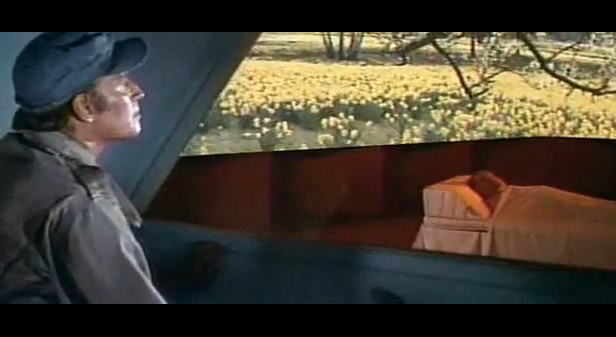
In de film ‘Soylent Green’ uit 1973 worden bejaarden ook op die manier ge-euthanaseert om de overbevolking tegen te gaan. Het is efficiënt, goedkoop en eerlijk. Okay, in de film worden de mensen vervolgens in koekjes omgezet en dat hoeft nou ook weer niet (niet te vreten, sowieso).

Zijn er nog andere ideeën om de gemiddelde leeftijd wat omlaag te krijgen? Accijns op alcohol en roken afschaffen bijvoorbeeld. Of de snelheid op provinciale wegen verhogen. We komen er wel… Zolang de begroting maar sluitend is. Mensen, dat vindt u toch ook het belangrijkste?

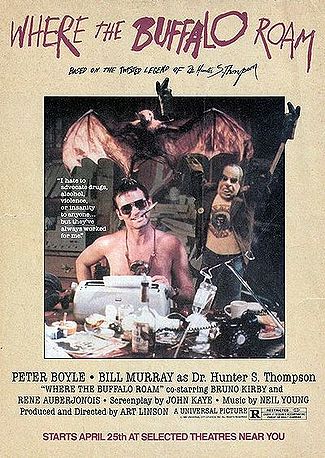
Where the Buffalo Roam

Director: Art Linson
Written by: Hunter S. Thompson (stories), John Kaye (screenplay)
Cast: Bill Murray, Peter Boyle, Bruno Kirby, R.G. Armstrong

Year / Country: 1980, USA
Running Time: 95 mins.

‘I hate to advocate weird chemicals, alcohol, violence or insanity to anyone, but in my case it worked.’ Where the Buffalo Roam is the first movie adaptation of the work of legendary Gonzo journalist Hunter S. Thompson, who is portrayed by Bill Murray in the movie.

The story of Where the Buffalo Roam deals with Thompson’s encounters with his equally legendary ‘mutant’ attorney Oscar Zeta Acosta, who is called Carl Lazlo here and is portrayed by Peter Boyle. The movie is based on Thompson’s obituary for his attorney who disappeared in Mexico in 1974, three years after their two trips to Las Vegas that were immortalized in Thompson’s masterpiece ‘Fear and Loathing in Las Vegas’.

Screenplay writer John Kaye also drew from other works of Thompson, including ‘Fear and Loathing on the Campaign Trail 72’’, ‘Fear and Loathing in Las Vegas’ and ‘The Great Shark Hunt’. The final result depicts three journalistic adventures of Thompson in which Lazlo shows up. The first one involves San Francisco drug trials in which Lazlo represents wrongfully indicted youngsters. The second story shows Thompson missing the Super Bowl to accompany Lazlo on a failed activist mission. Finally, Thompson is seen on the presidential campaign where he has a one-on-one encounter with his self proclaimed nemesis Richard Nixon.

Most of the people involved, including Thompson himself, didn’t like the final result or even hated the movie. It is easy to see why. Much of Thompson’s razor sharp journalism resorts into a bunch of silliness. The second half is especially very uneven. Still, it is a lot of fun hearing a number of great Thompson quotes being uttered by Bill Murray, who’s excellent in the role of Gonzo journalist. Boyle is also enjoyable as his dope crazed attorney.

As a whole, the movie is indeed too silly to be perceived as a success or an effective movie translation of Thompson’s writing. However, separate parts range from funny to almost great. Especially the sequences in which Thompson has to meet deadlines, but is too preoccupied with weirdness and dope frenzies. Also includes an excellent soundtrack featuring: Neil Young, Bob Dylan, Jimi Hendrix and Creedence Clearwater Revival.

Rating:

Biography: Art Linson (1942, Chicago) was born in Chicago, but grew up in Hollywood. He graduated from UCLA Law School in 1967 but never practiced. Linson has distinguished himself in Hollywood by developing scripts and stories that attract the highest caliber talent, resulting in some of the most admired and successful motion pictures of the last two decades, including Heat, Fight Club and The Untouchables. In 1995, Linson published his first book, ‘A Pound of Flesh: Perilous Tales of How to Produce Movies in Hollywood’. His second book, ‘What Just Happened? Bitter Hollywood Tales From the Front Line’, was published in 2002.

Filmography: Where the Buffalo Roam (1980) / The Wild Life (1984)

Bedrijfsleven Nederland is braaf (geworden)

Toen ik begon in de business journalistiek, bijna 4 jaar geleden, had ik nog een heel ander beeld bij het bedrijfsleven. Ik zag mezelf wel conferenties en kantoorpanden afstruinen, zoekend naar excessen in drugs, vrouwen of onbehoorlijk gedrag. Nou ja, niet echt dat natuurlijk, maar meer opvallend en opmerkelijk gedrag binnen de zakenwereld had ik toch wel verwacht, ja.

Geïnspireerd door Hunter S. Thompson, uitvinder van de Gonzo journalistiek – een werkwijze waarbij de journalist alles vanuit eigen perspectief vertelt en al zijn ruwe materiaal onbewerkt publiceert – zou ik de zakenmensen en gebeurtenissen beschrijven. Misdragingen voorzien van subtiele kritiek. Lekkere journalistiek waar we toch al weinig van zien deze dagen.

Inmiddels kan ik stellen dat de heren bedrijfsleven zich in Nederland keurig netjes gedragen. Af en toe een foute opmerking over Chinezen of Indiërs tijdens een rondetafeldiscussie over outsourcing, maar daar is het wel grotendeels mee gezegd. Het ruwe materiaal publiceren zou ook weinig onthullends opleveren (nu gaat alles keurig langs corporate communications). Vorige week toen ik een verslag van collega Michiel uitwerkte stond er in zijn aantekeningen over een recente bijeenkomst voor CFO’s waar hij bij was geweest:

Main dude: “ha ha, stropdas in de auto laten liggen, ik ben duidelijk in de minderheid.”

Niet heel onthullend, nee. In de afgelopen vier jaar en kredietcrisis zijn er wel degelijk wat ‘mooie’ verhalen geweest in Nederland over excessen en onethisch gedrag. Het eerste wat me zo te binnen schiet is Dirkje Scheringa en zijn DSB Bank. Maar, inmiddels anno 2011, wordt het braver en braver. Onlangs op een enorme conferentie voor financiële toplui stond het onderwerp duurzaamheid op het programma. Duurzaamheid!! Vier jaar terug was het nog ‘What leads to high performance’, oftewel keiharde winst ($$$) maken.

In Het Financieele Dagblad van afgelopen week riep Feike Sijbesma, CEO van DSM, op om massaal geld te doneren aan Oost-Afrika. Wat is er gebeurd met de inhalige wolven die corporate Nederland ooit domineerden? Of komen die alleen in de VS voor?

De wereld is echt aan het veranderen. En er lijkt iets goeds uit te gaan komen, of tenminste iets beters dan er was. Niet om melancholisch te klinken, maar waar zijn de dagen dat bankiers de samenleving van miljoenen beroofden? De American Psycho days? Misschien is het allemaal van korte duur en kan ik alsnog onthullende rapportages gaan maken over boeven in maatpak. Maar met een betere wereld neem ik ook wel genoegen.