Why Donald Trump is the Best Socialist Reviver Imaginable

In a wide-ranging conversation on the Econoclasts podcast, the Marxist economist Richard Wolff laid out a sweeping account of where American capitalism stands today, why he believes the United States is past its peak as a global power, and why he sees a genuine, if still inchoate, socialist revival taking shape among a new generation of Americans. What follows is a summary of his argument, segment by segment.
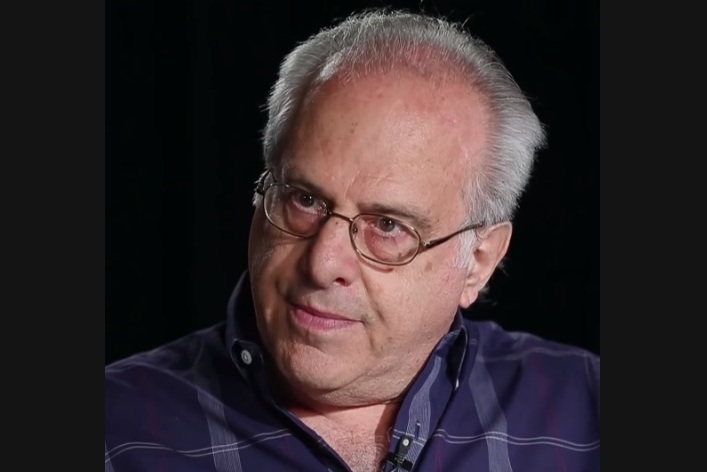
Who is Richard Wolff?

Richard Wolff is a professor of economics emeritus at the University of Massachusetts, Amherst, and a visiting professor at the New School in New York City, where he now lives. Over a long career he has also taught at Yale, the City University of New York, and the Sorbonne in Paris.

Wolff describes himself as having spent most of his life working on the margins of acceptable American discourse – Marxist economics was, for decades, treated in the United States as barely tolerable even inside universities. He recalls that as a student he had to pursue his interest in Marxism largely on his own, in part by choosing to study at Stanford specifically so he could work with the radical economist Paul Baran in the final year of Baran’s life.

Today, Wolff says, the ideas he has spent a career developing have moved from the fringes toward the center of American political conversation, a shift he attributes in part, ironically, to Donald Trump. In his view, Trump’s presidency has done more to organize a socialist revival in America than any organizer on the left could have managed alone.

What is his view on this stage of capitalism?

Wolff argues that capitalism suffers from three structural flaws it has never managed to overcome. The first is its built-in tendency toward extreme inequality of wealth and income – a tendency so severe that, historically, it has periodically triggered uprisings from below before reasserting itself once those uprisings subside.

He points to the contrast between the celebration of Elon Musk’s path toward becoming the world’s first trillionaire and the fact that roughly two-thirds of Americans live paycheck to paycheck. Because capitalism enriches only a minority, he argues, that minority is perpetually anxious that democratic majorities might use the ballot to undo the inequality – which is why, in his account, the wealthy are compelled to corrupt politics to protect their position, something he says was made visible when billionaires sat arrayed on the dais at Trump’s 2025 inauguration.

The second flaw is instability: the recurring cycle of booms and busts that the National Bureau of Economic Research clocks at roughly every four to seven years, and which Wolff says has struck on schedule in 2000, 2008, and 2020, despite decades of Keynesian efforts to tame it. The third flaw is ecological – the way the profit motive drives capitalism to neglect or postpone the collective needs of both human beings and the natural environment.

Taken together, Wolff frames these as reasons to conclude, as humanity once concluded about slavery and feudalism, that a better system is both necessary and achievable.

What is happening to America that is quickly failing as a leading nation?

According to Wolff, the United States has passed its peak and entered a period of imperial decline, and he points to several converging signs. Militarily, he argues the U.S. failed to achieve its goals in Vietnam, Afghanistan, and Iraq, and is faring no better against Iran, while the outcome in Ukraine remains uncertain.

Diplomatically, he says Washington has squandered the ‘soft power’ that once made allies eager to align with it – citing, as a striking example, a petition drive in Canada, a longstanding ally, with more than 250,000 signatures calling for the expulsion of the American ambassador.

Domestically, he sees a historic collapse of trust in both major parties. As evidence, he points to New York City’s 2025 mayoral election, in which Zoran Mamdani – a democratic socialist and member of the Democratic Socialists of America – defeated the establishment-backed Cuomo family by a wide margin, despite carrying two labels (socialist, Muslim) that Wolff says have traditionally been politically fatal in America.

Wolff also connects this domestic decline to the country’s chronic government debt, which – echoing the interviewer’s framing – he treats not as a side effect but as part of the very mechanism that has funded American global dominance since the 1970s, as trading partners recycle dollars earned from U.S. imports back into American debt.

Is socialism on the rise?

Wolff believes it is, though he is careful to describe it as an awakening rather than a mature movement. He notes that support for both Trump and for left figures like Bernie Sanders and Mamdani spring from the same underlying source: a widespread recognition, across the political spectrum, that ordinary Americans’ economic security has been stripped away since the rollback of the New Deal began after 1945.

Polling, he says, shows that the younger the American, the more favorably they view socialism – even though, as he readily admits, most young people who hold this view know relatively little about socialism’s history or internal debates. What they are expressing, in his reading, is not yet a worked-out ideology but a rejection: a conviction that the current system is unbearable and cannot be reformed from within.

What would real socialism look like?

Wolff is emphatic that the socialism he has in mind bears little resemblance to the popular image of Soviet-style shortages and bureaucratic stagnation. For him, the USSR and similar systems represented state-run capitalism, in which the state simply replaced private owners as the boss while workers still had no say over their own workplaces – not genuine socialism at all.

The alternative he has spent much of his recent career developing is what he calls the Worker Self-Directed Enterprise, or WSDE. In a WSDE, there are no outside shareholders and no board of directors separate from the people who do the work; instead, the employees who work in an enterprise collectively and democratically decide what to produce, how to produce it, and – critically – what to do with the profits, or surplus, the business generates. Rather than that surplus flowing to distant owners, it stays with the people who created it, to be allocated toward wages, reinvestment, or community needs as the worker-members themselves decide. Wolff points to Spain’s Mondragon Corporation, a federation of more than 85,000 worker-members operating on a one-worker, one-vote basis, as the clearest real-world proof that the model can function at scale.

Wolff does not propose abolishing markets or nationalizing the economy overnight. Instead, he envisions a gradual, legally supported transition: laws that make it easier to convert existing firms into WSDEs or to start new ones, school curricula that teach the model alongside conventional corporate structures, and political movements that represent the interests of a growing WSDE sector the way today’s parties represent capital and labor.

The underlying principle, as he puts it, is that economic democracy inside the workplace is the necessary foundation for real political democracy, because a society cannot be genuinely self-governing at the ballot box while most people spend eight hours a day answerable to bosses they had no part in choosing.

SOURCE:
America is quietly losing the world – Yanis Varoufakis & Richard D. Wolff | The Econoclasts

Is America’s Existential Crisis Unsolvable?

The Trump regime has been in power for 15 months now, and its actions are becoming increasingly damaging for the country and the world. The start of the Iran war by rogue states US and Israel, in which a girls’ school has already been bombed (170 children dead) and U.S.-Israeli airstrikes on oil depots caused ‘acid rain’ poisoning the population, is only the latest in a long list of scandalous crimes and human tragedies.

There is certainly a loud call for Trump to be impeached, but despite a lot of talk of a rupture in the MAGA movement, he still has full support of MAGA and the Republican Party. That is despite all the campaign promises he has broken and crimes he has committed, including his name being mentioned in the Epstein files a million times.

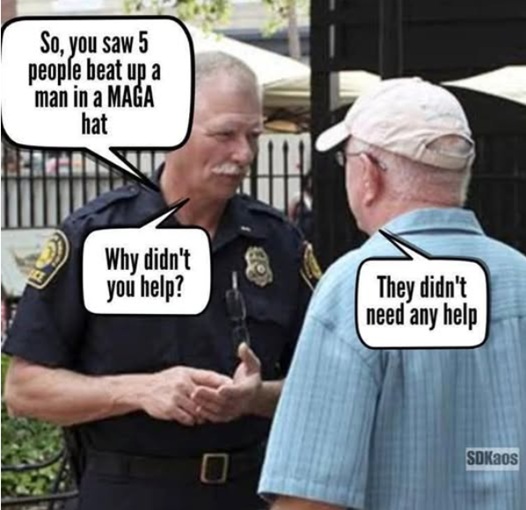
What does that tell us about the state of the country? In short: America is cooked. A recent post by a MAGA canal really drove it home for me:

The post refers to a recent scandal in which it became known that Secretary of War Crimes Bourbon Pete Hegseth went on a mad spending spree at the Pentagon blowing millions on lobster and steak.

The way this message is framed is that if you are opposed to over-spending at the Pentagon, you are against American troops getting decent food. Even worse, if you’re against American soldiers getting fed lobster and steak, you are obviously in favor of spending huge amounts of money on insurance premiums for illegals.

The debate over public spending on undocumented immigrants is completely unrelated to Pentagon spending, but the division in the USA paints everything in a toxic black and white picture. Trump has amplified these tensions through persistent misinformation, inflammatory rhetoric, and the promotion of unfounded conspiracy theories.

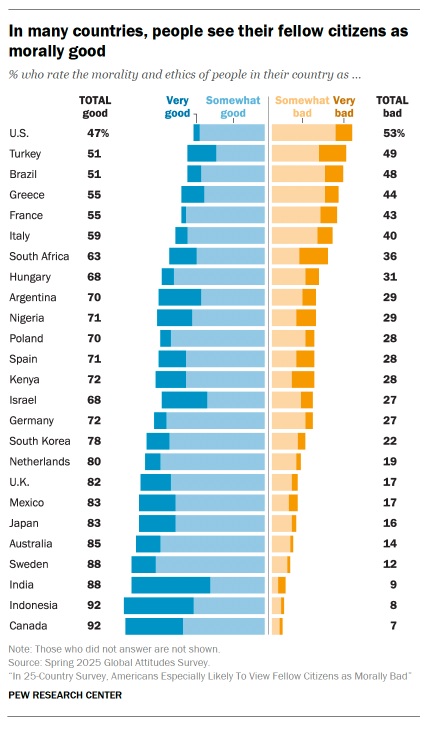
A recent poll indicates how deep this distrust in American society goes:


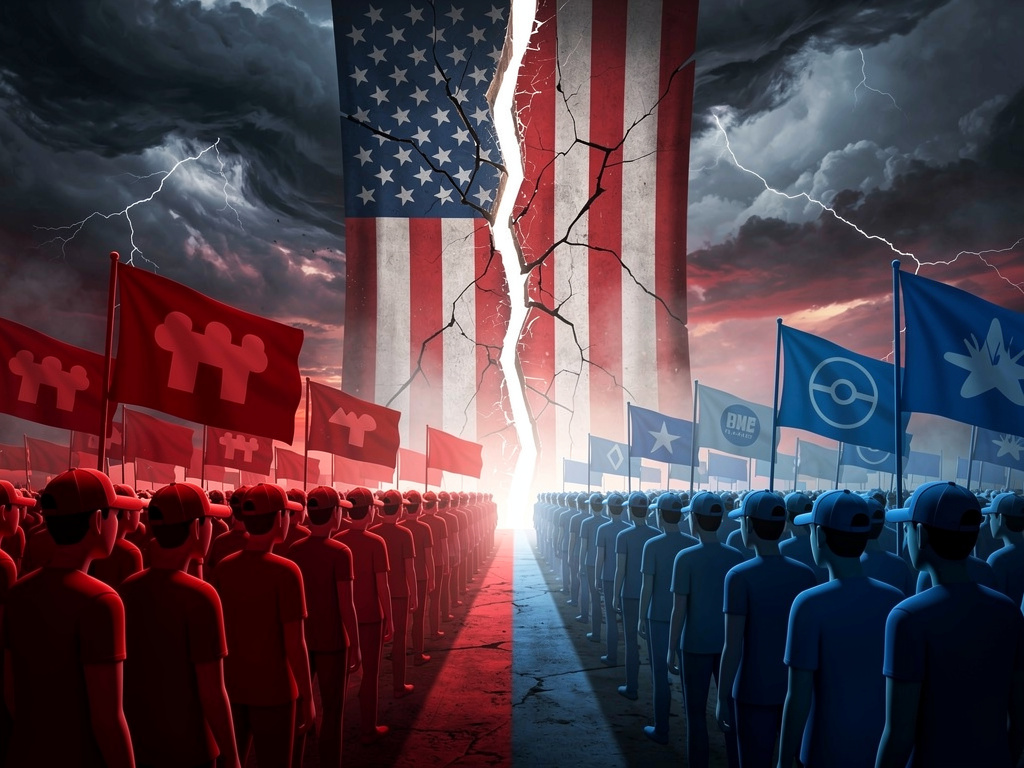
A whopping 53 percent of Americans see their fellow citizens as immoral, and this is obvious from how they are portraying each other in the media. MAGA is condemned for supporting an obviously criminal and completely immoral president who is destroying democracy, while democrats are seen as evil people who want to overflow the country with illegal criminals and rapists. This has become such a widespread belief among a large part of the country that it will be hard to get them back from this – even if Trump would be gone.

And that’s the heart of the problem: Americans are now living in entirely separate realities, each shaped by fundamentally different value systems. Democrats generally believe America should strive to be a force for good – flawed as it may be – working to improve lives and promote democracy around the world, even if the execution isn’t always perfect. In contrast, the ‘America First’ ideology pushes for a vision rooted in white, Christian, male dominance, where the U.S. operates as an unapologetic superpower, taking what it can with little or no regard for others. Under this worldview, immigrants are not just excluded but actively demonized, treated as threats to be expelled or erased.

How do you convince the MAGA crowd that Trump and his party are only in it for personal gain, and their actions are severely damaging to the country in the short and especially the long term?

The media are a big part of the problem. Mainstream channels have chosen for Trump (like FOX ‘News’) or a middle of the road approach, which really doesn’t work in this environment. A newspaper headline, like ‘Trump wants to acquire Greenland’ really doesn’t reflect what is really going on: ‘Dictator Trump wants to aggressively annex Greenland with military force’.

So the media is not doing its job, and even worse, many Trump supporters now own all major media, especially after the recent acquisition of Warner Bros Discovery by Trumper Larry Ellison.

And this is one of the reasons I am so pessimistic about America’s future prospects. The media is extremely important to turn the tide, but the legacy media are not doing their job and social media (owned by Trump’s billionaire cronies) that monetize conflict are making things much much worse.

But it is far from the only problem. These are other major issues that make a turnaround in the short term very unlikely:

● The Republican party are the only ones who could really stop Trump, but they are not doing it. The old party – yes, they were assholes, but at least they had some independent thinking going on that would definitely be opposed to much of what Trump is doing – is dead. Trump has destroyed it, and they are now in it for 100 percent. No matter how insane their leader is, they won’t stop him.

● The democrats – while they have some good people – are far from united and they are not speaking with one voice. Take the Iran war, where is their reunited condemnation of this illegal war?

● The corporate political donor system is still very much in place. That means that not the American people, but the big corporations decide which policies will be implemented. At the same time, the concentration of wealth and a non-level playing field for the middle and working classes are turning American democracy into an oligarchy.

● The current U.S. Supreme Court is widely seen as both a reflection and an amplifier of the country’s deep political polarization. The Court now has six conservative justices and three liberal justices. This ideological split is the most pronounced in decades, and the Court’s rulings increasingly break along these lines. In recent terms, the number of cases decided by a purely partisan vote has tripled, while unanimous decisions have declined sharply. The Court’s rulings on issues like abortion (Dobbs), campaign finance, voting rights, and executive power have not only reflected, but also deepened political divisions. The Court’s growing alignment with partisan politics has led many Americans to view it less as an impartial legal institution and more as a political actor. This shift is evident in public opinion polls, where favorable views of the Court are near historic lows, especially among Democrats and younger Americans

What America needs is a huge turnaround, a systematic change in government and how it functions. I currently see no evidence of this happening. The focus is now – understandably – on winning the Mid Terms by democrats and then winning the 2028 election in order to stop Trump. And it will certainly be a relief to see Trump removed. If they can, and this is a huge if.

However, the problems mentioned above will still be there. Which democratic leader will really solve this mess? Bernie Sanders was that leader, but the dems thought nominating him was too risky. A new leader of that calibre has not yet emerged.

We have been here before. When Biden won the election in 2020 we were relieved. But 74 million people still voted Trump in 2020 even after his disastrous first term. Just as worrying: about 89 million eligible Americans did not vote in 2024, while the country was under threat by a fascist takeover by MAGA. That means the trust in politics to solve problems has sunk to rock bottom in the US.

Optimists note that the U.S. has navigated previous existential threats – including the Revolutionary and Civil Wars – suggesting a capacity to overcome deep crises.

That may well be, but I currently see no way out of the polarization, so my current analysis is that the American crisis is terminal. We, as Europeans, have to steadily derisk from the USA and realign ourselves with reliable partners, such as Canada.

Let’s hope that in the long term, the crisis is an opportunity for the US to address long-standing flaws (such as economic inequality or political dysfunction) and create a ‘new Renaissance’ or a more inclusive society.

But for now, this is unfortunately the status of the country:

😅