In Brussels (2)

“The mind is not only an internal phenomena, but an external landscape thing as well. When you walk around a city, it is located in your mind and you’re creating every external object you observe in this cityscape. Those objects wouldn’t be present without you. They don’t exist in the world, they exist strictly in observers.”
― Nicky Mento, ObserverWorld

[22-05-25] The road was becoming familiar by now. As I approached Belgium, five towers loomed on the outskirts of Antwerp, overlooking the highway. What a terrible, unnatural way to live, I thought. But I suppose, in this day and age, that qualifies as prime real estate.

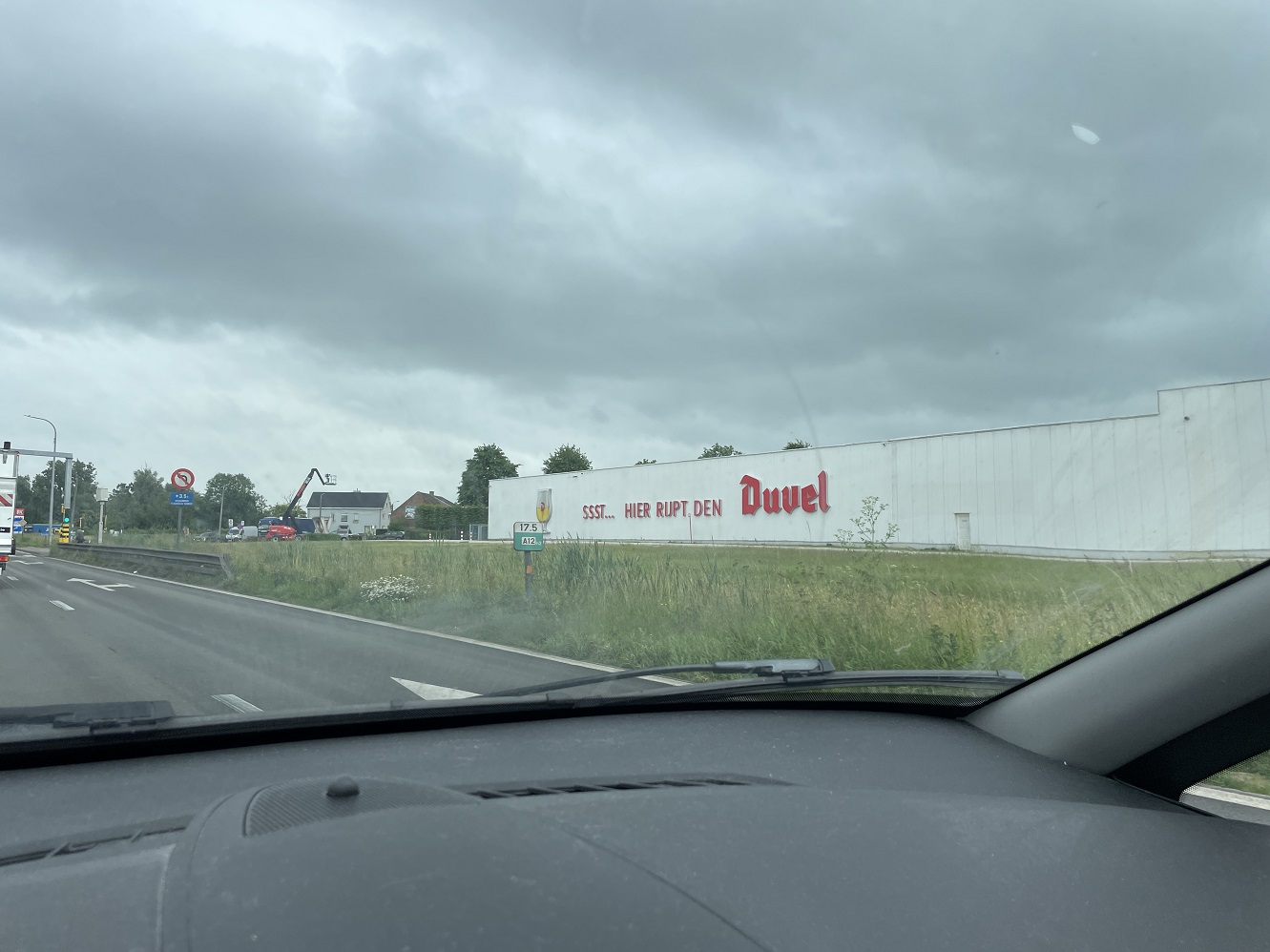
Other landmarks slipped past on the A12: the Duvel brewery, the gleaming geometry of the Atomium, and of course, the beautiful cathedral that greets you as you enter Brussels. I was in the city for the second time that week – this time for an interview with the head of the Belgian antitrust authorities, which, in the world of M&A, is no small thing.

It was a week before my 45th birthday, and I felt good. Energized, even. Ready to explore this engaging city once more. The interview went well, and afterward, I ducked into a café to get some work done. Later, I made my way to De Brouckère Square again. But instead of stopping at the Metropole like last time, I went to the UGC cinema to watch Mission Impossible: Dead Reckoning.

I’d noticed Tom Cruise’s face of posters scattered across the city when I drove in. In this eighth – and possibly final – installment, he was truly up against the impossible: defeating a rogue artificial intelligence that had seized control of the internet.

The film wasn’t perfect, it dragged on in parts, but the finale was spectacular. The airplane sequence was a genuine triumph. It also tapped into one of the most pressing threats facing the modern world: the drift from information war to potential nuclear conflict. So kudos to Cruise and director Christopher McQuarrie for pulling it off.

Luther had the last word, and it was a hopeful one: there are countless possibilities ahead, and we can choose well: not just for ourselves, but for others. “Nothing is written.” A message that harmonizes beautifully with quantum physics – and fittingly so, given this city’s history. In 1927, the world’s leading physicists gathered at the Metropole on De Brouckère Square to grapple with the implications of their discoveries.

They didn’t phrase it in those exact terms, but the idea was present: the universe arises from unmanifested potential, and it is consciousness – expressed through living beings – that brings it into form, shaping reality within the space-time field they themselves create.

In the film, the AI, known simply as The Entity, can calculate the probabilities of human choices, predicting the future with uncanny accuracy. To defeat it, the characters must make wildly improbable decisions, thereby evading its forecasts. That concept stuck with me: What improbable choice should I make? Should I invest everything into Free-Consciousness and try to get the platform off the ground?

I wandered into a sushi restaurant to think it over. The waiter greeted me with a nod and showed me to my table. I felt a bit like Robert De Niro’s character, Noodles, in Once Upon a Time in America, being led to a bed in the Chinese opium den – where he proceeds to dream the second half of the film into existence. Or so it seems. Only my opium was sushi and cola from an unfamiliar brand.

But I was there to dream. To dream about life, about work, about writing and movies. The week before, I’d come to a realization: I have too many passions. And by trying to do them all, none of them is really going anywhere. I started Free-Consciousness to bring a small spark of awareness to a world in decline. But if I want it to succeed, do I need to go all in?

To help answer that question, I brought along a trusted companion: the I Ching, or Book of Changes – one of humanity’s oldest living oracles. For more than three thousand years, this ancient Chinese system of divination and wisdom has helped emperors, sages, and ordinary people navigate life’s complexities. While traditionally understood through classical philosophy, new interpretations suggest the I Ching might be an early interface for the consciousness field; a symbolic system for engaging with probability patterns and glimpsing potential futures.

My question to the book was simple: Is it okay to dabble in all my hobbies, or should I focus on just one and fully commit?

The system revolves around 64 hexagrams – six-line figures made up of either solid (yang) or broken (yin) lines. Each hexagram represents a universal situation or process. I took three coins from my wallet and cast them six times to determine which lines to draw.

The result was Hexagram 53: Chien / Development. And it was exactly what I needed to hear.

The text read:

‘The image of this hexagram is that of a tree growing high on a mountaintop. If this tree grows too quickly, without properly rooting itself, it becomes vulnerable to the wind and may be torn apart. But if it takes time to establish strong roots and is content to grow gradually, it will enjoy a long life and a lofty view. Human beings are no different. While we often crave rapid progress – immediate achievement of all our goals – we must eventually come to understand that the only lasting progress is gradual. Chien urges you to accept this truth and shape your thoughts, attitudes, and actions accordingly.’

Word. Free-Consciousness is like that tree. It needs time to root before it can rise.

Mijn Top 20 favoriete filmmakers

1. Martin Scorsese
Verantwoordelijk voor mijn favoriete film aller tijden: GoodFellas. Maar maakte talloze andere meesterwerken; Raging Bull, Taxi Driver, Casino, en vele anderen. Scorsese is een echte maestro die nooit teleur stelt.
Beste film: GoodFellas

2. Sergio Leone
Leefde te kort om een enorm portfolio na te laten, maar alles wat hij gedaan heeft is te gek. The Dollars Trilogy met Eastwood zijn de coolste films ooit en Once Upon a Time in America is een geniaal gangster epos.
Beste film: Once Upon a Time in the West

3. Quentin Tarantino
Maakt originele & uber coole films die hij baseert op onbekende pareltjes. Zijn meesterwerk is nog altijd Pulp Fiction, maar Reservoir Dogs en Kill Bill zijn bijna net zo briljant. Maakt nooit iets ondermaats.
Beste film: Pulp Fiction

4. Peter Jackson
Wist de onmogelijke missie om The Lord of the Rings te verfilmen tot een onvoorstelbaar succes te maken. Was daarvoor al een geweldig regisseur die Nieuw-Zeelandse splatter horror films maakte zoals Bad Taste en Braindead.
Beste film: The Lord of the Rings: The Two Towers

5.
The Coen Brothers
Hun oog voor bizarre personages is hyper ontwikkeld, hun humor onovertroffen en hun pen vlijmscherp. Ze maken om de twee jaar een te gekke film al zo’n 25 jaar lang, met hun hoogtepunt in de jaren 90 toen ze achtereenvolgens Fargo, The Big Lebowski en O Brother, Where Art Thou? maakte.
Beste film: Miller’s Crossing

6. Stanley Kubrick
De perfectionist. Leverde meesterwerken af die voor altijd verankerd zijn in de filmgeschiedenis. Wist uit te blinken in verschillende genres waaronder sci-fi (2001: A Space Odyssey), oorlog (Full Metal Jacket) en misdaad (The Killing)
Beste film: A Clockwork Orange

7. Steven Spielberg
Objectief de beste regisseur ter wereld. Weet de magie van film te pakken als geen ander. Heeft talloze klassiekers op zijn staan waaronder E.T.: The Extra-Terrestrial, Close Encounters of the Third Kind, Schindler’s List en Jurassic Park.
Beste film: Raiders of the Lost Ark

8.
Alfred Hitchcock
Hitchcock weet van een kartonnen doos nog tot een super spannend voorwerp te maken. Ze noemen hem niet voor niets de Master of Suspense. Is waarschijnlijk de meest invloedrijke regisseur ooit. Talloze scènes uit zijn oeuvre staan voor altijd op mijn netvlies gebrand.
Beste film: Rear Window

9. Sam Raimi
Maakte de hoogst vermakelijke Spider Man films, maar waar hij zichzelf wat mij betreft mee onsterfelijk heeft gemaakt is de Evil Dead trilogie. Heerlijke films. Maakte met The Quick and the Dead ook een fantastische western.
Beste film: Evil Dead II

10. Francis Ford Coppola
Hey, hij regisseerde The Godfather trilogie, hoe ga ik hem niet in mijn Top 10 zetten? Was ook verantwoordelijk voor de beste oorlogsfilm aller tijden met Apocalyse Now. Fenomenaal.
Beste film: The Godfather

Daarna volgen:
11. George Lucas (Beste Film: Star Wars: Episode IV – A New Hope)
12. James Cameron (Beste Film: Terminator 2: Judgment Day)
13. Danny Boyle (Beste Film: Trainspotting)
14. Brian De Palma (Beste Film: The Untouchables)
15. Akira Kurosawa (Beste Film: Throne of Blood)
16. Paul Verhoeven (Beste Film: RoboCop)
17. Robert Zemeckis (Beste Film: Back to the Future Part II)
18. Richard Linklater (Beste Film: Dazed and Confused)
19. Robert Rodriguez (Beste Film: Sin City)
20. Jim Jarmusch (Beste Film: Ghost Dog: The Way of the Samurai)

Once Upon a Time in America


As boys, they said they would die for each other. As men, they did.

Directed by:
Sergio Leone

Written by:
Harry Grey (book ‘The Hoods’)
Leonardo Benvenuti (screenplay)
Piero De Bernardi (screenplay)
Enrico Medioli (screenplay)
Franco Arcalli (screenplay)
Franco Ferrini (screenplay)
Sergio Leone (screenplay)

Cast:
Robert De Niro (David ‘Noodles’ Aaronson), James Woods (Maximilian ‘Max’ Bercovicz), Elizabeth McGovern (Deborah Gelly), James Hayden (Patrick ‘Patsy’ Goldberg), William Forsythe (Philip ‘Cockeye’ Stein), Tuesday Weld (Carol), Treat Williams (James Conway O’Donnell), Scott Tiler (Young Noodles), Rusty Jacobs (Young Max / David Bailey), Jennifer Connelly (Young Deborah)

In the late 1970s, master director Sergio Leone turned down the offer to direct The Godfather in order to make another gangster film, this one based on the novel ‘The Hoods’ by former mobster Harry Grey. When filming was completed, the total footage ran between eight and ten hours. Leone and editor Nino Baragli trimmed it down to around six hours, intending to release the film as two three-hour features. The producers, however, rejected this idea and cut the film down to just over two hours for the American market. In doing so, they also abandoned the film’s non-linear structure, rendering the story almost incomprehensible. Unsurprisingly, the film flopped in the U.S., and Leone was left devastated.

Fortunately, a 3-hour and 49-minute version was prepared for international release, with the original non-chronological storytelling restored. Audiences overseas responded more positively, and many critics recognized it as a cinematic masterpiece. With his spaghetti westerns, Leone revealed the gritty, opportunistic side of the Old West. Here, he does the same for the American city ruled by mobsters. He strikes exactly the right tone. His sprawling gangland epic shows a world that may sparkle with a thin coat of glamour, but beneath that lies grime and plenty of it.

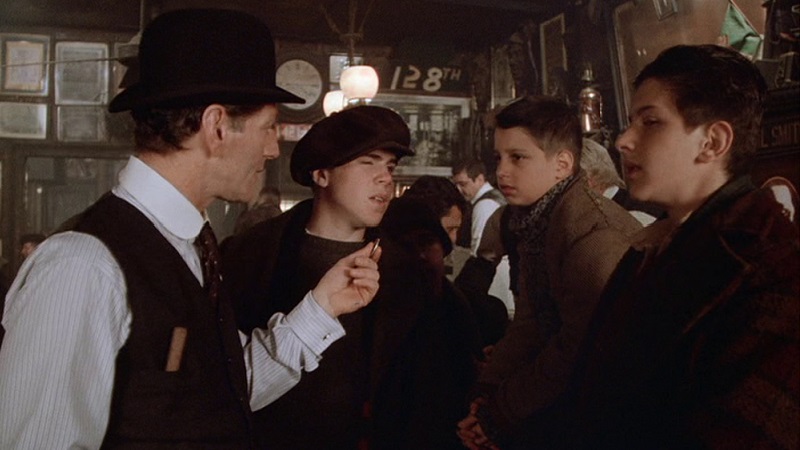
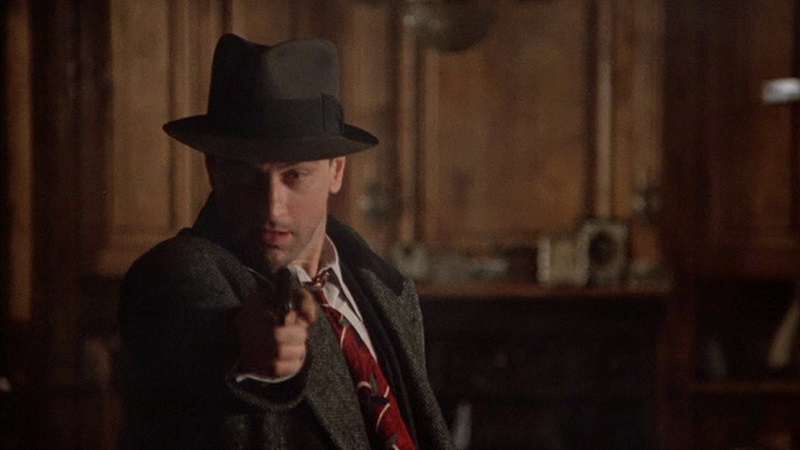
The narrative jumps across time, following Jewish gangster Noodles (Robert De Niro) through three phases of his life. First, his youth in the Lower East Side, where he meets his lifelong friend, the cunning but volatile Max (James Woods). In their prime during the Prohibition era, the two – along with childhood friends – rise to control a lucrative bootlegging operation. But tensions rise, and their friendship deteriorates with devastating consequences. In the third act, Noodles returns to New York as an old man after 35 years, confronting the ghosts of his past.

The fragmented screenplay may not feel intuitive, but it doesn’t need to be. The film works on a dreamlike, emotional logic. Many interpret the second half as nothing more than an opium-induced fantasy – a fugue state in which Noodles imagines a resolution, a reckoning, and perhaps a redemption that never truly came. It’s an ambiguous, melancholic meditation on memory, regret, and American myth. This is not a typical rise-and-fall gangster story; it’s about life itself. The psychological depth is extraordinary. Few films give you such an encompassing sense of a person’s entire existence: memories, pain, joy, death and, of course, love.

As with Leone’s finest work, the film is packed with haunting, unforgettable moments: Max and Noodles beaten in the alley, Noodles’ opium haze in the Chinese theater, Little Dominic dying in Noodles’ arms (“Noodles, I slipped”), and Noodles peeking through the wall at Deborah’s dance rehearsal. The art direction and cinematography render every frame like a painting, each one worthy of being hung on a wall. In that sense, this is Leone’s The Godfather.

Together with composer Ennio Morricone, Leone achieves true cinematic synergy. The film’s pacing often mirrors the rhythm of Morricone’s hauntingly beautiful score, enhancing the emotional impact to mesmerizing effect. The casting is another strength: De Niro brings nuance and reluctant sympathy to a deeply flawed anti-hero, while Woods is chillingly effective as Max. Strong supporting roles are delivered by Jennifer Connelly, Joe Pesci, Tuesday Weld, and Burt Young.

Though it may have its imperfections, Once Upon a Time in America remains a towering, influential achievement. Leone spent over a decade bringing this vision to life and it shows. It’s a shame it turned out to be his final film, but few directors could hope to end their career with something so ambitious, haunting, and unforgettable.

Rating:

Quote:
NOODLES: “You can always tell the winners at the starting gate. You can always tell the winners and you can tell the losers.”

Trivia:
Robert De Niro suggested that James Woods wear a set of perfect, bright white teeth to demonstrate Secretary Bailey’s wealth and vanity. The producers balked at the cost, so De Niro paid for them himself.

Z Channel: A Magnificent Obsession

Z-Channel 3

(2004, USA)

Director: Xan Cassavetes
Features: Robert Altman, Penelope Sheeris, Jim Jarmusch, Quentin Tarantino, ao.

Running Time: 120 mins.

Documentary about the legendary Z Channel in Los Angeles, a pay TV channel where great cinema was shown between 1974 and 1988. Aspiring filmmaker Jerry Harvey became chief programmer of the channel and created a Walhalla for cinema lovers in that time in L.A.

Unfortunately, Harvey was mentally very unstable and in 1988 he committed suicide after killing his wife. After his death, Z Channel was finished as well when it turned into a sports channel. In this ‘legacy’ of Harvey, former friends, teachers and colleagues as well as filmmakers explain why Z Channel was such a successful and important platform for cinema at that time.

It was before VHS made its way into the living room, and people were dependent on television, besides cinema, to view movies. Harvey combined art films and commercial films in his programming which turned out to be a fantastic formula. Quentin Tarantino and Jim Jarmusch explain how much they loved Z Channel when they were growing up, and how it formed an important part of their education. Director Xan Cassavetes, the daughter of actor-director John Cassavetes and actress Gena Rowlands, got hooked to Z Channel after being grounded as a child. It was the beginning of her obsession with cinema.

The channel was so popular that even market leaders HBO and Showtime couldn’t muscle it out of L.A. Z Channel had a zero turnrate which means that no subscriber ever cancelled the channel.

Z-Channel 1
Programmer Harvey wrote the screenplay for the western China 9, Liberty 37

Another one of Harvey’s triumphs was to show uncut versions of films such as The Wild Bunch, Heaven’s Gate, Once Upon a Time in America and 1900. Films that were initially trashed by critics now became very successful features. Z Channel also became a platform for European directors, like Paul Verhoeven, that found work in America thanks to the screening of their European work on the channel. Harvey and his team also organised regular film festivals with retrospectives of Kurosawa and the likes. It must have been truly magnificent.

Cassavetes shows a great collection of film fragments that give a good sense of how brilliant and revolutionary the Z Channel programming must have been. Cinema lovers will be thrilled at the idea of seeing something like Fassbinder’s Berlin Alexanderplatz uncut on television. It was not made to last. Like one of the interviewees says; ‘you just never know when you are living in a glorious time’. The downfall of Z Channel came together with the downfall of Harvey. An obvious loss that Cassavetes makes manifestly clear.

Z-Channel 4
Boxoffice hit The Empire Strikes Back had its television premiere on Z Channel

Review originally written for International Film Festival Rotterdam, where this documentary was screened in 2005.

See also: List of Film Fragments in Z Channel: A Magnificent Obsession